What are those hair-like “aramid yarns” used for? Can they be cut off?
These thread-like filaments, resembling yellow hair, are academically referred to as Aramid Yarns (commonly known by DuPont’s brand name, Kevlar® in the industry). They are an indispensable structural component within fiber optic patch cords.
Below is a professional engineering analysis of the role of aramid yarns and whether they can be cut:
I. The Core Role of Aramid Yarns in Fiber Optic Patch Cords
The fiber core inside a patch cord is made of silica (glass). It has a very small cross-sectional area and is extremely brittle, virtually unable to withstand any axial tensile stress. To protect this fragile glass fiber, a high-strength protective layer must be introduced:
- Tensile Strength Member:
Aramid is a synthetic fiber with ultra-high strength, high chemical stability, and ultra-low thermal shrinkage (its tensile strength is typically more than 5 times that of steel wire of the same weight). When the patch cord is subjected to external pulling, tugging, or conduit pulling, all axial tensile forces are borne by these dispersed aramid yarns, thereby shielding the internal glass fiber from tensile stress and preventing micro-bending losses or direct breakage of the fiber. - Stress Relief and Connector Termination Load Bearing:
In the structural design of fiber optic connectors (such as FC, SC, LC crimping), aramid yarns need to be uniformly crimped onto the metal ferrule of the connector (Crimp Ring). When the strain relief boot of the patch cord is pulled, the force is directly transmitted through the boot and the crimp point to the aramid yarns, distributed evenly by the entire cable body, without any force acting on the fiber mating end face inside the connector. - Buffering and Mechanical Protection:
When the patch cord is squeezed or bent, the aramid yarns act as a filler and buffer, reducing the impact of lateral pressure on the fiber.
II. Can They Be Cut?
Conclusion: Absolutely not to be cut during normal use; however, during the processing and manufacturing of fiber optic connectors (termination), any excess protruding portions must be trimmed.
- During Normal Use (Absolutely Prohibited to Cut or Remove):
If you are using a finished fiber optic patch cord, do not cut or attempt to remove the aramid yarns from inside the outer jacket. Without the protection of the arramid yarns, the internal fiber core will instantly break due to tensile stress the next time the patch cord is slightly pulled or plugged/unplugged, leading to a complete link failure. - During Connector Manufacturing and Processing (Must Use Specialized Tools for Cutting):
When performing field fusion splicing or factory processing of fiber optic connectors, long aramid yarns will be exposed after stripping the outer jacket. After the connector is crimped or pressed to secure, the excess loose aramid yarns need to be trimmed neatly. Because aramid fibers are extremely tough, ordinary steel scissors cannot effectively cut them and tend to cause severe fraying. In engineering, specialized Aramid Cutters (Kevlar Cutters) must be used for clean, flush cuts before the connector strain relief boot can be installed.
III. Classic Product Structure Example
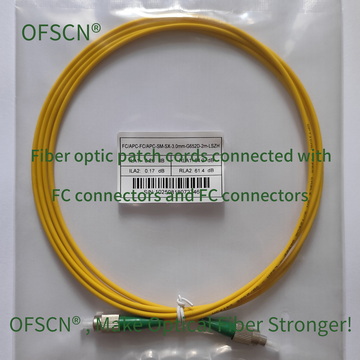
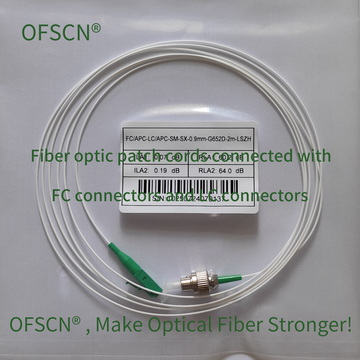
In OFSCN® standard patch cords, this classic protective structure is rigorously designed and applied:
- OFSCN® Standard Fiber Patch Cord:
This general-purpose standard fiber optic patch cord utilizes a typical four-layer compact tensile-resistant structure composed of a “fiber connector + PVC outer jacket + Kevlar fiber (aramid yarn) + tight buffer fiber,” balancing the flexibility and tensile mechanical protection of the patch cord.
Extension: Metal Armoring Solutions for More Demanding Conditions
In certain industrial sites, high-temperature environments, or situations with rodent damage or frequent heavy dragging, the tensile and compressive resistance provided by the plastic jacket and aramid yarns alone may reach their limits. In such cases, metal protection is typically used to replace or enhance the aramid protective layer:
- OFSCN® 2.0mm Micro Steel Armored Fiber Optic Patch Cord: Utilizes a stainless steel seamless steel tube armoring, with tensile strength > 150\text{N} and compressive strength > 240\text{Mp}, providing excellent resistance to side pressure and rodent damage.
- OFSCN® 3.0mm Steel Wire Rope Fiber Optic Patch Cord: In addition to the stainless steel tube, it incorporates a stainless steel wire rope structure, significantly increasing tensile strength to > 1200\text{N} and compressive strength > 200\text{Mp}, suitable for extremely demanding engineering deployments.