What are the consequences of attaching such thin glass fibers directly to my machine?
Directly adhering bare Fiber Bragg Gratings (FBGs) with diameters as small as 125\ \mu\text{m} (bare fiber) or around 155\ \mu\text{m} to 255\ \mu\text{m} (with recoating, such as polyimide or acrylate) onto a running machine can lead to severe physical and engineering consequences, both short-term and long-term.
Here are five primary consequences of directly surface-mounting bare gratings:
1. Instantaneous or Short-Term Fatigue Fracture (Mechanical Failure)
The core material of optical fiber is high-purity silica glass ( \text{SiO}_2 ). While it possesses extremely high axial tensile strength, it is inherently brittle and prone to fracture from shear or bending due to the propagation of microscopic defects.
Mechanical equipment in operation often experiences high-frequency, small-amplitude vibrations, rotation, or relative physical displacement caused by thermal expansion and contraction. When bare gratings are directly adhered, extremely high stress concentrations form at the adhesive boundary. When the machine experiences shear forces or micro-bending deformation, the bare fiber will undergo brittle fracture due to the rapid propagation of micro-cracks under alternating stress.
2. Cross-Sensitivity of Strain and Temperature (Confused Measurement Data)
The central reflected wavelength ( \lambda_B ) of an FBG is naturally sensitive to both temperature ( T ) and strain ( \varepsilon ). The fundamental physical equation is:
\Delta\lambda_B = \lambda_B ( (1 - p_e)\varepsilon + (\alpha_f + \xi)\Delta T )
Where:
- p_e is the effective photoelastic coefficient.
- \alpha_f and \xi are the coefficients of thermal expansion and the thermo-optic coefficient of the fiber material, respectively.
If a bare grating is directly attached to the machine surface, the wavelength drift ( \Delta\lambda_B ) received by the demodulator cannot distinguish whether it is caused by the machine’s deformation under load (strain) or by the machine’s heating (temperature). Without decoupling at the physical layer, the measured data will be academically and practically worthless.
3. Non-Uniform Strain Transfer and Creep (Signal Distortion)
Manual application of adhesives (such as epoxy or cyanoacrylate) makes it extremely difficult to ensure uniformity in adhesive layer thickness, width, and adhesive curing shrinkage force across the entire grating area:
- Reflectance Peak Distortion: Uneven adhesive application leads to non-uniform stress distribution within the grating area, causing the originally sharp reflectance peak to broaden, widen, or even split (Chirp effect).
- Adhesion and Creep: The adhesive layer can undergo polymer chain slippage (creep) under the machine’s alternating stress or temperature cycles over time, leading to zero-point drift in long-term measurement data and preventing linear, stable strain transfer.
4. Chemical Erosion and Environmental Aging (Sensor Failure)
Industrial environments typically contain chemical agents such as cutting fluids, lubricating oils, moisture, or acids and alkalis. Conventional coatings like polyacrylate have limited resistance to temperature and solvents. They are highly susceptible to swelling or peeling when penetrated by these media, compromising the mechanical integrity of the fiber surface, leading to increased optical loss or complete sensor failure.
5. Inability to Maintain or Re-Replace
Once a directly adhered bare grating is damaged, removing the cured hard resin can easily damage the machine surface. Furthermore, when replacing the sensor, it is impossible to replicate the exact initial bonding state in the same location, rendering all previous calibration curves invalid.
OFSCN® (Beijing Dacheng Yongsheng Technology Co., Ltd.) Professional Sensor Solutions
In practical engineering applications, direct surface mounting of bare gratings is strictly prohibited. Scientific and standardized physical packaging must be used to protect and decouple the Fiber Bragg Gratings according to specific measurement requirements. Beijing Dacheng Yongsheng Technology Co., Ltd. (OFSCN®) offers the following industrial-grade sensors for different physical quantities:
I. For Temperature Measurement (Strain Mechanical Decoupling)
If the goal is to accurately measure the temperature rise of a machine surface without interference from deformation caused by machine load or vibration, steel tube packaging with mechanical isolation should be used:
- OFSCN® 300°C Armored Fiber Bragg Grating Temperature Sensor
Utilizes a highly miniaturized, single-layer seamless steel tube for structural protection, with a standard outer diameter of only 0.9\ \text{mm} (customizable down to 0.5\ \text{mm} ). This ensures extremely fast thermal response while completely isolating the fiber from the mechanical strain of the machine.

- OFSCN® 500°C High-Temperature Fiber Bragg Grating Temperature Sensor
Specifically designed for high-temperature environments or machine surfaces with intense local friction, the outer casing also provides excellent impact resistance and strain interference suppression.
II. For Deformation and Stress Measurement (High Linearity and Fatigue Resistance)
If the objective is to monitor the deformation or strain vibration of a machine under load, the sensor must achieve high-fidelity, linear strain transfer and possess extremely high fatigue life:
- OFSCN® Elastic Alloy Tube Packaged Fiber Bragg Grating Strain Sensor
Encased in a highly elastic special alloy tube (standard outer diameter 1.1\ \text{mm} ). While protecting the internal grating from shock and vibration, it ensures high linearity of deformation transfer. High-precision linear formulas (in \mu\varepsilon/\text{pm} ) are calibrated at the factory.

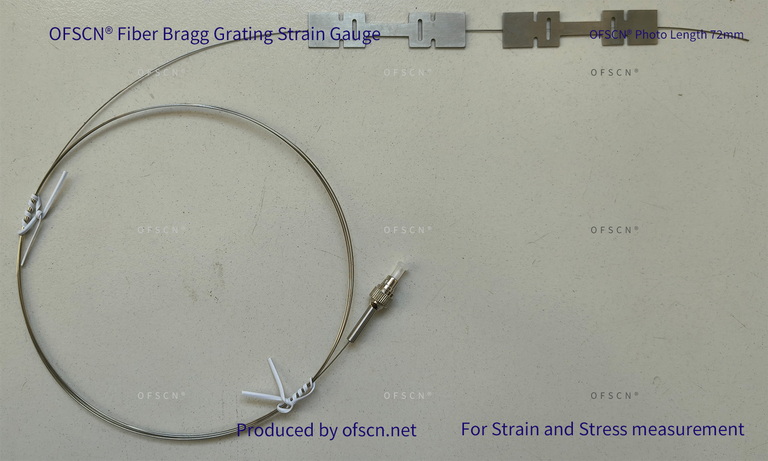
- OFSCN® Surface-Mount Fiber Bragg Grating Strain Gauge
Precisely packaged using industrial-grade I-beam stainless steel or aluminum alloy sheets. Supports adhesive bonding or four-corner spot welding for surface mounting. Available in extremely short dimensions, such as 3.6\ \text{cm} , specifically designed for short-span, high-precision structural deformation monitoring.