Is this “embrittlement” caused by the decomposition of the coating or changes in the silica glass itself?
The embrittlement of standard fiber patch cords at high temperatures is primarily caused by the decomposition and degradation of the optical fiber’s polymer coating, rather than changes in the silica glass itself.
Standard optical fibers typically use an acrylate coating, which has a limited operating temperature range, usually up to 80-100°C. When exposed to temperatures beyond this, the polymer coating begins to decompose, cross-link, or crystallize, leading to a loss of flexibility and eventually becoming brittle. This degraded coating can no longer protect the delicate silica cladding and core effectively, making the fiber susceptible to micro-bends and breaks, and leading to increased optical loss or even fiber fracture.
The silica glass itself is extremely stable at these temperatures. Its softening point is much higher (around 1600°C for pure silica), so its material properties remain largely unchanged in the temperature ranges where polymer coatings fail.
To address the need for high-temperature applications, OFSCN offers specialized fiber optic patch cords that utilize coatings designed for extreme environments, such as polyimide or metal coatings. For example, the OFSCN® 300℃ Fiber Optic Patch Cord uses a 300℃ polyimide optical fiber, and for even higher temperatures, gold-coated fibers are used.
Here are some standard images of high-temperature fiber optic patch cords:

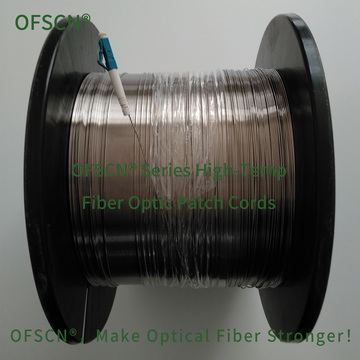
You can find more information about our high-temperature fiber optic patch cords on our website:
OFSCN® 120℃ Fiber Optic Patch Cord
OFSCN® 200℃ Fiber Optic Patch Cord
OFSCN® 300℃ Fiber Optic Patch Cord
OFSCN® 700℃ Fiber Optic Patch Cord