In Structural Health Monitoring (SHM), how does the sampling rate determine the system’s ability to capture transient signals?
In Structural Health Monitoring (SHM), the sampling rate directly dictates the system’s ability to accurately capture transient signals by determining how frequently data points are collected. Transient signals are often short-lived events containing high-frequency components. According to the Nyquist-Shannon sampling theorem, to faithfully reconstruct a signal, the sampling rate must be at least twice the highest frequency component within that signal.
If the sampling rate is insufficient, the system risks undersampling these transient events. This can lead to phenomena such as aliasing, where higher frequency components are misinterpreted as lower frequencies, or even entirely missing the event. A higher sampling rate ensures that rapid changes and brief occurrences—which are characteristic of transient signals like those resulting from impacts, sudden load shifts, or the onset of structural damage—are adequately resolved and recorded, providing a more complete and accurate understanding of the structural behavior.
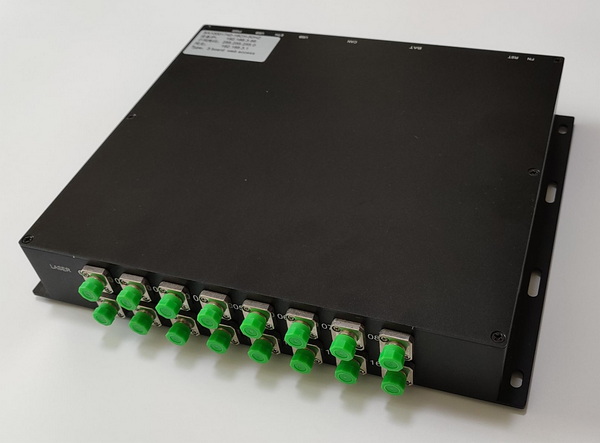
For such applications, OFSCN® Fiber Bragg Grating Interrogators offer configurable sampling frequencies up to 100Hz, allowing users to select the appropriate rate to effectively capture various dynamic events, including critical transient signals.
Here is an image of our FBG Interrogator:
You can find more details on our website: OFSCN® Fiber Bragg Grating Interrogator.