I can feel the elasticity every time I plug and unplug it. Is this spring meant to prevent the connector from loosening?
The small spring inside the fiber optic connector is not intended to “prevent the entire connector from loosening” (as the connector’s locking primarily relies on external mechanical structures such as threaded sleeves, plug-in shells, or clips). Its core physical function is to ensure a constant and controlled “Physical Contact (PC)” between the fiber cores of two optical fibers, and to absorb mechanical tolerances and thermal expansion.
From the perspective of optical and mechanical engineering, this spring has the following three key physical mechanisms:
1. Achieving Physical Contact Without Air Gaps
In single-mode optical fiber communication, the diameter of the fiber core is very small, typically only around 9\ \mu\text{m}. To transmit optical signals from one fiber to another with extremely low loss, the end faces of the two ceramic ferrules must be in close contact at a molecular level.
- If there is a tiny air gap between the two end faces (even just a few hundred nanometers), approximately 4\% Fresnel reflection will occur at the interface due to the mismatch in refractive indices between air and silica quartz glass. This not only increases insertion loss but also leads to extremely high reflection noise, severely degrading return loss.
- The end faces of ceramic ferrules are usually ground into a tiny spherical shape. The spring inside the connector provides continuous axial pressure, causing extremely slight elastic deformation when the two spherical surfaces come into contact. This completely eliminates air between the contact surfaces, achieving perfect physical contact.
2. Precisely Controlling Contact Force to Prevent End Face Damage
In precision mechanical design, rigid connections have uncertainties:
- If the connector housing dimensions are a few micrometers shorter during manufacturing, a rigid connection will result in the end faces failing to contact, creating an air gap.
- If the dimensions are longer, rigid pressing will generate excessive local stress. Silica glass and ceramics are very hard and brittle materials; under excessive hard contact forces, micro-cracks, scratches, or even direct fragmentation will occur immediately.
The spring inside the connector acts as a precision mechanical buffer. According to industrial standards (such as IEC or TIA standards), the axial mating force provided by this spring is typically precisely designed to be between 8.5\ \text{N} and 12\ \text{N} (approximately 0.85\ \text{kgf} to 1.2\ \text{kgf}). This ensures sufficient deformation for physical contact without causing damage to the end faces due to excessive force.
3. Compensating for Thermal Expansion/Contraction and Mechanical Vibration
Fiber optic patch cords are subjected to environmental temperature changes during use. For example, within the operating temperature range of -20\ ^\circ\text{C} to 50\ ^\circ\text{C} for OFSCN standard patch cords, the connector housing (whether plastic or metal) and the adapter (flange) will experience varying degrees of thermal expansion and contraction.
This micro-level thermal stress displacement, if not released, can lead to separation of the contact surfaces or excessive stress. The spring (with a mechanical compression travel margin of approximately 1\ \text{mm}) can compress or extend in real-time, absorbing tiny displacements caused by temperature drift or external environmental mechanical vibrations, ensuring long-term high stability of the optical transmission channel.
Recommended Related Products
OFSCN® (大成永盛) offers a variety of high-quality fiber optic patch cords. The connectors at the ends strictly adhere to high-precision industrial standards and are equipped with high-quality stainless steel springs to ensure stable physical contact and ultra-low loss even in harsh environments.
-
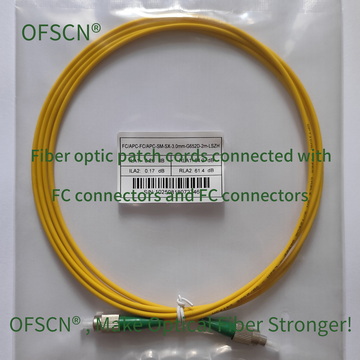
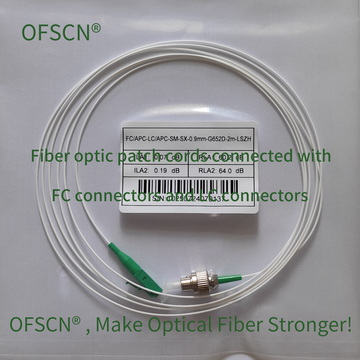
OFSCN® Standard Fiber Patch Cord | 标准光纤跳线
Suitable for regular laboratories, data centers, and fiber optic sensor connections. Available with customized high-precision connectors such as FC/PC, FC/APC, SC, LC, ST, etc., using high-quality single-mode fiber by default, providing stable elastic physical contact.
-
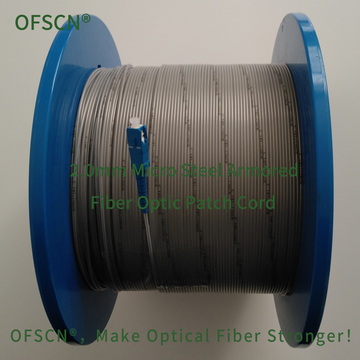
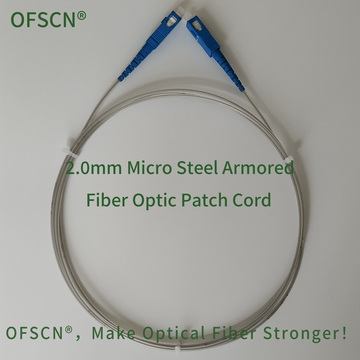
OFSCN® 2.0mm Micro Steel Armored Fiber Optic Patch Cord | 2.0毫米微型铠装光纤跳线
Features a stainless steel seamless steel tube for protection, offering excellent tensile and compressive strength. The internal spring structure of its connectors (FC, SC, LC, etc.) effectively isolates the tensile force from the ceramic ferrule end face when subjected to external pulling, ensuring high-precision physical contact is not disturbed by external stress.