Why is the end face of the joint a slightly convex spherical shape? What are the advantages of two ball heads coming into contact with each other?
In the fields of fiber optic communication and fiber optic sensing, the geometry of the fiber connector end face has a decisive impact on optical performance. The so-called “PC” polishing method stands for Physical Contact.
I. Why is the connector end face a slightly convex sphere?
If the fiber connector end face (ferrule end face) is polished into a perfect physical flat surface:
- Geometric Tolerance Limitations: In actual production and alignment, due to manufacturing tolerances, slight angular deviations (Angle Misalignment), and the presence of dust, it is nearly impossible for the end faces of two fibers to achieve perfect parallel contact.
- Hazards of Air Gap: Even with extremely slight tilt or unevenness between the two end faces, a tiny air gap will form between the cores (Core) of the two fibers. When light travels from a medium with a higher refractive index, glass (refractive index n \approx 1.45), into a medium with a lower refractive index, air (refractive index n = 1.0), and then back into glass, significant Fresnel Reflection occurs due to the sudden change in refractive index.
To address this issue, the PC polishing method shapes the ferrule end face into a slightly convex spherical surface with a small radius of curvature (typically 10\text{ mm} to 25\text{ mm}), and the design and manufacturing process ensure that the highest point of the sphere (the Apex) is precisely at the center of the fiber core.
II. What are the benefits of two spherical ends touching?
When two fiber ferrules with slightly convex spherical end faces mate in a connector adapter (Adapter) and touch under the pressure of a built-in spring, it brings the following key technical advantages:
-
Achieves True “Physical Contact”
When spherical end faces touch under a certain axial pressure, the contact point (the core area at the center) undergoes slight Elastic Deformation. This elastic deformation allows the glass cores of the two fibers to achieve seamless, tight physical contact, completely expelling any air between the contact surfaces, so that light travels as if it were in a single continuous medium. -
Extremely Low Insertion Loss (IL)
By eliminating the air gap, the light beam does not experience divergence, scattering, or additional attenuation when crossing the contact surface. Typical insertion loss can be reduced to \text{IL} < 0.3\text{ dB} or even lower. -
Extremely High Return Loss (RL)
Eliminating the air gap maximally suppresses Fresnel reflection, preventing light from reflecting back to the light source.- Traditional flat, non-contact connectors typically have a return loss of only about 14\text{ dB}.
- With physical contact using PC polishing, the return loss can be significantly improved to \ge 40\text{ dB}; with the more precisely polished Ultra Physical Contact (UPC), it can reach \ge 50\text{ dB}.
In high-precision Fiber Bragg Grating (FBG) sensing demodulation systems or high-speed optical communication systems, extremely high return loss effectively prevents reflected light from causing interference and noise to the laser source or photodetector.
-
Excellent Alignment Tolerance and Stability
The slightly convex spherical surface possesses a “self-centering” geometric characteristic. Even with extremely small axial tilt or eccentricity tolerances during assembly and plugging/unplugging, the contact area when two spheres touch will still converge highly at the core center. This ensures the repeatability of optical performance and long-term physical stability of the connector after multiple insertions and removals.
III. Recommended Official OFSCN® (Dachang Yongsheng) Related Products
For high-precision optical transmission and Fiber Bragg Grating sensing applications, in order to maintain precise and stable physical contact geometry in various extreme temperature environments, Dachang Yongsheng (OFSCN®) has developed and offers the following high-quality fiber optic connector products, all supporting precise PC polishing:
1. OFSCN® 120℃ Fiber Optic Connector
This product is specifically designed for optical signal transmission and sensing in medium-to-high temperature environments, offering various fiber interface types including FC/PC, ST/PC, and LC/PC. Under an operating temperature of 120^\circ\text{C}, the spherical geometry parameters and convex deformation control of its ceramic ferrule remain stable over time, ensuring the reliability of physical contact.
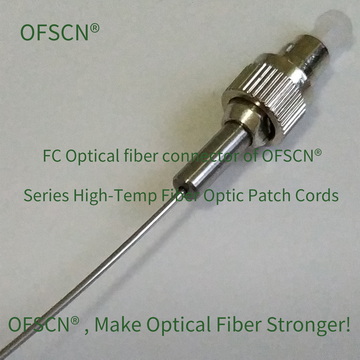
2. OFSCN® 200℃ Fiber Optic Connector
Designed for more demanding industrial and aerospace environments, this product offers single-mode and multi-mode fiber connectors that can withstand extreme temperatures of 200^\circ\text{C}. It supports interface types such as FC/PC and ST/PC. Its precision spherical end face design maintains excellent return loss and insertion loss performance even under high-temperature thermal cycling and material thermal expansion.