If during construction, leather shoes step on optical fiber, or if it is run over by a small cart, will the glass inside shatter?
Whether optical fibers will be crushed when stepped on by heavy objects or run over by vehicles depends on the encapsulation structure of the fiber and the degree of lateral stress concentration at the point of force application.
Analyzing from the perspective of materials mechanics and optical engineering, the specific situations are as follows:
I. Analysis of Physical Mechanisms and Material Properties
1. Bare Fiber
- Physical Characteristics: The glass core and cladding outer diameter of standard communication single-mode fiber are typically 125\ \mu\text{m} , with a coating outer diameter of 250\ \mu\text{m} . The material is high-purity silicon dioxide glass (SiO_2).
- Performance under Pressure: Silicon dioxide is a typical brittle material. Although optical fibers have extremely high tensile strength along the axis, their resistance to lateral concentrated loads and shear stress is very poor. If stepped on by hard-soled shoes during construction (especially if there are fine sand particles creating stress concentration points), or run over by a small vehicle wheel, the lateral pressure exceeds the critical value for crack propagation in glass, causing the fiber to instantly fracture or shatter into tiny glass fragments.
2. Ordinary Indoor Soft Fiber / Tight-Buffered Fiber Cable
- Physical Characteristics: The outer layer typically relies only on a PVC, LSZH, or TPE plastic sheath and a small amount of aramid for tensile buffering.
- Performance under Pressure: When subjected to pressure from shoe soles or vehicle tires, the plastic outer layer undergoes irreversible deformation. Due to the low elastic modulus of plastic, it cannot withstand significant concentrated lateral pressure. The internal glass fiber core is easily broken by compression, or severe microbending losses occur, leading to optical signal interruption.
3. Armored Optical Fiber Cable
- Physical Characteristics: Provides radial support and protection to the optical fiber through a high elastic modulus metal sheath (e.g., seamless stainless steel tube, steel wire stranded layer).
- Performance under Pressure: Under heavy pressure, the lateral load is borne and dispersed by the hard metal outer casing, ensuring that the radial stress on the internal optical fiber remains below the fracture limit of the glass, thus preventing the fiber from being crushed and ensuring that the transmission signal is unaffected.
II. Official Anti-Pressure Products and Technical Specifications
To cope with harsh mechanical environments such as stepping and vehicle rolling on construction sites, Beijing Dacheng Yongsheng Technology Co., Ltd. (OFSCN®) has designed armored fiber optic patch cord and cable products with extremely high compressive strength:
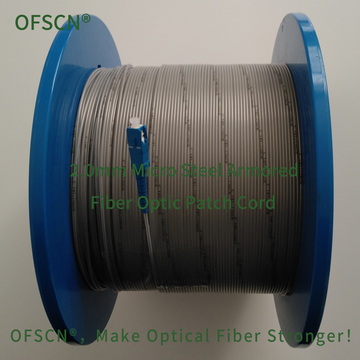
1. OFSCN® 2.0mm Micro Steel Armored Fiber Optic Patch Cord
This product has a built-in 0.6\text{mm} seamless stainless steel tube, capable of resisting strong lateral extrusion.
- Compressive Strength: >150\text{MPa}
- Tensile Strength: >1500\text{N}
- Structural Composition: PVC sheath, 0.6\text{mm} seamless stainless steel tube, and single-mode fiber.
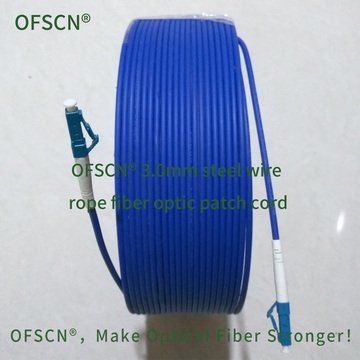
2. OFSCN® 3.0mm Steel Wire Rope Fiber Optic Patch Cord
Utilizes a double armor structure of “stainless steel wire rope + seamless stainless steel tube”, specifically designed for extremely high resistance to rolling and tensile construction scenarios.
- Compressive Strength: >200\text{MPa}
- Tensile Strength: >1200\text{N}
- Structural Composition: PE sheath, 0.45\text{mm} stainless steel wire rope structure, 0.9\text{mm} seamless stainless steel tube.
III. Conclusion
- Bare fiber or ordinary non-armored optical cable: Under shoe stepping (especially concentrated force application) or vehicle rolling, the glass fiber core inside is extremely prone to fracture or breakage.
- Seamless steel tube and steel wire armored optical cable: By virtue of the high compressive strength of the metal sheath (compressive strength can reach 150\text{MPa} to over 200\text{MPa} ), the internal glass fiber core can remain intact and undamaged.