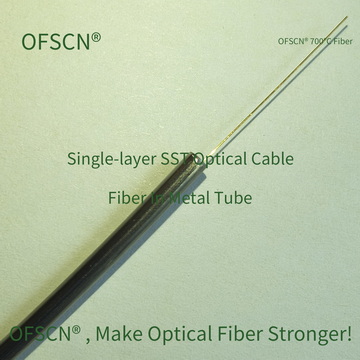
Why does OFSCN® choose this material for its casing? Will it rust in seawater?
As a professional manufacturer in the high-level fiber optic sensing field, OFSCN® (Beijing Dacheng Yongsheng Technology Co., Ltd.) meticulously selects 316L stainless steel as the default or core optional metallic encapsulation (FIMT - Fiber in Metal Tube) material for its extensive range of seamless steel tube fiber optic cables and distributed fiber optic sensors, based on rigorous material physics and engineering mechanics considerations.
Here is a scientific analysis of why this material is chosen and its corrosion resistance performance in marine environments:
I. Why Does OFSCN® Choose 316L Stainless Steel for Seamless Steel Tube Housings?
- Enhanced Resistance to Pitting and Crevice Corrosion
Compared to standard 304 stainless steel, 316L stainless steel contains an additional 2\% \sim 3\% of Molybdenum (Mo). This significantly enhances its resistance to localized pitting corrosion and crevice corrosion in environments rich in chloride ions (\text{Cl}^-) and other halogens. - Extremely Low Carbon Content to Avoid Intergranular Corrosion
The “L” in 316L stands for Low Carbon, with a strictly controlled carbon content of C \le 0.03\%. Under high-temperature conditions during seamless steel tube welding, sealing end-cap fabrication, or in high-temperature sensing operations, the ultra-low carbon content effectively prevents the precipitation of chromium carbides at grain boundaries (i.e., avoids “sensitization”), thereby preserving excellent intergranular corrosion resistance in welded areas. - Mechanical Stability Across a Wide Temperature Range
Across a broad temperature spectrum, from cryogenic temperatures (e.g., -270\ ^\circ\text{C}) to moderate-high temperatures (e.g., 300\ ^\circ\text{C} to 700\ ^\circ\text{C}), 316L stainless steel maintains high toughness and excellent tensile and compressive strength. It does not suffer from brittle fracture at low temperatures or rapid softening at high temperatures. This provides an extremely reliable physical protective barrier for the quartz glass optical fiber, which is highly susceptible to external stresses (micro-bending, stretching). - Excellent Processability and Hermetic Sealing
316L stainless steel is easily processed into ultra-fine seamless steel tubes with extremely thin walls (e.g., 0.2\text{mm} \sim 0.3\text{mm}), offering near-perfect barrier properties against moisture, water vapor, and hydrogen. This prevents hydrolysis or hydrogen-induced degradation of the optical fiber.
II. Does 316L Stainless Steel Rust in Seawater?
The conclusion is: 316L exhibits extremely high corrosion resistance in seawater, but under specific extreme conditions, it still carries a risk of corrosion (rusting).
-
Under benign conditions (low risk of rusting):
In flowing, ambient or low-temperature ( T \lt 20\ ^\circ\text{C} \sim 25\ ^\circ\text{C}) seawater with sufficient oxygen content, the surface of 316L can rapidly form and maintain a dense, chromium-rich protective oxide film (passive film). In this state, it possesses excellent resistance to seawater corrosion and can operate reliably for extended periods. -
Under extreme or specific conditions (potential for localized rusting/corrosion):
- Crevice and Stagnant Water Environments (Crevice Corrosion): If the cable is located in stagnant, non-flowing water, or is covered by seabed sediments (mud and sand), or is within the crevices of flanges or threaded connections. These areas are prone to forming “oxygen-depleted zones,” preventing the localized passive film from self-healing through oxygen replenishment. Chloride ions accumulate here, inducing crevice corrosion.
- Warm Water Environments (Pitting Susceptibility): When seawater temperature is higher (e.g., above 25\ ^\circ\text{C} \sim 30\ ^\circ\text{C}), such as in tropical shallow seas or near hydrothermal vents, the activity of chloride ions increases, potentially exceeding the critical pitting temperature (CPT) for 316L, leading to pitting corrosion.
- Marine Biofouling: The attachment of marine organisms like barnacles and algae to the cable surface creates localized micro-environments with low oxygen and acidic conditions beneath them, initiating microbiologically influenced corrosion (MIC).
III. Upgraded Solutions for More Demanding Marine/High-Corrosion Environments
To address deep-sea oil and gas wells or extreme geothermal marine environments containing high concentrations of hydrogen sulfide, strong acids, and high temperature and salinity, Beijing Dacheng Yongsheng Technology Co., Ltd. (OFSCN®) offers, in addition to the standard 316L stainless steel, a more extreme corrosion-resistant option: Incoloy 825 special alloy (a high-nickel-chromium-molybdenum-copper alloy) as an upgrade for the encapsulation housing for relevant high-end sensors and fiber optic cables. This alloy exhibits exceptional resistance to chloride stress corrosion cracking, pitting, and crevice corrosion.
Here are key OFSCN® products that use 316L stainless steel as the default encapsulation and can be customized with Alloy 825:
1. OFSCN® Double-Layer High-Temperature Downhole Fiber Optic Cable
Features a double-layer seamless steel tube encapsulation, with 316L stainless steel as the default material. Specifically designed for distributed fiber optic sensing in high-pressure, high-corrosion environments such as deep wells and offshore oil and gas wells. Alloy 825 is an optional upgrade.

2. OFSCN® Triple-Layer Downhole High-Temperature Fiber Optic Cable
Utilizes a triple-layer seamless steel tube encapsulation, with 316L stainless steel as the default material and Alloy 825 as an option, providing enhanced mechanical protection and corrosion resistance.

3. OFSCN® 300°C Seamless Steel Tube Fiber Cable
Features a single-layer 316L stainless steel seamless steel tube encapsulation for robust protection, housing high-temperature polyimide fiber, with a maximum operating temperature of 300\ ^\circ\text{C}.
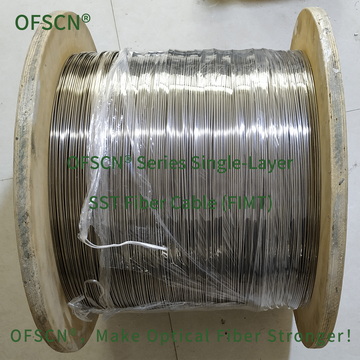
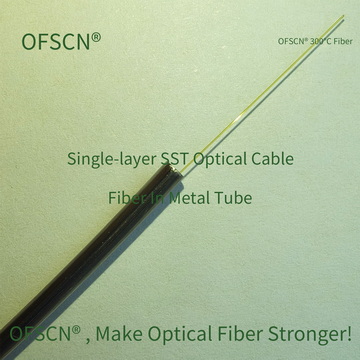

4. OFSCN® 650/700°C Seamless Steel Tube Fiber Cable
Encapsulated in a single layer of ultra-high temperature alloy tubing (default 316L stainless steel) housing gold-coated fiber, capable of withstanding extreme temperatures and harsh industrial/geological environments.