In a marine environment, how many years can it last without perforations?
In a marine environment, the time it takes for 316L stainless steel to experience pitting perforation depends on the wall thickness of the metal component, seawater flow and temperature conditions, dissolved oxygen content, and the presence of biofouling or crevice corrosion.
From the perspective of material physics and electrochemical corrosion, the anti-perforation lifespan of 316L in seawater can be scientifically assessed as follows:
I. Passive Film Rupture and Pitting Corrosion Mechanism
316L stainless steel (containing 16 \sim 18\% chromium, 10 \sim 14\% nickel, 2 \sim 3\% molybdenum) has a Pitting Resistance Equivalent Number (PREN) formula:
\text{PREN} = \% \text{Cr} + 3.3 \times \% \text{Mo} + 16 \times \% \text{N} \approx 23 \sim 25
- Critical Pitting Temperature (CPT) in Seawater: The CPT for 316L typically ranges between 15\ ^\circ\text{C} \sim 25\ ^\circ\text{C}. When seawater temperature exceeds this range and high concentrations of chloride ions (\text{Cl}^-, typically around 19000\text{ mg/L} in seawater) are present, the passive film of chromium oxides on the surface is prone to localized rupture.
- Pitting Growth Rate: The relationship between pit depth d and time t is non-linear exponential (d = k \cdot t^n, where n \approx 0.3 \sim 0.5). During the active pitting development stage, the localized pit propagation rate can reach 0.1\text{ mm/a} \sim 0.5\text{ mm/a} or even higher.
II. Seawater Perforation Lifespan Assessment for Different Wall Thicknesses
1. Thin-Walled Structures (Wall Thickness t = 0.2\text{ mm} \sim 0.3\text{ mm} )
- Static/Warm Seawater (> 20\ ^\circ\text{C}) or Seabed Mud Immersion: Without external protection, under conditions of biofouling, sediment coverage, or crevice corrosion, localized pitting typically leads to perforation within a few months to 1-3 years.
- Dynamic/Cold Seawater (< 15\ ^\circ\text{C}): When water flow keeps the surface clean, perforation time may extend to 2-5 years, but the risk of sudden pitting initiation cannot be entirely eliminated.
2. Medium-Thick Walled Structures (Wall Thickness t = 1.0\text{ mm} \sim 3.0\text{ mm} )
- Perforation time is typically around 3-10 years. Although the overall uniform corrosion rate is extremely low (approx < 0.005\text{ mm/a}), the deep growth of localized pits is the primary cause of perforation.
III. Application and Protection in Fiber Optic Sensing Engineering
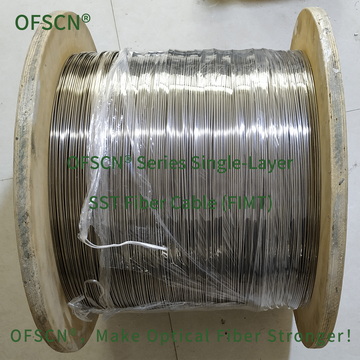
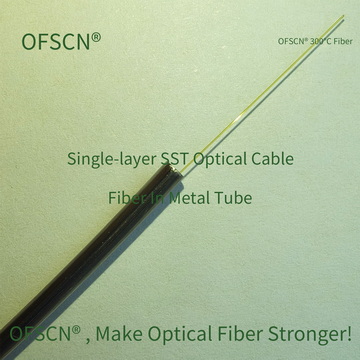
In fiber optic sensing engineering for marine monitoring or complex downhole environments, micro steel tube fiber optic cables (such as those protecting internal optical fibers with 316L stainless steel seamless steel tubes) are often used. For example:
OFSCN® 300°C Seamless Steel Tube Fiber Cable

Long-Life Usage Recommendations:
- Sacrificial Anodes / Cathodic Protection: Used in conjunction with zinc or aluminum anodes, it can significantly inhibit the initiation of pitting corrosion.
- Upgrade to Higher Corrosion-Resistant Alloys: For projects requiring more than 10 years of fault-free operation in seawater, it is recommended to choose materials with a higher PREN (such as Alloy 825 nickel-based alloy, \text{PREN} \approx 31, or 2205 duplex stainless steel/titanium alloy).