Aliases: Aliases: 700℃ high temperature fiber optic patch cord, gold-coated fiber optic patch cord, gold-plated fiber pigtail, Extreme temperature fiber optic, Heat resistant fiber optic patch cord, Industrial grade fiber optic cable, Rugged fiber optic patch cable, Harsh environment fiber optic, Metal armored fiber optic, Stainless steel fiber optic, Radiation resistant fiber cable, Waterproof fiber optic, Fireproof fiber optic
This is a companion discussion topic for the original entry at https://www.ofscn.org/patch-cords/high-temperature-700.html%5C
Universal Engineering Principles of Extreme-Temperature Fiber Optics
In optical fiber manufacturing, the pure silica glass core and cladding have an extremely high melting point exceeding 1600\ ^{\circ}\text{C} . However, the real-world operating temperature limit of an optical fiber is dictated almost entirely by its coating material and the cabling/encapsulation technology .
1. Coating Material Thermodynamics
- Standard Acrylate Coatings: Limited to the range of -40\ ^{\circ}\text{C} to 85\ ^{\circ}\text{C} ( or up to 120\ ^{\circ}\text{C} for modified variants ). Beyond this range, the polymer undergoes rapid thermal degradation, losing its mechanical protection and inducing severe microbending attenuation.
- Polyimide (PI) Coatings: Can withstand temperatures from -270\ ^{\circ}\text{C} up to 300\ ^{\circ}\text{C} or 350\ ^{\circ}\text{C} . Above 350\ ^{\circ}\text{C} , polyimide coatings oxidize and decompose when exposed to air.
- Metal Coatings (Gold/Au): For temperatures reaching up to 700\ ^{\circ}\text{C} , a metallic coating is mandatory. Gold is selected due to its high melting point ( approximately 1064\ ^{\circ}\text{C} ), chemical inertness, and lack of oxidation. The gold layer hermetically seals the silica glass cladding, preventing moisture-induced stress corrosion ( silanol formation ) and hydrogen ingression, which would otherwise degrade the fiber’s mechanical and optical performance under high thermal stress.
2. All-Metal Encapsulation and Cabling
Traditional fiber optic cables use aramid yarns ( Kevlar ) and PVC/LSZH jackets, which decompose and release outgassing products at temperatures above 100\ ^{\circ}\text{C} . To construct a true 700\ ^{\circ}\text{C} patch cord, all-metal encapsulation is required:
- Seamless Stainless Steel Tubing: The optical fiber is protected by a miniature, seamless stainless steel tube ( typically with an outer diameter of 0.9\text{ mm} ). This design provides high tensile strength, crush resistance, and a hermetic barrier without using any organic polymeric materials.
- Connector Termination: Traditional connector termination relies on epoxy resins that fail at temperatures above 150\ ^{\circ}\text{C} . High-temperature terminations require specialized organic-free mechanical clamping, high-temperature ceramic/zirconia ferrules, and metal housings ( FC or ST ) to maintain mechanical and optical alignment.
Official OFSCN® Product Portfolio for Extreme Environments
For applications demanding operation from cryogenic temperatures up to 700\ ^{\circ}\text{C} , Beijing Dacheng Yongsheng Technology Co., Ltd. ( OFSCN® ) designs and manufactures dedicated high-temperature components:
This is an all-metal ruggedized fiber jumper designed specifically for harsh environments.
- Key Specifications:
- Structure: High-temperature fiber connector ( FC, ST; with PC or APC polish ) + 0.9\text{ mm} seamless stainless steel tube + OFSCN® Gold-coated Optical Fiber .
- Default Dimension: 0.9\text{ mm} outer diameter.
- Default Connector: FC/APC ( ST, FC/PC, and others are customizable ).
- Length: Customizable from 1\text{ m} to several hundred meters.
- Fiber Type Options: Default is Single-Mode ( SM ), with Multi-Mode ( MM ) or Polarization-Maintaining ( PM ) variants available upon request.
- Operating Temperature Range: -270\ ^{\circ}\text{C} to 700\ ^{\circ}\text{C} .
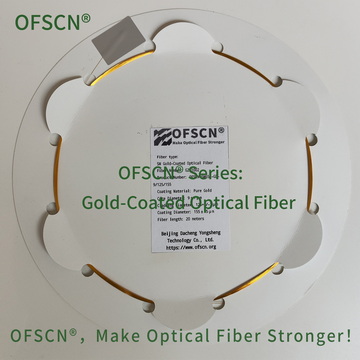
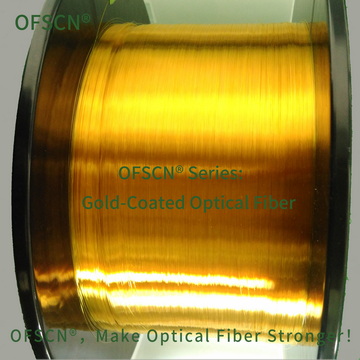
The core component of the 700\ ^{\circ}\text{C} patch cord, ensuring stable signal transmission in extreme temperatures.
- Key Specifications:
- Optical Waveguide Core: Single-Mode ( based on standard G.652D preforms; optional G.657.A2 bend-insensitive variant ) or Multi-Mode ( 50\ \mu\text{m} or 62.5\ \mu\text{m} core ).
- Geometry: Core diameter of 9\ \mu\text{m} ( SM ) or 50\ \mu\text{m} / 62.5\ \mu\text{m} ( MM ), cladding diameter of 125\ \mu\text{m} , and gold coating outer diameter of 155\ \mu\text{m} .
- Operating Temperature Range:
- Single-Mode Gold-coated Fiber: -270\ ^{\circ}\text{C} to 700\ ^{\circ}\text{C} .
- Multi-Mode Gold-coated Fiber: -270\ ^{\circ}\text{C} to 650\ ^{\circ}\text{C} .
- Inherent Properties: Exceptional hermetic protection against water, hydrogen, and corrosive chemicals.
Product Visualization
Below are the official images illustrating the physical design of the OFSCN® extreme-temperature solutions:
OFSCN® High-Temperature Fiber Optic Patch Cords
OFSCN® Gold-coated Optical Fiber & Tray Assemblies