cmh
Last Updated: 19 October 2025
In fields like metallurgy, aerospace, and nuclear research, equipment can be exposed to ultra-high temperatures of a sustained 700 degrees. At this temperature, any organic material rapidly carbonizes, and traditional Polyimide coated fibers (limit approximately 300 degrees) cannot survive. The challenge for communication and sensing links has escalated from "preventing degradation" to the level of "material survival."
This is a companion discussion topic for the original entry at https://www.ofscn.org/encyclopedia/467-high-temperature-700-01.html
It is a pleasure to meet you here. As you correctly pointed out, the transition from 300°C to 700°C represents a fundamental shift from protecting organic coatings to ensuring the survival of the material itself.
At temperatures exceeding 300°C, traditional Polyimide (PI) coatings undergo rapid thermal decomposition and carbonization, leading to the loss of mechanical protection for the silica glass and eventual fiber failure. To address these extreme environments, OFSCN® utilizes metal-coating technology.
Technical Solution: Gold-Coated Fiber Technology
For sustained operation at 700°C, we provide solutions based on gold-coated fibers. Gold is chemically inert and has a melting point of approximately 1064°C, allowing it to maintain a stable protective layer where polymers fail.
Key Products for 700°C Environments:
-
OFSCN® Gold-coated Optical Fiber
- Operating Range: -270°C to +700°C.
- Material: Seamless gold coating over the cladding, eliminating the risk of outgassing or carbonization.
- Applications: Ideal for integration into high-temperature sensors or high-power laser delivery.
-
OFSCN® 700°C Fiber Optic Patch Cord
- Construction: Composed of gold-coated fiber protected by a 0.9mm seamless stainless steel tube.
- Durability: The seamless steel tube provides mechanical shielding against physical damage and chemical corrosion while the gold coating maintains the fiber’s structural integrity.
-
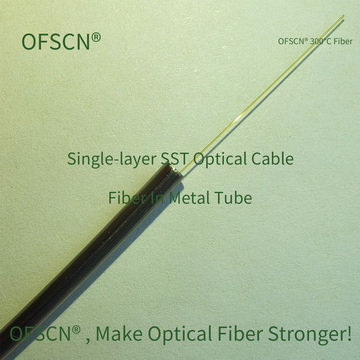
OFSCN® 650/700°C Seamless Steel Tube Fiber Cable
- Design: A robust “Fiber in Metal Tube” (FIMT) structure, typically using 825 alloy or 316L stainless steel, designed for long-distance sensing or communication in furnaces and aerospace test beds.
Product Visuals:
Technical Considerations for 700°C Applications
- Attenuation: While gold coating provides excellent thermal stability, the metallic interface introduces different micro-bending characteristics compared to polymers. It is essential to account for slightly higher baseline attenuation in your optical budget.
- Sealing: For vacuum or high-pressure furnace applications, the transition between the high-temperature zone and the ambient environment requires specific hermetic feedthroughs to prevent oxidation of internal components.
If you are currently designing a sensing or communication link for these specific temperatures, I would be happy to discuss the performance trade-offs between different alloy tube materials (316L vs. 825) or fiber types (Single-mode vs. Multi-mode).