How can optical fibers sense the pressure inside the vacuum chamber of a semiconductor factory?
In the vacuum chamber environment of semiconductor manufacturing (such as etching, PVD, CVD process chambers), from the perspective of physical mechanisms and fiber optic sensing principles, optical fibers themselves cannot directly sense “vacuum degree” (i.e., molecular number density of extremely rarefied gases), but can indirectly sense it through physical quantity conversion mechanisms or responses of the chamber structure.
I. Physical Mechanism Analysis: Why Optical Fibers Cannot Directly Measure Vacuum?
The fundamental physical responses of fiber Bragg gratings (FBGs) or interferometric fiber optic sensors depend on the axial strain (photoelastic effect) or temperature changes (thermo-optic and thermal expansion effects) applied externally to the optical fiber:
- Extremely Weak Hydrostatic Pressure: When pumping from atmospheric pressure (approx. 10^5\ \text{Pa} = 0.1\ \text{MPa}) to medium-high vacuum (e.g., 10^{-1}\ \text{Pa} to 10^{-7}\ \text{Pa} ), the absolute pressure difference is only up to 0.1\ \text{MPa}.
- Extremely Low Static Pressure Sensitivity of Bare Fiber: The wavelength drift sensitivity of bare quartz fiber under isotropic fluid hydrostatic pressure is typically only around -3\ \text{pm/MPa} to -4\ \text{pm/MPa}. This means that the wavelength drift caused by the absolute change in gas pressure during the entire vacuum pumping process is less than 0.4\ \text{pm}, which is far below the temperature cross-sensitivity noise of approximately 10\ \text{pm/}^\circ\text{C} for FBG sensors, making it impossible for conventional instruments to directly resolve.
II. General Fiber Optic Engineering Principles for Sensing Pressure in Vacuum Environments
In practical scientific research and industrial detection, optical fibers are primarily used to sense vacuum or in-chamber pressure through the following indirect methods:
- Elastic Diaphragm Strain Conversion Method (Differential Pressure / Absolute Pressure Conversion)
- Princ: An optical fiber or FBG is attached/welded to the surface of an elastic metal (or micro-silicon) diaphragm within a sealed reference cavity, or it forms an optical fiber Fabry-Perot (F-P) microcavity.
- Process: When the gas pressure in the vacuum chamber changes, the pressure difference across the diaphragm causes it to deflect. This mechanical strain is transmitted to the optical fiber, thereby modulating the output wavelength or interference cavity length.
- Fiber Optic Pirani Thermal Conduction Method (Gas Thermal Conductivity Measurement)
- Princ: In the low to medium vacuum range (approx. 10^{-1}\ \text{Pa} \sim 10^3\ \text{Pa} ), the mean free path of gas molecules is comparable to the characteristic dimensions, and its thermal conductivity is strictly correlated with gas pressure.
- Process: By injecting laser light or using an integrated heating element to heat the FBG’s temperature sensing point, the FBG’s highly sensitive measurement of its thermal equilibrium temperature is utilized. The heat dissipation rate changes with vacuum degree, which in turn allows for the inference of the vacuum level.
- Chamber Wall Mechanical Strain Monitoring
- Princ: When pumping down a vacuum, a pressure difference of up to approximately one standard atmosphere is formed between the inside and outside of the chamber. The rigid vacuum chamber structure undergoes elastic compressive strain in the micron range. By installing high-sensitivity fiber optic strain sensors on the outer wall of the chamber, the vacuum load state borne by the chamber can be monitored in real-time.
III. OFSCN® Product Series and Vacuum Chamber Matching Component Descriptions
- Product Scope: Beijing Dacheng Yongsheng Technology Co., Ltd.'s (OFSCN®) core product series focuses on fiber Bragg grating (FBG) and distributed optical fiber (OFDR/BOTDA) temperature, strain, displacement, and mechanical sensors. We do not offer Pirani gauge tubes or fiber optic vacuum gauges specifically for direct vacuum degree readings.
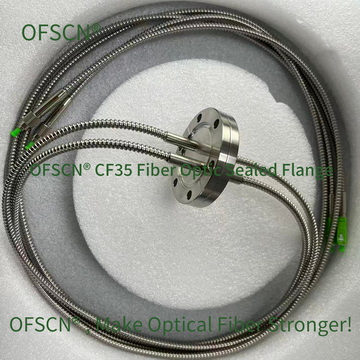
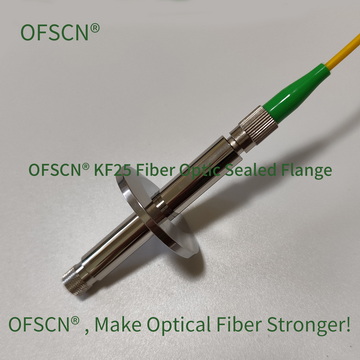
- Vacuum Feedthrough Matching Components: Semiconductor vacuum chambers often require high-frequency, plasma-resistant, and electromagnetically shielded temperature/strain monitoring for wafer stages, electrostatic chucks (ESC), or chamber walls. Optical fibers must be absolutely sealed when entering and exiting the vacuum chamber. Beijing Dacheng Yongsheng Technology Co., Ltd. provides standard sealed flange components specifically designed for extracting optical signals from vacuum chambers:
- Product Name: OFSCN® Fiber Optic Vacuum Sealed Flange
Key Parameter Specifications:
- Applicable Interfaces: Divided into CF and KF standard series, offering male and female configurations, supporting single-channel and multi-channel fiber penetration;
- Temperature Range: Standard design, with customizable high-temperature structures supporting up to 250\ ^\circ\text{C};
- Vacuum Sealing Performance: Leak rate and vacuum holding capability better than 1 \times 10^{-7}\ \text{Pa} and 1 \times 10^{-9}\ \text{Pa} respectively, meeting the high vacuum and ultra-high vacuum requirements of semiconductor process chambers.