If inserted backwards like a battery, would it damage the device?
It won’t burn out equipment like a battery.
This is a classic physics and engineering problem. From the fundamental physical principles of optics and electricity, the working principle of fiber optic patch cords is fundamentally different from electrical devices like batteries.
I. Fundamental Physical Differences
1. “Polarity” in Batteries and Electrical Devices
In electrical systems, polarity refers to the distribution of positive and negative charges. Electrical devices transmit energy through the directional movement of electrons under a potential difference. If the positive and negative terminals of a battery are reversed:
- The current direction in the circuit will be completely reversed.
- Sensitive semiconductor components (such as diodes, transistors, integrated circuits, etc.) will experience reverse voltage or overload current.
- This will cause the device to experience thermal breakdown or short circuit, thus burning out the equipment instantaneously.
2. “Polarity” in Optical Fibers and Optical Systems
The physical medium of a fiber optic patch cord is silicon dioxide (quartz glass; some specialty fibers use plastic or other multi-component glass), which is a purely non-conductive medium (dielectric). What is transmitted in the fiber is photons (light waves), not electric charges:
- Photons are uncharged: Light transmits unidirectionally or bidirectionally within a glass medium, involving no voltage or current.
- Physical Passivity: A fiber optic patch cord is a passive device. Inserting it into an adapter or optical module simply establishes an optical channel.
- Consequences of Incorrect Insertion: If the transmitting end (TX) and receiving end (RX) of a duplex fiber optic patch cord are swapped, it’s equivalent to “TX facing TX, and RX facing RX”. In this case, the optical signal cannot reach the correct receiver, and the system will display “Link Down” (link not connected / signal interrupted).
- Safety: Under these circumstances, as no abnormal current passes through, there is absolutely no possibility of an electrical short circuit, nor will the equipment be burned out.
II. Abnormal Physical Situations in High-Power Applications (Not Electrical Burnout)
While incorrectly plugging in a fiber optic patch cord will not cause electrical burnout, in extremely rare specific high-power or high-precision optical applications, attention should be paid to the following optical reflection issues:
- Mixing APC (Angled Physical Contact) and PC (Physical Contact) Connectors:
If a green connector (APC, 8^\circ angled end-face) is forcibly mixed with a blue/black connector (PC/UPC, spherical end-face), the mismatch in end-face geometry will result in very high insertion loss and very low return loss. - High-Power Return Loss (RL) Impact:
In kilowatt-class industrial fiber lasers or ultra-high-power optical amplifiers (e.g., high-power EDFAs, output power \gt 30\ \text{dBm} or \gt 1\ \text{W}), if the fiber end-face is severely misaligned, contaminated, or has strong reflections, photons reflected back into the laser cavity can cause optical damage to the pump source or laser diode (known as back-reflection damage). However, this is due to high-power optical feedback, and modern equipment usually has built-in optical isolators for protection. For ordinary communication equipment and sensor demodulation devices, the operating optical power is typically between -10\ \text{dBm} and +10\ \text{dBm} (approximately 0.1\ \text{mW} to 10\ \text{mW}). Reflections at this power level are well within the safety threshold of the detectors and will not cause damage.
III. Related Products and Link Assurance
In the fiber optic transmission and sensing system of Dacheng Yongsheng (OFSCN®), we offer a variety of high-quality fiber optic patch cords that comply with industrial standards and extreme environments. These patch cords feature precise geometric positioning and high return loss specifications to ensure accurate optical path alignment during connection:
-
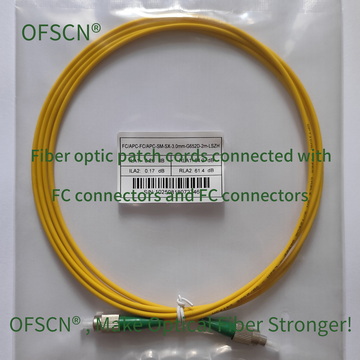
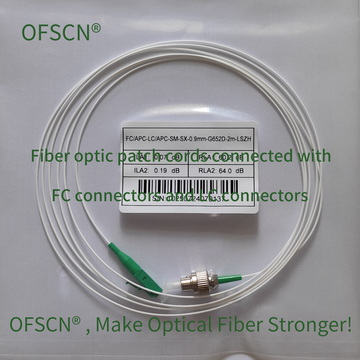
OFSCN® Standard Fiber Patch Cord:
Standard fiber optic patch cord, providing high-precision connector alignment, equipped with single-mode G.652D fiber as standard. It effectively prevents physical wear and tear caused by insertion/extraction friction or repeated connections.Product Standard Images:
-
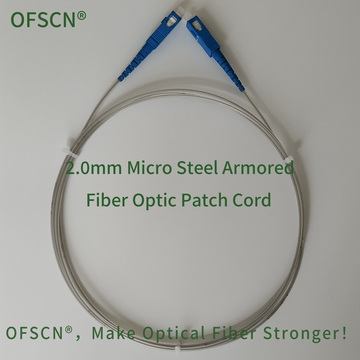
OFSCN® 2.0mm Micro Steel Armored Fiber Optic Patch Cord:
Micro stainless steel armored patch cord, with a stainless steel seamless steel tube encapsulated within a sheath with an outer diameter of only 2.0\ \text{mm}. It is suitable for industrial and sensor link connections requiring high mechanical strength against tension and pressure.Product Standard Images:
-
OFSCN® 300℃ Fiber Optic Patch Cord:
Utilizes high-temperature resistant polyimide fiber and a flexible metal conduit for protection. It provides stable, high-precision optical connections within a temperature range of -270^\circ\text{C} to 300^\circ\text{C}, ensuring link polarity and optical transmission safety in extreme industrial environments.Product Standard Images:


Summary
Fiber optic patch cords have “transmit-receive polarity” (TX to RX routing correspondence) in their transmission path, but no electrical positive or negative poles. Even if inserted incorrectly, it will only result in signal interruption (Link Down), and there is absolutely no physical possibility of burning out the equipment.