When faced with the temptation of low prices, what three core parameters should customers pay attention to?
When selecting Fiber Bragg Grating (FBG) sensing systems, low-cost products typically achieve savings by compromising on grating microstructure processing quality, packaging reliability, and calibration testing procedures. From the perspectives of optical physics and sensor engineering, customers should prioritize the evaluation of the following three core parameters when faced with the temptation of low prices:
I. Intrinsic Spectral Quality Parameters: Side Mode Suppression Ratio (SMSR), 3dB Bandwidth, and Reflectivity
The essence of FBG demodulation lies in high-precision peak detection and Gaussian/centroid fitting of the reflected spectrum. Low-cost fiber gratings are prone to non-uniform chirp, waveguide defects, or core damage during mask UV exposure or continuous writing, leading to degraded reflection spectra.
- Side Mode Suppression Ratio (SMSR): Industrial and research-grade fiber gratings require \text{SMSR} \ge 15\text{ dB}. Low-cost gratings, due to inadequate writing processes, often exhibit excessively high side lobes. In wavelength-division multiplexing (WDM) multi-point series connections or when strain gradients are present, high side lobes can cause the demodulator to “peak-hop” or result in inter-channel crosstalk.
- 3dB Bandwidth (FWHM) and Reflectivity: For general sensing, the 3dB bandwidth of gratings with lengths of 8 mm to 10 mm typically needs to be controlled within \le 0.4\text{ nm}, with standard reflectivity usually specified at \ge 70\% (or specific ratios for weak gratings, e.g., 20\%). Low-cost, inferior gratings often have broadened or asymmetric reflection spectra, causing the center of the demodulation algorithm’s fit to shift, which severely degrades the system’s measurement resolution and accuracy.
II. Packaging Structure and Material Tolerance Limits: Coating Material, Operating Temperature Range, and Anti-Creep Zero Drift
Fiber gratings are essentially fragile bare elements made of quartz glass, whereas engineering applications require reliable sensors. Low-cost products often cut costs on coatings and packaging structures:
- Coating Temperature Tolerance: Standard low-cost fiber gratings typically use ordinary polyacrylate coatings, with a temperature resistance limited to -40\ ^\circ\text{C} \sim 100\ ^\circ\text{C}. If used in environments exceeding these temperatures, the coating will rapidly carbonize and detach, leading to fiber embrittlement and fracture. Industrial-grade high-temperature gratings require polyimide coatings (-200\ ^\circ\text{C} \sim 300\ ^\circ\text{C}) or even metal-plated fibers (up to 700\ ^\circ\text{C}).
- Packaging Interface Strain Transfer and Zero Drift (Creep & Drift): Low-cost strain or temperature sensors often use simple organic adhesives for fixation or are packaged in non-metallic tubes. Under long-term stress or high/low-temperature cycles, these packaging types can experience substrate material relaxation and interface micro-slippage (creep), manifesting as permanent baseline drift (zero drift) in the sensing system. High-reliability sensors must employ seamless stainless steel tubes or elastic alloy tubes with micro-metallic structures to eliminate adhesive layer relaxation and ensure long-term mechanical protection and elastic response in harsh environments.
III. Wavelength Dispersion and Calibration Accuracy: Center Wavelength Tolerance, Linearity, and Calibration Formula
The physical basis of FBG sensing systems is the monotonic drift of the Bragg wavelength with external temperature and strain (\Delta\lambda_B). Manufacturing tolerances and calibration data should not be overlooked during selection:
- Wavelength Tolerance: The factory tolerance for the center wavelength of high-quality fiber gratings at room temperature should be strictly controlled within \pm 0.2\text{ nm} to \pm 0.3\text{ nm}. Low-cost products often have large dispersion. When deploying multiple temperature or strain measurement points within the limited scanning spectral window of a demodulator (e.g., the typical 40\text{ nm} bandwidth from 1525\sim 1565\text{ nm}), excessive initial wavelength deviation can easily lead to channel overlap during dynamic measurements.
- Actual Factory Calibration and High-Order Nonlinear Fitting: Low-cost sensors typically only provide general theoretical sensitivity coefficients (e.g., approximately 10\text{ pm/}^\circ\text{C} for temperature) and lack point-by-point calibration from a real high/low-temperature test chamber. In reality, over a wide temperature range (e.g., room temperature to 300\ ^\circ\text{C} or higher), the thermo-optic and thermal expansion coefficients exhibit nonlinearity, requiring a binomial fitting formula for calibration (^\circ\text{C/pm}). Low-cost sensors without actual measurement calibration will introduce significant system errors.
Reference to Related Official High-Reliability Products
In response to the stringent performance requirements mentioned above, Beijing Dacheng Yongsheng Technology Co., Ltd. (OFSCN®) offers fiber gratings and packaged sensors with standardized physical parameters:
1. Fiber Bragg Grating Intrinsic Elements
OFSCN® Standard Femtosecond Fiber Bragg Gratings / FBG Strings (Bare): Written point-by-point using a femtosecond laser without damaging the fiber coating, achieving an SMSR \ge 15\text{ dB}. The room temperature wavelength deviation is strictly controlled within \pm 0.2\text{ nm}. Polyimide high-temperature fibers can be selected, covering a temperature range from -270\ ^\circ\text{C} \sim 800\ ^\circ\text{C}.




2. Seamless Metal Tube Packaged Temperature Sensors
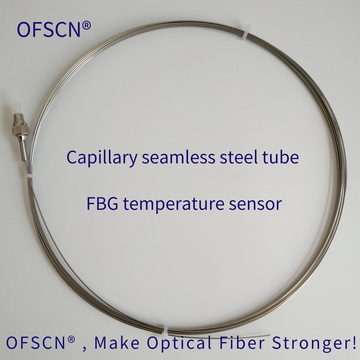
OFSCN® 300°C Fiber Bragg Grating Temperature Sensor: Packaged in a single-layer stainless steel seamless metal tube with an outer diameter of 0.9\text{ mm} (customizable to 0.5\text{ mm}). It offers resistance to tension, compression, and corrosion, eliminates adhesive stress, and comes with precise binomial high/low-temperature calibration formulas (^\circ\text{C/pm}) from the factory.

3. Elastic Alloy Tube Packaged Strain Sensors
OFSCN® Alloy Tube Packaged Fiber Bragg Grating strain sensor: Based on an all-metal elastic alloy tube structure with an outer diameter \le 1.1\text{ mm}, it provides extremely high strain transfer fidelity and anti-creep characteristics. Factory calibration for strain wavelength is performed with a precise first-order formula (\mu\varepsilon\text{/pm}).



4. High-Precision Demodulation and Analysis Equipment
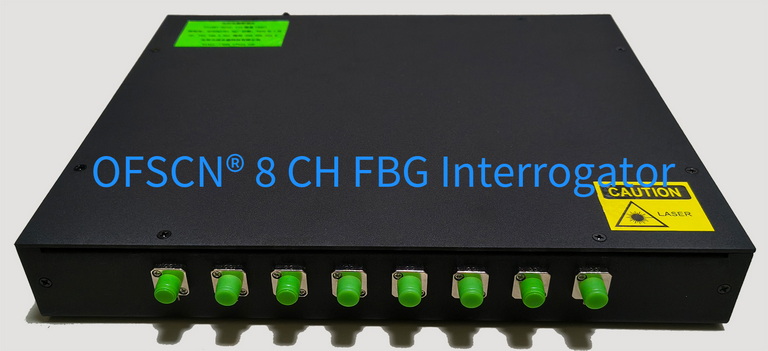
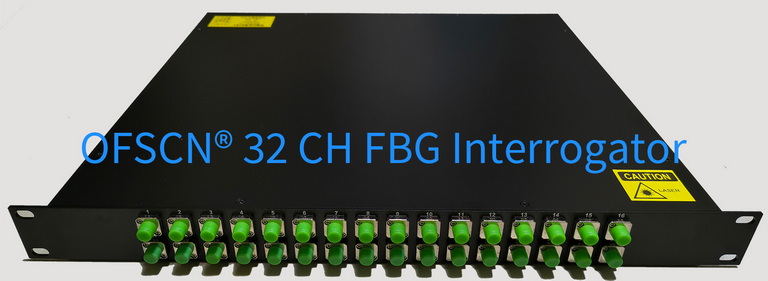
OFSCN® Fiber Bragg Grating Interrogator: Standard wavelength range 1525\sim 1565\text{ nm}, data sampling frequency supports 10\text{ Hz}\sim 100\text{ Hz}, wavelength resolution up to 1\text{ pm} (customizable to 0.1\text{ pm}), and provides industrial-grade multi-channel concurrent demodulation algorithm support.