I’m just experimenting on the desktop, is it necessary to buy the high-intensity armored type? Will a regular patch cord suffice?
In desktop testing environments within optical and sensing laboratories, the choice between standard fiber optic patch cords and armored fiber optic patch cords primarily depends on the frequency of dynamic operations on the workbench, the risk of mechanical stress, and the tolerance for fiber bending loss.
I. Physical Mechanisms and Engineering Selection Analysis
1. Standard Fiber Optic Patch Cords (PVC + Aramid Structure)
- Internal Structure: Typically consists of a core/cladding (approx. 125\ \mu\text{m} diameter), coating ( 250\ \mu\text{m} ), tight buffer ( 900\ \mu\text{m} ), tensile aramid yarn (Kevlar), and an external PVC jacket.
- Mechanical Characteristics: Primarily relies on aramid fibers to withstand axial tensile forces, but possesses extremely low lateral compressive strength and bending resistance.
- Workbench Suitability:
- If the optical path on the workbench is permanently fixed, infrequently plugged/unplugged, and free from interference by instrument feet or metal clamps, standard patch cords are entirely sufficient to meet optical transmission requirements (their optical insertion loss and return loss are not fundamentally different from armored patch cords).
- Limitations: During frequent movement of equipment on the workbench, if sharp bends occur with a radius smaller than the minimum bend radius (e.g., R < 30\text{mm} for standard G.652D fiber), it can lead to high macro-bending loss or even brittle fracture of the quartz fiber core. If pressed by the edge or feet of heavy-duty benchtop instruments (like oscilloscopes or spectrometers), it can easily cause localized stress damage.
2. Armored Fiber Optic Patch Cords (Stainless Steel Armored Structure)
- Internal Structure: Adds a spiral stainless steel tape or a micro seamless steel tube outside the tight buffer, with some high-strength models also incorporating steel wire rope strands.
- Mechanical Characteristics: Possesses extremely high resistance to lateral pressure (crush resistance) and tensile limits (tensile strength), while the mechanical structure restricts the minimum bend radius, providing excellent anti-kinking properties.
- Workbench Suitability:
- If the experiment involves frequent changes in optical paths, switching connectors between different workbench equipment, or if the fiber runs downwards and is prone to being run over by chair wheels or crushed by clamps, armored patch cords can significantly prevent fiber path interruptions or breaks caused by accidental mechanical damage.
II. Mainstream Laboratory Matching Solutions
Solution A: Conventional Static Workbench Connection — Standard Fiber Optic Patch Cord
For static connections between fixed fiber optic demodulators, light sources, and spectrometers, standard fiber optic patch cords are recommended:
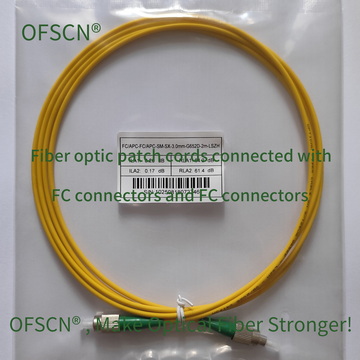
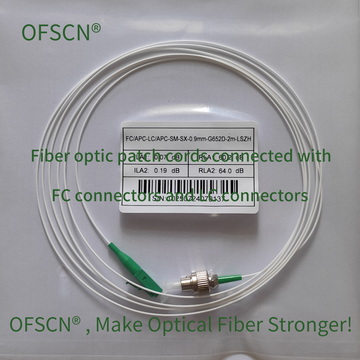
- Product Reference: OFSCN® Standard Fiber Patch Cord
- Specifications: Utilizes a PVC jacket and aramid fibers, default outer diameter 3.0\text{mm} (optional 2.0\text{mm} or 0.9\text{mm} ), operating temperature range -20^\circ\text{C} to 50^\circ\text{C} , supports FC, SC, LC, ST connectors and PC/APC polishing.
Solution B: High Dynamics, Frequent Plugging, or High-Stress Environments — Micro Armored Fiber Optic Patch Cord
If the experiment bench is cluttered, patch cords need to pass through equipment clamps, or require frequent coiling and storage, micro armored patch cords are recommended. Compared to cumbersome heavy-duty industrial patch cords, micro armored patch cords offer high compressive strength from their stainless steel tubes while maintaining a flexible 2.0\text{mm} outer diameter:
- Product Reference: OFSCN® 2.0mm Micro Steel Armored Fiber Optic Patch Cord
- Specifications: Integrates a 0.6\text{mm} stainless steel seamless tube and a PVC jacket, with an outer diameter of only 2.0\text{mm} . Compressive strength > 240\text{MPa} , tensile strength > 150\text{N} , effectively preventing crushing by heavy objects on the workbench and breakage from kinking.


III. Summary Recommendations
- Scenarios where standard patch cords suffice: Tidy workbench, fixed fiber laying path, no risk of being stepped on or clamped, and minimal movement after setup.
- Scenarios requiring an upgrade to armored patch cords: Complex experimental conditions, frequent dragging and movement, cables hanging from the workbench to the floor, or needing to pass through metalwork/mechanical test benches. For such desktop applications, a flexible 2.0\text{mm} micro armored patch cord is usually sufficient; heavy-duty, outdoor-grade steel wire rope armored patch cords are not necessary.