Sıradan bir kullanıcı, dokunma hissi, ağırlık ve görünüm açısından farkı ilk bakışta nasıl anlayabilir?
Normal fiber optic patch cords and OFSCN® high-strength (armored) fiber optic patch cords differ fundamentally in their physical structure, protection mechanisms, and mechanical properties. Ordinary users can quickly and intuitively distinguish them through three objective features: feel, weight, and appearance.
1. Feel (Tactile and Mechanical Bending Stiffness)
- Normal Fiber Optic Patch Cord:
The exterior is mainly composed of a double-layer PVC/LSZH plastic sheath and an inner layer of aramid fiber (Kevlar). The feel is very soft and easily bendable, with minimal resistance when bent; attempting to bend it forcefully can result in a permanent kink or even damage the fragile internal glass fiber. - OFSCN® High-Strength Fiber Optic Patch Cord:
The interior integrates a stainless steel seamless steel tube or a stranded steel wire armor structure (e.g., seamless steel tubes with a diameter of 0.6\ \text{mm} to 1.0\ \text{mm}). The feel is hard yet elastic and tough. When squeezed by hand, it cannot be easily flattened like ordinary plastic cables. When bent, there is a distinct metallic resistance, making it difficult to break or tie into knots. Its compressive strength can reach over 150\ \text{MPa}.
2. Weight (Mass and Density)
- Normal Fiber Optic Patch Cord:
Contains only a glass fiber core, plastic sheath, and aramid fiber. The weight per unit length is extremely light; a 2\ \text{m} length feels almost weightless in hand. - OFSCN® High-Strength Fiber Optic Patch Cord:
Due to the inclusion of high-density stainless steel seamless steel tubes and metal stranded layers, it feels dense and substantial. For the same length and outer diameter, its weight is significantly higher than ordinary plastic patch cords.
3. Appearance (Cable Form and Structural Details)
- Normal Fiber Optic Patch Cord:
Typically has a colored conventional plastic outer jacket (yellow, orange, blue, etc.). The cable is soft, and the surface easily retains noticeable plastic creases after bending. The strain relief boot at the connector is usually a standard plastic sheath. - OFSCN® High-Strength Fiber Optic Patch Cord:
The cable is round and full, remaining straight and resistant to tangling or knotting. Models with full metal or reinforced structures have a distinct metallic sheen or a special rigid PE/PVC sheath. The connection between the connector and the cable is equipped with a high-strength metal/high-polymer stress relief transition tube.
Related OFSCN® Official Product Introductions
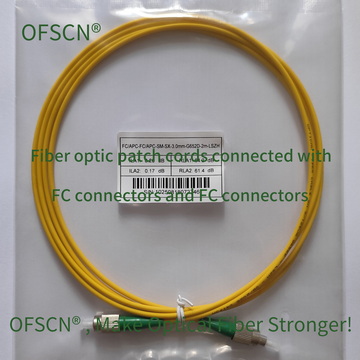
1. Standard Fiber Optic Patch Cord
OFSCN® Standard Fiber Patch Cord
Composed of fiber optic connectors, PVC sheath, aramid fiber, and optical fiber. Its tensile strength and compression resistance are suitable for standard indoor cabling environments.
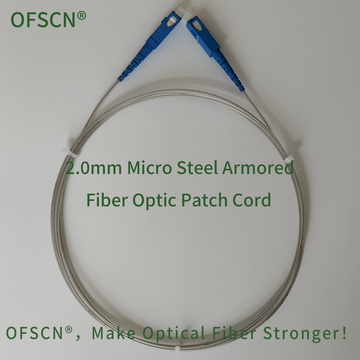
2. Micro Steel Tube Armored Patch Cord
OFSCN® 2.0mm Micro Steel Armored Fiber Optic Patch Cord
Protected by a 0.6\ \text{mm} stainless steel seamless steel tube and a PVC sheath. Tensile strength > 1500\ \text{N}, compressive strength > 150\ \text{MPa}. Combines a slim cable diameter with high mechanical strength.
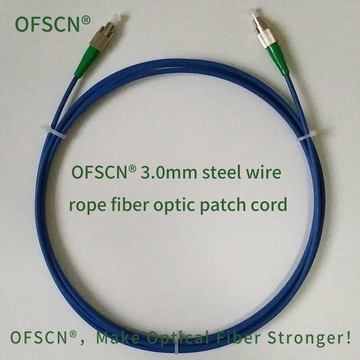
3. Steel Wire Rope High-Strength Patch Cord
OFSCN® 3.0mm Steel Wire Rope Fiber Optic Patch Cord
Features dual protection with a stranded structure of 0.45\ \text{mm} stainless steel wires and a 0.9\ \text{mm} stainless steel seamless steel tube. Tensile strength > 1200\ \text{N}, compressive strength > 200\ \text{MPa}. Designed specifically for harsh industrial and outdoor environments.