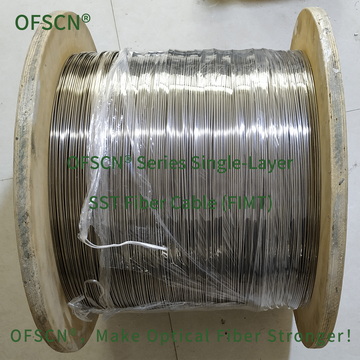
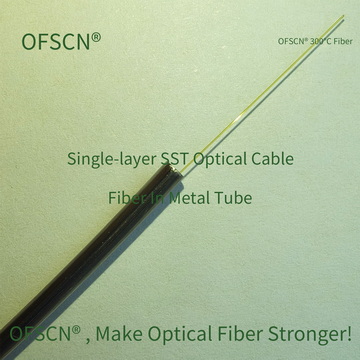
Given that optical fibers have so many vulnerabilities, why is an all-metal encapsulation the only ultimate solution?
In fiber optic sensing and communication engineering, the core material of optical fibers is high-purity silicon dioxide (\text{SiO}_2), with a typical cladding diameter of only 125\ \mu\text{m}. Despite the extremely high theoretical tensile strength of pure fused silica glass along its axis, its physical and chemical properties render it susceptible to numerous vulnerabilities in complex industrial environments.
Seamless steel tube (micro-metal tube) encapsulation and all-metal encapsulation are considered the ultimate protective solutions for harsh operating conditions primarily due to the following material science and mechanical principles:
I. Intrinsic Vulnerabilities of Optical Fibers and Physical Defects in Traditional Encapsulation
- Moisture and Stress Corrosion (Microcrack Propagation)
Microscopic cracks are inevitably present on the surface of silica glass during manufacturing and use. When an optical fiber is under tension and exposed to ambient moisture (\text{H}_2\text{O}), water molecules react with the \text{Si-O-Si} bonds on the glass surface via hydrolysis, accelerating the propagation of cracks at their tips. This leads to fiber fracture at stresses far below the theoretical limit (i.e., static fatigue and stress corrosion). - Hydrogen Aging and Chemical Erosion
Upon permeation into the fiber core, hydrogen molecules (\text{H}_2) can form hydroxyl (-\text{OH}) absorption peaks or induce absorption losses, causing a drastic increase in transmission attenuation at communication and sensing wavelengths (e.g., 1310\ \text{nm}, 1550\ \text{nm}). Industrial acidic or alkaline media can also gradually erode conventional polymer jacketing. - Failure Limits of Traditional Polymer Jackets and Adhesive Encapsulation
- Temperature Resistance and Degradation: Standard acrylate coatings have a temperature limit of only 85\ ^\circ\text{C}. At elevated temperatures, polymers rapidly soften, decompose, or carbonize.
- Creep and Mismatch in Thermal Expansion: Conventional sensors rely on polymer adhesives like epoxy to bond the fiber. Polymers have a significantly different coefficient of thermal expansion (CTE) compared to silica glass (\approx 0.5 \times 10^{-6}/\text{K}). Furthermore, adhesives exhibit viscoelastic creep and aging failure under long-term stress or thermal cycling, leading to distorted strain transmission and zero-point drift in measurements.
- Hidden Risks of Welded Steel Tubes
In welded metal tubes of micro-dimensions, the microstructure at the weld seam is non-uniform. Under conditions of high pressure, deep water, bending, or corrosive ions (like \text{Cl}^- ), pitting corrosion, stress corrosion cracking (SCC), and micro-leakage are highly likely to occur along the weld seam.
II. Technical Advantages of Seamless Steel Tube and All-Metal Encapsulation
The use of monolithic cold-drawn/seamless extruded micro-metal tubes (e.g., 304, 316L, Inconel, or 825 alloys) resolves the aforementioned degradation mechanisms from a physical structural perspective:
- Absolute Hermeticity and True Barrier Against Water, Hydrogen, and Chemicals
Seamless metal tubes eliminate weld defects and possess a continuous, dense metallic crystalline grain boundary structure. This completely prevents the permeation of moisture, chemical liquids, and harmful gases, thereby eliminating the hydrolysis conditions for stress corrosion on the fiber surface and the pathways for hydrogen aging. - Superior Protection Against Lateral Pressure, Tension, and Impact
The metal tube casing offers excellent rigidity and a high elastic deformation limit, enabling it to withstand external mechanical crushing, lateral point loads, impacts, and shear forces from ground movement, thus preventing micro-bending losses or breakage of the optical fiber. - Elimination of Adhesive Reliance, Achieving Pure Metal Mechanical Transfer
In all-metal encapsulation structures, the interface between the optical fiber and the metal substrate is achieved through all-metal bonding (e.g., metallized fiber coupled with welding/metal solidification), completely dispensing with polymer adhesives. This results in high linearity and minimal hysteresis in mechanical and thermal responses, ensuring extremely high temporal stability and repeatability for sensors. - Extremely Wide Operating Temperature Range Adaptability
When encapsulated with compatible high-temperature resistant specialty fibers (e.g., polyimide-coated fibers, gold-coated fibers), the limit operating temperature for fiber optic cables and sensors can be extended to between -270\ ^\circ\text{C} and 700\ ^\circ\text{C}, making them suitable for demanding environments such as high-temperature oil and gas wells, aerospace engines, nuclear industry, and cryogenic superconductivity.
III. OFSCN® Official Seamless Steel Tube Fiber Optic Cables and Sensor Series
OFSCN® has developed a range of temperature-resistant and highly reliable products based on seamless micro-metal tubes and all-metal processing techniques:
- OFSCN® 85°C Seamless Steel Tube Fiber Cable
- OFSCN® 200°C Seamless Steel Tube Fiber Cable
- OFSCN® 300°C Seamless Steel Tube Fiber Cable
- OFSCN® 650/700°C Seamless Steel Tube Fiber Cable
- OFSCN® Double-Layer High-Temperature Downhole Fiber Optic Cable
- OFSCN® Distributed Fiber Optic Sensors and Seamless Steel Tube Fiber Optic Cables Product Category Link