Why does it maintain the polarization state of light waves? What are its applications in precision sensing?
Polarization-Maintaining Fiber (PM Fiber), and the PM fiber patch cords made from it, play a crucial role in precision optics and fiber optic sensing. The following provides a professional, academic, and engineering-oriented explanation from three perspectives: the physical optical mechanism, precision sensing applications, and the high-standard product line from OFSCN®.
I. Why Does Polarization-Maintaining (PM) Fiber Maintain the Constant Polarization State of Light Waves?
In an ideal, symmetrical single-mode fiber, the fundamental mode (HE_{11}) contains two orthogonally polarized degenerate modes with perpendicular electric field vibration directions. However, due to minute geometric non-circularity during fiber manufacturing, uneven internal thermal stress distribution, and disturbances such as bending, twisting, and temperature gradient variations in the actual working environment, these two degenerate modes experience slight refractive index differences, leading to continuous random coupling and rotation of the polarization state during propagation.
To ensure the stable maintenance of the input light wave’s polarization state during transmission, PM fiber design incorporates the High Birefringence (Hi-Bi) effect, whose core physical mechanisms are as follows:
- Introduction of Stress-induced Birefringence Structure:
Taking the classic PANDA-type PM fiber as an example, two Stress-applying Parts (SAPs) with significantly different thermal expansion coefficients from the silica substrate are symmetrically embedded on both sides of the fiber core. After the fiber is drawn and cooled, these two parts generate immense mechanical stress along a specific axis in the fiber’s cross-section. - De-degeneration of Propagation Constants:
Due to the artificially applied directional stress, a significant difference in refractive index arises along the fast and slow axes of the fiber’s cross-section (typically on the order of 10^{-4}, i.e., \Delta n = n_x - n_y \neq 0).
This leads to a significant separation of the propagation constants \beta_x and \beta_y for the two orthogonally polarized modes. - Suppression of Mode Coupling Condition:
Minor external environmental perturbations (such as bending, micro-bending, vibration, etc.) lack sufficient spatial frequency to compensate for the large phase difference between the two propagation constants. Therefore, polarization mode coupling between the fast and slow axes is greatly suppressed.
When linearly polarized light is precisely coupled into one of the fiber’s eigenaxes (typically the slow axis), its polarization direction will be stably locked throughout the optical path and will not change its polarization state due to external mechanical disturbances.
II. What Are the Applications of PM Fiber in Precision Sensing?
In precision fiber sensing and coherent optical networks, the stability of the polarization state typically determines the system’s coherent signal-to-noise ratio (SNR). Its main uses and application scenarios include:
- Interference-based Sensors:
In Fiber Optic Gyroscopes (FOGs), Sagnac interferometers, Mach-Zehnder, and Michelson interferometers, the detected signal relies heavily on the interference fringes generated by the interference of two or more coherent light beams at the receiver.- If the polarization state undergoes random drift, it introduces Polarization Fading. When the polarization directions of coherent light become orthogonal, the interference contrast (visibility) drops directly to zero, leading to complete sensor failure.
- The use of PM fiber and patch cords ensures a highly consistent polarization state of the transmitted and interfering light waves, greatly enhancing SNR and measurement accuracy.
- High-Precision Distributed Fiber Sensing (e.g., Coherent OTDR / OFDR Measurement Systems):
In distributed optical frequency domain reflectometry (OFDR) based on coherent detection technology, polarization control is extremely stringent when measuring temperature, strain, and minute deformations with millimeter-level spatial resolution. PM transmission helps suppress demodulation errors caused by polarization mode dispersion (PMD) or system polarization fluctuations. - High-Speed Coherent Optical Communication and Connection of Polarization-Sensitive Devices:
Used for connecting active and passive polarization-sensitive devices such as high-performance narrow linewidth lasers, Electro-optic Modulators, and Polarization Beam Splitters (PBS), ensuring low-loss, high-extinction-ratio alignment of linearly polarized states within the system.
III. OFSCN® High-Matching Core Products
Beijing DACAN YongSheng Technology Co., Ltd. has developed and provided industrial-grade and extreme-temperature-resistant high-precision PM products based on the demands of precision sensing and high environmental adaptability.
1. High-Matching Special PANDA PM Optical Fiber
-
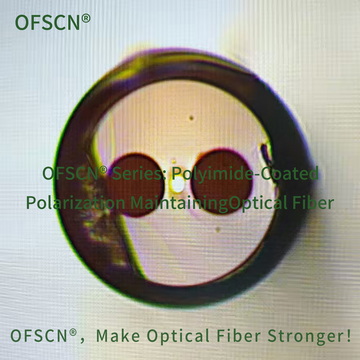
OFSCN® 300℃ Polyimide Panda-type PM Optical Fiber
- Technical Advantages: Employs a high-precision PANDA stress structure design, offering excellent birefringence and polarization-maintaining characteristics. The coating layer uses high-temperature resistant polyimide material, capable of withstanding an ultra-wide temperature range of -200℃ \text{ to } 350℃ or -270℃ \text{ to } 350℃. It is suitable for PM precision sensing in aerospace, oil and gas exploration, precision nuclear physics experiments, and extreme industrial environments.
- Physical Parameters: Core diameter 9μm, cladding diameter 125μm, coating diameter 155μm, applicable working wavelength 1550nm.
- Standard Product Images:
-
For more special fiber inquiries, please refer to:OFSCN® Special Optical Fiber Product Classification Link

2. OFSCN® Fiber Optic Patch Cord Products Customizable to PM Type
OFSCN® offers personalized customization services for PM fiber patch cords across its entire range of fiber optic patch cords. Combined with advanced stainless steel seamless steel pipe armored encapsulation technology, it ensures that PM fibers are protected from external stress interference such as micro-bending and side pressure.
-
OFSCN® Standard Fiber Patch Cord: General-purpose PM patch cords.
-
OFSCN® 120℃ Fiber Optic Patch Cord: Operating temperature range -40℃ \text{ to } 120℃, supports PM fiber customization.
-
OFSCN® 200℃ Fiber Optic Patch Cord: Operating temperature range -200℃ \text{ to } 200℃, uses 200℃ polyimide PM fiber with stainless steel armoring.
-
OFSCN® 300℃ Fiber Optic Patch Cord: Operating temperature range -270℃ \text{ to } 300℃, uses 300℃ polyimide PM fiber, suitable for precision PM transmission in ultra-low temperature, high vacuum, and high-temperature working conditions.
-
OFSCN® 700℃ Fiber Optic Patch Cord: Operating temperature range -270℃ \text{ to } 700℃, supports customization based on metal-coated (e.g., gold) PM fiber and high-temperature special patch cord processes.
-
For more fiber optic patch cord types and details, please refer to:OFSCN® Fiber Optic Patch Cord Product Classification Link