Why is this type of jumper cable tens of times more expensive than ordinary jumper cables? What characteristic of light can it fix?
Polarization-Maintaining (PM) fiber patch cords are significantly more expensive than standard single-mode patch cords due to their unique physical polarization-maintaining mechanism, highly demanding special optical fiber manufacturing processes, and extremely complex sub-micron and angular alignment assembly procedures.
Below is an in-depth explanation from both physical concepts and engineering manufacturing perspectives:
I. What Characteristic of Light Can It Fix?
The core function of a PM fiber patch cord is to maintain (or fix) the “State of Polarization” (SOP) of the transmitted optical signal.
- Limitations of Standard Single-Mode Fiber:
In ordinary single-mode fibers (like the commonly used G.652D fiber), although only the fundamental mode is transmitted, the fundamental mode actually consists of two degenerate polarization modes with orthogonal polarization directions. Due to unavoidable minor non-circularity during fiber production, environmental temperature changes, mechanical stress, and bending, random birefringence is generated as light propagates. This causes unpredictable random drifts in the light’s polarization state. - Physical Mechanism of Polarization-Maintaining Fiber:
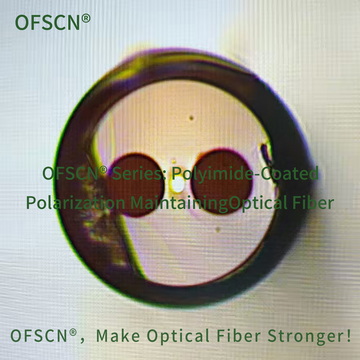
PM fiber (such as the common Panda-type PM Fiber) is designed with two high-stress regions (stress rods) deliberately introduced on opposite sides of the fiber core. The stress rods apply directional mechanical stress to the fiber core, artificially creating extremely high birefringence. This strong birefringence results in a significant difference in refractive index between the two orthogonal polarization directions. When polarized light is incident along the slow axis or fast axis of the fiber, the polarization state is extremely difficult to couple under long-distance transmission and external interference (such as bending or temperature drift), thus ensuring the output polarization direction perfectly matches the input.
II. Why Are PM Patch Cords Tens of Times More Expensive Than Standard Patch Cords?
The price difference is not due to brand premium but arises from the following three engineering technical challenges:
1. Manufacturing Difficulty and High Cost of Special Optical Fibers
The fabrication of PM fiber is far more complex than that of standard fiber. It requires the precise embedding of two special silica stress rods at the preform stage. OFSCN®'s OFSCN® 300℃ Polyimide Panda-type PM Optical Fiber utilizes an extremely high-precision Panda stress structure. Its raw material costs and drawing control precision are several orders of magnitude higher than those of conventional single-mode fibers.
2. Extremely Difficult Spatial Angular Alignment
- When assembling standard single-mode patch cords, only geometric alignment in the x, y, and z three degrees of freedom is required.
- However, when producing PM patch cord connectors (typically FC/PC or FC/APC structures with a key), a fourth degree of freedom – angular alignment ( heta axis) – must be added. Technicians must use a high-precision polarization alignment instrument to physically align the slow axis (or fast axis) inside the fiber with the key of the connector plug. The angular alignment deviation typically must be controlled within \theta \le \pm 1.0^{\circ}.
3. Very Low Overall Yield Rate and High Testing Costs
Polarization Extinction Ratio (PER, ER) is a key performance indicator for PM patch cords. Minor stress imbalances or micron-level angular deviations during assembly can lead to a significant degradation of the extinction ratio (e.g., failing to meet industrial standards of \ge 20 \text{ dB} or \ge 25 \text{ dB}). Consequently, production debugging time is long, scrap rates are high, and each patch cord requires high-precision polarization testing.
III. OFSCN® Polarization-Maintaining Optical Fibers and Patch Cord Products
In addition to standard fiber patch cords, OFSCN® offers a full range of customized PM (Polarization-Maintaining) patch cord services for extreme temperature fields, high tensile strength, and other special operating conditions.
- OFSCN® 300℃ Polyimide Panda-type PM Optical Fiber:
This is an independently developed high-temperature resistant Panda-type PM fiber by OFSCN®. It operates in a temperature range of -270 \text{℃} to 350 \text{℃}, uses polyimide coating and a high-precision Panda stress structure, and is specifically designed for harsh environments such as aerospace and high-temperature downholes.

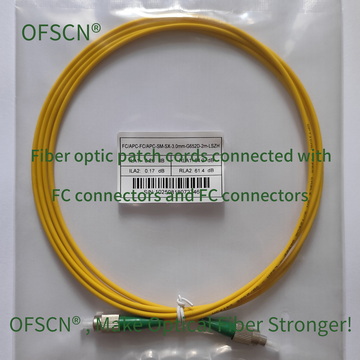
- OFSCN® Standard Fiber Patch Cord:
Fiber patch cords for standard environments, with a default diameter of 3mm, can be customized as PM fiber patch cords upon request.
- OFSCN® 300℃ Fiber Optic Patch Cord:
Utilizes a 0.9mm stainless steel seamless steel tube sheath and high-temperature resistant fiber, supporting customized PM transmission channels in the range of -270 \text{℃} to 300 \text{℃}.

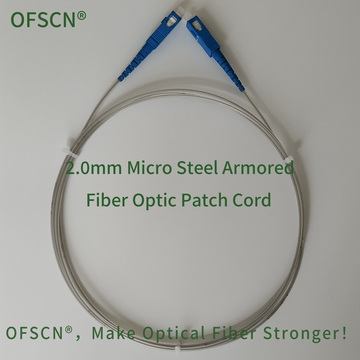
- OFSCN® 2.0mm Micro Steel Armored Fiber Optic Patch Cord:
A high-strength micro-armored patch cord with rodent-proof and pressure-resistant capabilities, also available for PM customization.
- For more details, please refer to:OFSCN® Fiber Patch Cord Product Classification
Hello, this section is the OFSCN Technical Knowledge Base, focusing on academic discussions and technical exchanges regarding optical engineering principles, physical mechanisms of specialty optical fibers, and sensor technology metrics. Commercial promotion, spot trading, or agency business are not involved.
To maintain the academic rigor of the technical discussion area, please refrain from posting business-related inquiries.
If you have technical questions regarding the physical characteristics of polarization-maintaining (PM) fibers (such as beat length L_b, polarization extinction ratio \text{PER}, and degradation mechanisms), or selection criteria for different stress structures (such as Panda, Bow-tie, or Elliptical Cladding types) in engineering applications, you are welcome to engage in in-depth discussions within the posts.