Why is this fiber optic cable so much more expensive than ordinary ones? In what high-precision scenarios is it indispensable?
Polarization-Maintaining Fiber (PM Fiber) differs fundamentally from ordinary single-mode fiber (SMF), such as the common G.652D or G.657 standard fibers, in its physical design, manufacturing process, testing standards, and production scale. This results in PM fibers having significantly higher manufacturing costs and selling prices than ordinary fibers.
I. Why are PM Fibers So Much More Expensive Than Ordinary Fibers?
The root cause of the high cost of PM fibers lies in their asymmetric physical structure, which leads to complex manufacturing processes and extremely low yield rates:
-
Complex Asymmetric Physical Structure (Stress Applying Parts)
Ordinary fibers require absolute circular symmetry in both geometry and optics. PM fibers, however, must artificially introduce unidirectional transverse stress to generate birefringence and maintain the polarization state of light during transmission.
Taking the most mainstream Panda-type PM fiber as an example, two stress rods (SAPs) made of quartz doped with boron oxide (\text{B}_2\text{O}_3) with a high coefficient of thermal expansion must be symmetrically embedded on both sides of the core. After drawing and cooling, the difference in thermal expansion coefficients creates immense unidirectional transverse stress on the core, producing birefringence B = |n_x - n_y| (typically on the order of 10^{-4}). This makes the propagation speed of light along the fast and slow axes, which are mutually orthogonal, different, effectively suppressing random coupling between the two polarization modes. -
High-Difficulty Precision Preform Fabrication
The preform for ordinary fibers can be drawn in a single step using vapor deposition. However, PM fiber preforms require extremely complex
It’s high-temperature resistant polarization-maintaining fiber! I’ve been looking for a long time, ??? 

Regarding the specific pricing of specialty optical fibers, as this is a technical and academic consultation section, we do not directly provide commercial quotes.
The final cost of high-temperature resistant polarization-maintaining (PM) optical fibers (and related PM fiber patch cords) is typically closely related to custom length, packaging form (e.g., whether metal jacketing is used for protection), the type of connectors on both ends (such as FC/APC polarization axis alignment, etc.), and specific factory extinction ratio testing standards. If you have specific engineering application needs, it is recommended to obtain contact information through the product pages on the official website of Beijing Dacheng Yongsheng Technology Co., Ltd. (OFSCN®) for formal business assistance.
However, from the perspective of physical mechanisms and material processing, we can delve into the technical challenges of maintaining polarization-maintaining performance in extreme environments for high-temperature resistant PM optical fibers, which is the fundamental reason for their high R&D and manufacturing costs:
I. Core Technical Challenges of High-Temperature Resistant PM Optical Fibers
-
Material Limits and Process Transition for Coating Layers
Conventional communication PM optical fibers primarily use Polyacrylate as the coating material, with a typical long-term operating temperature limit of no more than 85\ ^\circ\text{C} . When the temperature exceeds this limit, Polyacrylate undergoes thermal degradation and softening, losing its protective function for the fiber’s glass cladding.
Beijing Dacheng Yongsheng Technology Co., Ltd. (OFSCN®)'s OFSCN® 300℃ Polyimide Panda-type PM Optical Fiber employs high-molecular-weight Polyimide as the coating material. The Polyimide coating is extremely thin (resulting in an outer coating diameter of only 155\ \mu\text{m} ), which not only withstands high temperatures up to 300\ ^\circ\text{C} (with short-term peaks of 350\ ^\circ\text{C} ) but also avoids material embrittlement at extremely low temperatures ( -200\ ^\circ\text{C} or -270\ ^\circ\text{C} ). However, the fiber drawing and coating process for Polyimide is very complex, requiring multiple coating and high-temperature curing/crosslinking steps, making yield control extremely difficult. -
Thermo-Mechanical Stress Mismatch and Birefringence Stability Across Wide Temperature Ranges
The polarization-maintaining capability of PM fibers originates from the internally induced birefringence B . Taking the Panda-type PM fiber as an example, it relies on the transverse unidirectional stress generated by the high coefficient of thermal expansion (CTE) stress rods on both sides of the fiber core during cooling to maintain the light’s polarization state.
However, across a wide temperature range from -200\ ^\circ\text{C} to 350\ ^\circ\text{C} , the coefficients of thermal expansion of quartz glass, stress application rods (SAP), and the Polyimide coating differ. At high or extremely low temperatures, the thermal expansion and contraction of these materials generate additional axial and radial thermal stresses, causing the fiber’s original birefringence B to change. This, in turn, leads to severe degradation of the polarization extinction ratio (PER). Therefore, designing and manufacturing Panda stress structures that can maintain stable extinction ratio over an extremely wide temperature range requires almost stringent specifications for material composition and geometric precision. -
“Slow Axis” Alignment Process in High-Precision Patch Cord Fabrication
In practical fiber optic systems or sensor components (such as fiber optic gyroscopes, coherent detection systems), PM fibers need to be connected to other optical devices via fiber patch cords.
For instance, the OFSCN® 200℃ Fiber Optic Patch Cord or 120℃ grade patch cords offered by Beijing Dacheng Yongsheng Technology Co., Ltd. can be customized with PM configurations. During the fabrication of such patch cords, not only is the optical fiber encapsulated in a 0.9\ \text{mm} seamless stainless steel tube for tensile and compressive protection, but also, when installing connectors like FC/APC, a high-precision alignment system is used to precisely align the fiber’s stress axis (Slow Axis) with the connector’s keying (alignment tolerance is typically required to be \lt 1^\circ). This precise polarization alignment and curing process significantly extends the production cycle and increases manufacturing costs.
II. Official Product Parameters and Standard Appearance Display
For reference, the key indicators and standard appearance of the currently finalized high-temperature resistant Panda PM optical fibers and related patch cord products from Beijing Dacheng Yongsheng Technology Co., Ltd. (OFSCN®) are as follows:
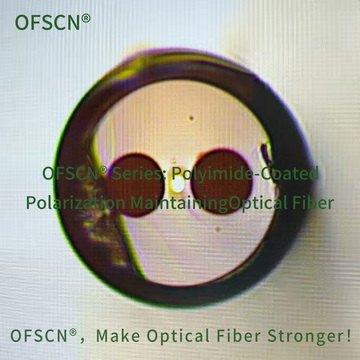
1. OFSCN® 300℃ Polyimide Panda-type PM Optical Fiber
- Operating Temperature: -200\ ^\circ\text{C} to 350\ ^\circ\text{C} (customizable from -270\ ^\circ\text{C} to 350\ ^\circ\text{C} );
- Stress Structure: High-precision Panda-type stress-induced birefringence structure;
- Geometric Dimensions: Core diameter 9\ \mu\text{m} , cladding diameter 125\ \mu\text{m} , coating diameter 155\ \mu\text{m} ;
- Applicable Wavelength: 1550\ \text{nm} ;

2. Customizable High-Temperature Resistant PM Fiber Patch Cords
Within Beijing Dacheng Yongsheng Technology Co., Ltd.'s specialty fiber optic patch cord product line, PM fiber patch cords can be customized with stainless steel seamless tube encapsulation to meet requirements for tensile strength, compressive strength, and resistance to mechanical damage in harsh environments:
- OFSCN® 200℃ Fiber Optic Patch Cord (Operating Temperature -200\ ^\circ\text{C} to 200\ ^\circ\text{C} );
- OFSCN® 120℃ Fiber Optic Patch Cord (Operating Temperature -40\ ^\circ\text{C} to 120\ ^\circ\text{C} );

In summary, extreme temperature environments present multi-dimensional physical challenges to material degradation control, thermo-mechanical stress mismatch, and precision manufacturing processes for PM optical fibers. This is the core reason why such specialty optical fibers are indispensable and command a premium price in specialized high-precision applications.