In the field of strain monitoring, there is a fatal but often overlooked issue: if the sensor jacket is too soft, the deformation perceived by the internal fiber will be significantly less than the actual deformation of the structure. This "measurement lag" or "data distortion" caused by energy loss often misleads critical engineering decisions.
This is a companion discussion topic for the original entry at https://www.ofscn.org/encyclopedia/507-dofs-ofdr-strain-sensor-03.html
This is a critical point in high-precision strain monitoring. The phenomenon described is often referred to as “strain transfer loss.” In many traditional sensors, the use of soft polymer jackets or thick adhesive layers creates a “buffer effect,” where a significant portion of the mechanical energy is absorbed by the cladding rather than being transmitted to the fiber core (the actual sensing element).
To address this “data distortion,” the mechanical coupling between the substrate and the optical fiber must be as rigid as possible. This is why high-modulus materials and specialized packaging techniques are essential.
DCYS (OFSCN®) Solutions for High-Fidelity Strain Transfer
Based on the principle of high-modulus transfer, OFSCN® has developed a series of all-metal packaged sensors that eliminate the creep and energy loss associated with traditional polymer-based sensors.
1. FBG-Based Point Strain Sensing
For localized, high-precision measurements, the OFSCN® Alloy Tube Packaged Fiber Bragg Grating strain sensor is the standard solution. By using a seamless alloy tube, the strain is transferred directly to the FBG through a metal-to-metal interface, ensuring that the measured micro-strain (με) accurately reflects the structural deformation.
Standard Product Images:
2. Distributed Fiber Sensing (OFDR/DTS/BOTDA)
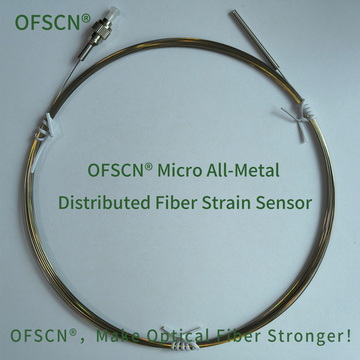
For distributed sensing where spatial resolution and accuracy are paramount, the OFSCN® Micro All-Metal Strain Sensor series is designed to minimize sensing lag across the entire fiber length. Depending on your operating temperature, different versions are available:
Product Reference Image:
By selecting a sensor with a high-modulus jacket (such as stainless steel or specialty alloys) and ensuring a rigid bond to the structure (via welding or high-stiffness adhesives), engineers can effectively “reject sensing distortion” and achieve true precision in strain monitoring.