cmh
Last Updated: 09 January 2026
In sectors such as aerospace, wind energy, and high-pressure vessel manufacturing, composite materials are rapidly replacing traditional metals. However, how do we perceive the "real heartbeat" inside these materials? How do we capture the precise moment a micro-crack initiates?
This is a companion discussion topic for the original entry at https://www.ofscn.org/encyclopedia/505-dofs-ofdr-strain-sensor-01.html
The integration of fiber optic sensors into composite materials for structural health monitoring (SHM) is a critical advancement in the era of “Smart Materials.” To capture the “real heartbeat” of such materials, specialized sensors are required that can withstand the embedding process and provide high-resolution data.
Technical Principles for Internal Monitoring
For monitoring micro-cracks and internal strain in composite materials, Distributed Fiber Optic Sensing (DOFS), specifically based on Optical Frequency Domain Reflectometry (OFDR), is often the preferred technical route. Unlike point-sensors, OFDR allows for millimeter-level spatial resolution, making it possible to detect the exact initiation point of a crack or local delamination.
Recommended Solutions for Embedded Sensing
Based on the environmental and material requirements, we offer several specialized sensors designed for embedding and high-performance monitoring:
-
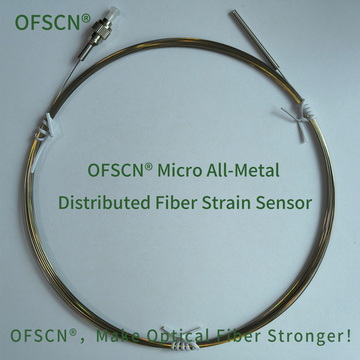
OFSCN® 85°C OFDR Micro All-Metal Strain Sensor
- Application: Ideal for standard composite curing processes and room-temperature monitoring.
- Design: Features an ultra-slim 0.6mm diameter with all-metal packaging, ensuring excellent strain transfer between the material and the fiber.
-
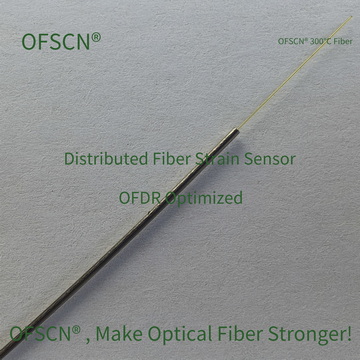
OFSCN® 300°C OFDR Micro All-Metal Strain Sensor
- Application: Suitable for high-temperature thermoplastic composites or aerospace components that undergo high-heat curing cycles.
- Design: Utilizes specialized polyimide-coated fibers within a seamless alloy tube.
Product Visuals:
Key Technical Advantages
- Small Form Factor: The 0.6mm outer diameter minimizes the “inclusion effect,” ensuring that the sensor does not become a structural defect within the composite.
- No Glue Creep: The all-metal seamless tube packaging avoids the degradation and “creep” issues associated with traditional polymer-based coatings or adhesives in high-stress environments.
- High Sensitivity: Designed to work with OFDR interrogators to provide continuous strain profiles along the entire length of the fiber.
To recommend the most appropriate sensor for your specific project, could you please clarify the maximum temperature reached during your material’s curing process? Also, are you looking to measure strain at specific points or across the entire structural surface/interior?