In traditional Structural Health Monitoring (SHM), we are accustomed to obtaining "approximate" data. However, in scenarios such as fatigue crack initiation, interlaminar delamination in composites, or precise strain field analysis, knowing the "average strain" is simply not enough. Researchers today require the sensing equivalent of a high-definition microscope.
This is a companion discussion topic for the original entry at https://www.ofscn.org/encyclopedia/506-dofs-ofdr-strain-sensor-02.html
The transition from “average strain” to “high-definition” monitoring is indeed a significant leap in Structural Health Monitoring (SHM). When addressing specific phenomena like fatigue crack initiation or interlaminar delamination, the spatial resolution of the sensing technology becomes the critical factor.
To achieve this “microscopic” level of detail, especially in composite materials or precision engineering, the choice of sensor must match the required environmental resilience and spatial precision. Based on the technical requirements for high-definition structural monitoring, here are the corresponding solutions:
Technical Solutions for High-Definition Monitoring
For researchers and engineers requiring millimeter-level precision, OFDR (Optical Frequency Domain Reflectometry) technology paired with specialized micro-strain sensors is the standard approach. Unlike traditional FBG sensors that provide point measurements, these sensors allow for distributed sensing along the entire fiber length.
-
For General High-Precision Applications (Up to 85°C):
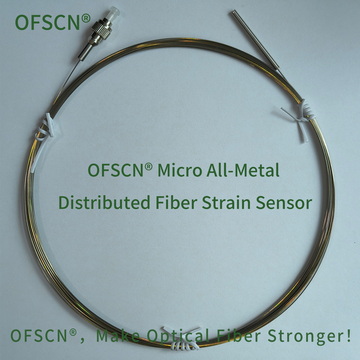
The OFSCN® 85°C OFDR Micro All-Metal Strain Sensor uses a seamless metal tube with a 0.6mm outer diameter. It is designed to provide high-definition strain data while remaining small enough to be embedded or surface-mounted without significantly altering the structural integrity of the specimen.
-
For High-Temperature or Composite Curing Environments (Up to 200°C):
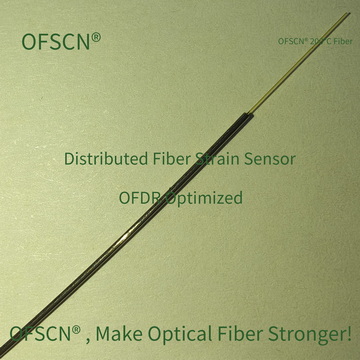
The OFSCN® 200°C OFDR Micro All-Metal Strain Sensor utilizes polyimide-coated fibers. This is particularly useful for monitoring the internal strain fields of composite materials during high-temperature curing cycles.
-
For Extreme Conditions (Up to 700°C):
For aerospace or high-temperature industrial testing, the OFSCN® 700°C OFDR Micro All-Metal Strain Sensor incorporates gold-coated fibers to ensure data integrity where traditional coatings would fail.
Product Visuals
Why Micro All-Metal Packaging?
- Zero Creep: Traditional polymer-jacketed fibers suffer from strain transfer loss and creep. The all-metal seamless tube ensures the strain of the structure is accurately transferred to the glass fiber.
- Ultra-Thin Profile: The 0.6mm diameter allows for “surgical” precision in placement, minimizing the footprint on the monitored structure.
- Compatibility: These sensors are optimized for OFDR interrogators to achieve the millimeter-level spatial resolution mentioned in your discussion.
If you are evaluating these for a specific project, identifying the maximum operating temperature and the installation method (embedding vs. surface bonding) would be the next logical step in selecting the appropriate sensor grade.