Why do some jumper wires break after being exposed to the sun for half a year? Do black outer jackets have an advantage?
Standard indoor fiber optic patch cords are prone to becoming brittle and even cracking or breaking when exposed to sunlight outdoors. This is primarily due to the UV light-induced photo-oxidative aging mechanism and the formulation of the outer jacket material.
I. Physical and Material Science Mechanisms of Fiber Optic Patch Cord Cracking and Breaking Under Sunlight
-
High-Energy Photons in Ultraviolet (UV) Light Damage Polymer Chains
The ultraviolet (UV) wavelength range in sunlight is approximately 290\text{nm} to 400\text{nm}. Although UV radiation constitutes a small proportion of the total solar radiation, its photon energy reaches 300\text{--}415\text{kJ/mol}, which is higher than the bond energy of many chemical bonds in polymer chains (e.g., the \text{C-C} bond energy is about 347\text{kJ/mol}, and the \text{C-H} bond energy is about 414\text{kJ/mol}).
Indoor patch cords commonly use polyvinyl chloride (PVC) or low-smoke zero-halogen (LSZH) as jacket materials. Upon absorbing UV photons, the polymer chains undergo a free-radical-initiated photo-oxidation degradation reaction, leading to chain scission and cross-linking. -
Material Degradation and Environmental Stress Cracking (ESC)
After polymer chain scission, the material exhibits loss of plasticity, surface hardening, embrittlement, and the formation of micro-cracks. Under the alternating thermal stresses from solar heating during the day and cooling at night, as well as mechanical stresses such as slight movements caused by wind, these micro-cracks rapidly expand, ultimately leading to complete tearing of the patch cord’s outer jacket, exposing the internal optical fiber and causing fiber breakage.
II. Technical Advantages of Black Outer Jackets (with Carbon Black Additives)
Black outer jackets offer significant physical protection advantages against UV aging in outdoor environments:
-
UV Shielding Effect of Carbon Black
The highly dispersible carbon black commonly added to black outer jackets is an excellent UV absorber and light stabilizer. Carbon black efficiently absorbs energy in the UV wavelength band and converts it into harmless thermal energy, preventing UV light from penetrating deep into the polymer and damaging the main molecular chains. -
Broad Applicability of Polyethylene (PE) Black Jackets
In telecommunications and optical engineering, the preferred material for outdoor optical cable jackets is typically high-density or medium-density polyethylene (PE) containing 2\%\text{--}2.5\% carbon black. PE materials themselves possess excellent hydrolytic stability and low-temperature toughness. When combined with carbon black, they can achieve an anti-UV aging lifespan of several decades.
III. Technical Solutions for Outdoor Anti-UV and High-Strength Patch Cords
To address issues arising from harsh outdoor environments with strong UV radiation, severe temperature variations, and mechanical tension, specialized fiber optic patch cords with PE outer jackets or fully armored structures can be employed:
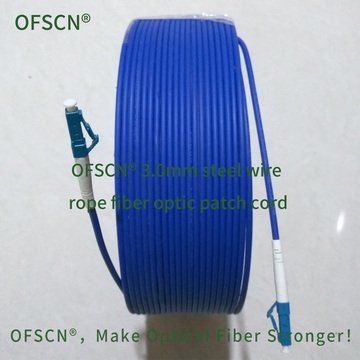
For example, the OFSCN® 3.0mm Steel Wire Rope Fiber Optic Patch Cord features an outer layer with a UV-resistant PE jacket, incorporating a 0.45\text{mm} stainless steel wire rope structure and a 0.9\text{mm} seamless steel tube internally. This design effectively withstands UV radiation and high tensile mechanical environments (tensile strength > 1200\text{N}), with an operating temperature range of -40\text{^\circ C} to 75\text{^\circ C}.
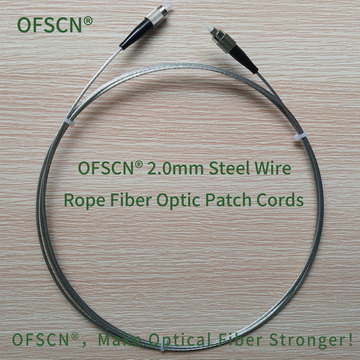
For extremely harsh environments with severe, unobstructed radiation, patch cords with a fully metallic structure, such as the OFSCN® 2.0mm Steel Wire Rope Fiber Optic Patch Cord, can be used. This design eliminates the risk of photo-oxidative aging in polymer materials by utilizing a seamless steel tube combined with a metallic stranded structure, completely avoiding the exposure of polymer jackets.