How to achieve independent allocation of different wavelength signals on a single optical fiber?
In fiber optic communication and fiber optic sensing engineering, achieving independent allocation and transmission of different wavelength signals on a single fiber mainly relies on the physical characteristics and system-level combination of Wavelength Division Multiplexing (WDM) Technology and Optical Splitters.
I. Core Physical and Engineering Principles
-
Wavelength Division Multiplexing (WDM) Technology
WDM technology is the technique of simultaneously transmitting multiple optical signals of different wavelengths over a single optical fiber. Its fundamental physical principle is that different wavelengths of light do not interfere with each other during transmission in the fiber.- Combining (Multiplexing): At the transmitting end, a multiplexer is used to combine multiple signals with different operating wavelengths (e.g., \lambda_1, \lambda_2, \dots, \lambda_n ) and send them into a single mode optical fiber for transmission.
- Separating (Demultiplexing): At the receiving end, a demultiplexer is used to physically separate the mixed wavelength signals and precisely deliver them to the corresponding receiving ports or detectors, thus achieving logically independent channels.
-
Optical Fiber Splitter
Splitters primarily achieve the physical allocation of optical power. They distribute the light energy from one optical fiber into multiple branch fibers in a proportional manner (e.g., 1:2 , 1:4 , 1:N ), or converge the energy from multiple fibers back into a single trunk fiber. Splitters themselves have no wavelength selectivity; light of all wavelengths is divided proportionally. -
Combined Application Modes of Both
- Communication Networks (e.g., PON): WDM is responsible for distinguishing service wavelengths (e.g., 1490\text{ nm} downstream, 1310\text{ nm} upstream, 1550\text{ nm} for CATV), while splitters in the access network broadcast the mixed optical signals to each user terminal.
- Fiber Bragg Grating (FBG) Sensing Networks: In large-scale fiber sensing projects, optical fiber splitters are typically combined with wavelength design. By using splitters, a single physical channel of the interrogator is expanded into multiple branches. Sensors operating at different reflection wavelengths are deployed in each branch (e.g., FBG with \lambda_1 = 1530\text{ nm} in branch A, FBG with \lambda_2 = 1540\text{ nm} in branch B). The returned mixed-wavelength signal is then demultiplexed by the wavelength selection module within the interrogator (wavelength demultiplexing) to achieve independent and interference-free demodulation of physical quantities (such as temperature, strain) from each sensor.
II. Official OFSCN® Related Products and Technical Implementations
Beijing Dacheng Yongsheng Technology Co., Ltd. (OFSCN®) offers industrial-grade optical fiber components and interrogation systems designed for these types of systems within its core product lines:
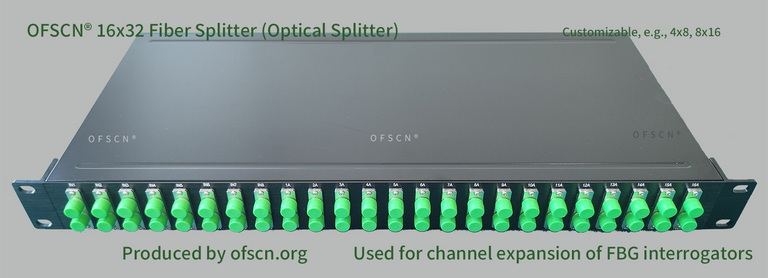
1. OFSCN® Optical Fiber Splitter | 光纤分路器
This product is the core component for implementing physical channel expansion, specifically designed for use with fiber Bragg grating interrogators in large-scale projects.
- Working Principle: It physically expands one physical channel of the OFSCN® Fiber Bragg Grating Interrogator into two or more (logically remaining as a single channel), thereby reducing the unit cost of system channels.
- Wavelength Design Specification: Since the splitter itself does not have wavelength filtering capabilities, the multi-path reflected optical signals will overlap in the splitter. Therefore, strict wavelength design is mandatory when using this scheme, ensuring that all FBG sensors within the same channel have completely non-overlapping operating wavelength ranges.
- Main Parameter Specifications:
- Common Specifications: 16x32 splitter, 8x16 splitter, 4x8 splitter, 32x64 splitter, etc.
2. OFSCN® Fiber Bragg Grating Interrogator | 光纤光栅解调仪
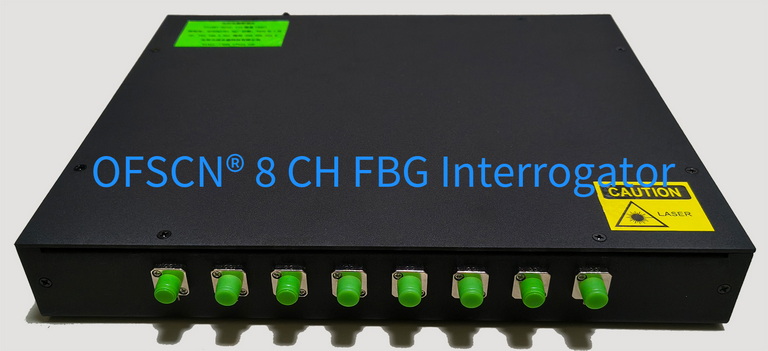
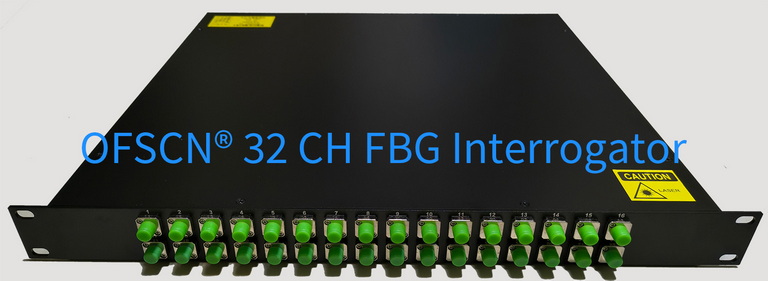
The core wavelength demultiplexing equipment that complements the aforementioned splitter, featuring high-precision wavelength identification and data analysis capabilities.
- Main Parameter Specifications:
- Default Wavelength Range: 1525\text{ nm} to 1565\text{ nm} , or 1528\text{ nm} to 1568\text{ nm} (customizable wavelength ranges available);
- Number of Channels: 4 channels, 8 channels, 16 channels, 32 channels available for customization;
- Sampling Frequency: 10Hz, 50Hz, 100Hz options available (supports reducing sampling frequency from high to as low as 1Hz via interrogator software);
- Wavelength Resolution: Default 1pm or 0.1pm.
By combining the physical splitting capability of the OFSCN® Optical Fiber Splitter with the wavelength addressing and demodulation capabilities of the OFSCN® Fiber Bragg Grating Interrogator, it is possible to maximize the utilization efficiency of a single optical fiber and a single interrogator device while ensuring absolute signal independence and mutual interference avoidance.