Can it support both 1310nm and 1550nm bands simultaneously?
Yes, a “broadband” optical splitter (Broadband Splitter / Dual-Window Splitter) can completely support both working bands of 1310\ \text{nm} and 1550\ \text{nm} simultaneously.
However, the method of implementation, specific performance, and whether it can “simultaneously support” depend on the physical manufacturing process used for the splitter:
1. PLC (Planar Lightwave Circuit) Splitter — Naturally Supports Broadband
PLC splitters are optical devices that fabricate silica waveguides on a silicon substrate using semiconductor processes.
- Physical Mechanism: The design of its waveguide structure is highly insensitive to wavelength.
- Band Support: PLC splitters typically have an extremely wide operating bandwidth, with a standard operating wavelength range of 1260\ \text{nm} to 1650\ \text{nm}.
- Conclusion: It naturally and simultaneously supports both 1310\ \text{nm} and 1550\ \text{nm} bands (as well as the O, E, S, C, L, etc. bands in between), maintaining excellent insertion loss (IL) and uniformity across the entire wavelength range.
2. FBT (Fused Biconical Taper) Splitter — Requires Specific Design (Dual-Window/Triple-Window)
FBT splitters are manufactured by removing the coating from two or more optical fibers, fusing and tapering them together.
- Physical Mechanism: The coupling coefficient in the tapered coupling region is a function of wavelength, exhibiting high wavelength selectivity.
- Band Support Classification:
- Single-Window Splitter: Optimized for a single wavelength only (e.g., supports only 1310\ \text{nm} or only 1550\ \text{nm}). If operated at a non-designed wavelength, the additional loss will increase sharply.
- Dual-Window/Triple-Window Broadband Splitter: By precisely controlling the length and geometric cladding structure of the coupling region during the tapering manufacturing process, the coupling efficiency reaches the designed splitting ratio simultaneously at the two characteristic wavelengths of 1310\ \text{nm} and 1550\ \text{nm}.
- Conclusion: If it is a dual-window or triple-window (1310/1490/1550nm) FBT broadband splitter, it can also simultaneously support these two bands.
Application Background in Fiber Bragg Grating (FBG) Systems
In Fiber Bragg Grating (FBG) sensing systems, the demodulator’s conventional operating wavelength is typically in the C-band (approximately 1525\ \text{nm} to 1565\ \text{nm}) or extended bands (1510\ \text{nm} to 1590\ \text{nm}). In large-scale FBG sensing networks, optical splitters are mainly used for multiplexing and expanding physical channels.
OFSCN® provides dedicated optical splitters for use with FBG demodulation systems in large projects:
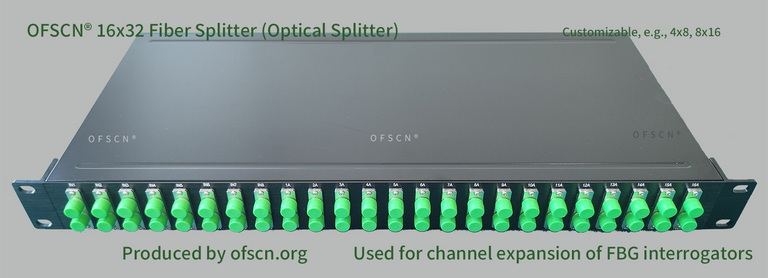
- Core Parameters and Applications: Standard specifications include 16x32, 8x16, 4x8, and 32x64 splitters. This device is primarily used to complement OFSCN® fiber optic grating demodulators, significantly reducing the average cost per channel of the system by logically extending one physical channel into multiple channels.
- Technical Requirements: When using this splitter for channel expansion, the FBG sensors on each branch must undergo strict wavelength planning and reflectivity design to avoid signal confusion caused by wavelength overlap.