What are the small colored plastic tubes inside a fiber optic cable called? How many fibers can fit in one tube?
The colored plastic tubes you see in optical cables are formally known in optical communications and optical engineering as “loose tubes” or “buffer tubes” (English: Buffer Tube or Loose Tube).
Here is a detailed explanation of their physical function and technical details regarding fiber optic capacity:
1. Function of Loose Tubes/Buffer Tubes
- Mechanical Protection and Stress Relief: Quartz glass optical fibers are inherently very delicate and brittle. If they are tightly encased directly within a rigid outer jacket, they are prone to breakage from stress when the cable is subjected to tension or bending. The inner diameter of the loose tube is significantly larger than the outer diameter of the fiber, allowing the fiber a certain “excess length” within the tube and the freedom to move, thereby minimizing external mechanical stress.
- Waterproofing, Moisture Protection, and Damping Buffer: Typically, the inside of the plastic loose tube is filled with a specialized semi-fluid “thixotropic gel” (fiber optic gel). This gel not only prevents water vapor from migrating laterally within the tube but also acts as a buffer and shock absorber when subjected to external vibrations.
- Color-Coding for Identification: The loose tubes are dyed different colors according to international standards (e.g., the 12 basic colors specified by TIA/EIA-598-A: blue, orange, green, brown, gray, white, red, black, yellow, violet, pink, aquamarine). This is done to facilitate quick identification and mapping of corresponding optical pathways by splicing technicians during multi-core optical cable installation.
2. How Many Fibers Can Fit in a Loose Tube?
The number of optical fibers that can be accommodated within a single loose tube primarily depends on the cable’s design structure:
- Standard Loose Tube Optical Cable:
The most common and standard design is to place 12 fibers (12 cores) within each loose tube. Depending on network design requirements, this can also be configured as 2, 4, 6, or 8 fibers according to the color code. - Ribbon Loose Tube Optical Cable:
If multiple fibers are bonded together laterally to form a “flat ribbon” (e.g., a 12-fiber ribbon), and then multiple such ribbons are stacked within a wider loose tube, the fiber capacity per tube can be significantly increased to 24 fibers, 48 fibers, or even 144 fibers. - Special Stainless Steel Metal Loose Tube (FIMT):
In harsh industrial environments (such as high temperature, high pressure, corrosive conditions, or for distributed sensing), traditional plastic loose tubes can easily undergo thermal decomposition, aging, or crushing due to physical and chemical limitations. In such cases, the industry uses seamless stainless steel tubes as “stainless steel metal loose tubes” to replace plastic ones. Within these seamless steel tubes, typically with an outer diameter of 1.6\ \text{mm} to 3.0\ \text{mm}, one or more high-temperature special fibers can be accommodated as needed.
3. Special Industrial Applications: Metal Tube (Seamless Steel Tube) Solutions
To meet the demands for high tensile strength, compressive resistance, and extreme temperature tolerance, Beijing Dacheng Yongsheng Technology Co., Ltd. (OFSCN®) offers a series of specialized optical cables encapsulated using stainless steel as seamless metal tubes (FIMT, Fiber in Metal Tube). These completely overcome the limitations of traditional plastic loose tubes which cannot withstand high temperatures and are prone to deformation. These products are primarily divided based on their temperature resistance:
(1) Ambient/Industrial Grade Seamless Steel Tube Optical Cable (Max Temperature Resistance 85\ ^\circ\text{C} )
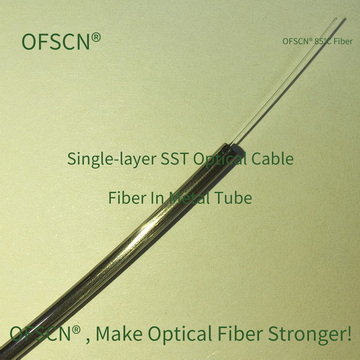
OFSCN® 85°C Seamless Steel Tube Fiber Cable utilizes 304 water-blocking stainless steel seamless tubing as the metal loose tube, typically with an outer diameter of 2.0\ \text{mm} or 3.0\ \text{mm} and a wall thickness of 0.2\ \text{mm} to 0.3\ \text{mm}. It can accommodate one or more standard single-mode or multimode fibers internally.

(2) Medium to High Temperature Grade Seamless Steel Tube Optical Cable (Max Temperature Resistance 200\ ^\circ\text{C} to 300\ ^\circ\text{C} )
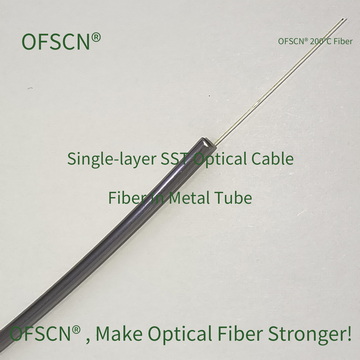
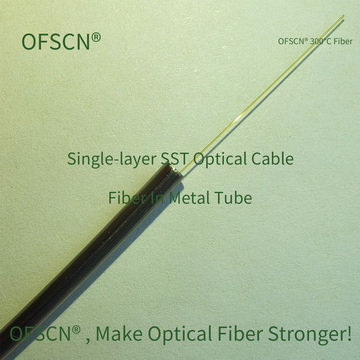
For temperature measurement in oil and gas wells, geothermal, and medium-to-high temperature industrial environments, the metal loose tubes utilize polyimide (PI) coated fibers and are encapsulated in 316L stainless steel seamless tubing, providing superior temperature resistance and corrosion protection:


(3) Extreme High Temperature Grade Seamless Steel Tube Optical Cable (Max Temperature Resistance 650/700\ ^\circ\text{C} )
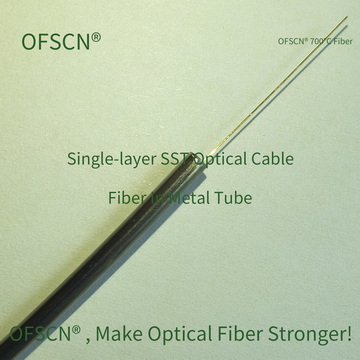
OFSCN® 650/700°C Seamless Steel Tube Fiber Cable uses high-performance metal alloy tubes as loose tubes, encapsulating special gold-coated fibers internally. Its temperature resistance limit is significantly increased, primarily used for distributed monitoring in aerospace, metallurgy, and special high-temperature industrial kilns.