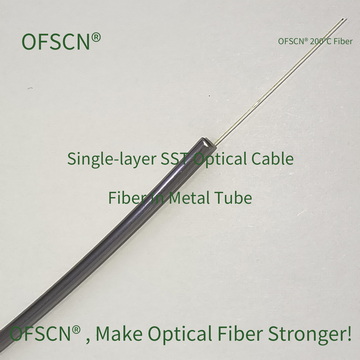
Why are fibers placed in a greasy tube? Does it prevent the fiber from being stressed?
The structure in which optical fibers are placed in a tube (loosely called a sheath) with dimensions far larger than their outer diameter, and filled with a viscous gel, is known in fiber optic communication and sensing engineering as a Loose-Tube Structure.
This design is not intended to fix the optical fiber; on the contrary, its core physical and engineering purpose is to achieve mechanical decoupling between the optical fiber and the outer sheath, and to provide long-term chemical and physical protection.
Here are the core physical and mechanical principles of this design:
I. Mechanical Decoupling: How to Prevent Fiber Stress?
In loose-tube optical fibers, the inner diameter D of the sheath is much larger than the outer diameter d of the optical fiber (e.g., the fiber outer diameter is only 125\ \mu\text{m} to 250\ \mu\text{m}, while the protective tube’s inner diameter is typically 1.0\ \text{mm} to 2.0\ \text{mm} or more).
- Utilizing “Excess Fiber Length” (EFL)
During the manufacturing of loose-tube optical cables, the length of the optical fiber is intentionally controlled to be slightly longer than the protective tube (i.e., there is excess length, typically between 0.1\% and 1.0\%). This means the optical fiber is not tautly straight within the tube cavity but forms a tiny helical or wavy bend. - Releasing Tensile Strain
When the optical cable is subjected to tension (e.g., external tension, pulling force during installation, or thermal expansion/contraction), the outer protective sheath elongates. Due to the ample space within the tube, the optical fiber can slide freely inside the cavity and releases excess length by “straightening” from its helical state. As long as the sheath’s elongation is within the designed excess length, the optical fiber itself does not bear any tensile stress, and its axial force remains at 0. - Accommodating Differences in Coefficient of Thermal Expansion
The coefficients of thermal expansion for different materials (such as silica glass and outer stainless steel or plastic) vary significantly. When the ambient temperature changes drastically, the outer sheath contracts or expands considerably. The loose-tube structure allows the optical fiber to automatically adapt to changes in the sheath’s length by increasing or decreasing its helical curvature within the spacious cavity, preventing the fiber from being pulled apart or squeezed to cause micro-bending losses.
II. The Crucial Role of Filling Gel (Fiber Gel)
The gel filled inside the tube (usually a thixotropic water-blocking gel) is not for rigidly fixing the fiber; it is a semi-fluid, high-viscosity hydrophobic medium with critical functions:
- Preventing “Stress Corrosion” Caused by Water Molecules
When quartz glass (silica SiO_2) is under slight stress and comes into contact with water molecules (H_2O), it undergoes a chemical reaction:SiO_2 + H_2O \rightarrow 2SiO-HThis leads to the rupture of silica’s chemical bonds, causing microscopic cracks on the fiber surface to expand rapidly. As a result, the optical fiber can undergo sudden brittle fracture under a tensile force far below its theoretical limit. The gel is highly hydrophobic, completely encapsulating the optical fiber, thus preventing moisture ingress and blocking axial penetration of water if the sheath is damaged. - Mechanical Damping and Micro-bend Buffering
The viscoelasticity of the gel provides a soft cushion for the optical fiber. When the optical cable is subjected to external high-frequency vibrations, impacts, or localized lateral pressure, the gel absorbs and dissipates some of the mechanical energy, acting as a damper to reduce shock and vibration. This prevents localized, severe micro-bending of the optical fiber (micro-bending loss), thereby ensuring the stability of optical signal transmission.
III. Industrial-Grade Seamless Steel Tube Loose-Tube Optical Cables
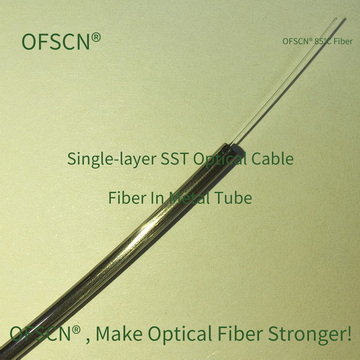
In Beijing Dacheng Yongsheng Technology Co., Ltd.'s (OFSCN®) high-end fiber optic and distributed sensing applications, we combine this “loose-tube” principle with high-strength metal manufacturing technology to introduce a series of optical cables based on seamless stainless steel tubes (i.e., Fiber in Metal Tube, FIMT).
In this structure, the stainless steel tube serves as an excellent physical protection barrier, bearing the vast majority of external compressive and tensile stresses. The high-temperature gel or special air gap inside the tube ensures that the optical fiber remains free from stress in harsh industrial environments (such as oil and gas well logging, geothermal monitoring).
Typical products include:
- OFSCN® 85°C Seamless Steel Tube Fiber Cable: Encapsulated in a seamless stainless steel tube and filled with water-blocking gel, it can accommodate single-mode or multi-mode fibers, providing excellent protection against moisture and external tensile/compressive forces.
- OFSCN® 200°C Seamless Steel Tube Fiber Cable: For medium to high-temperature environments, this cable uses a seamless steel tube loose-tube structure to protect polyimide-coated fibers, preventing damage from thermal and mechanical stress in harsh operating conditions.