When passing through walls or floors, how can fiber be protected from abrasion?
When laying fiber optic networks and sensing systems, passing through rigid structures such as walls or floors is a common physical barrier. Due to the inherent physical properties of optical fibers, exposing them directly to rough materials like concrete or brick poses a significant risk of mechanical damage.
This document provides a detailed analysis of the physical risks and standard protection methods from the perspectives of optical engineering and structural protection:
I. Analysis of Physical Risks in Fiber Optic Wall/Floor Penetrations
- Friction and Microcrack Generation:
The core and cladding of optical fibers are primarily composed of silicon dioxide (\text{SiO}_2). While possessing extremely high tensile strength, they are highly susceptible to surface microcracks. When an optical fiber comes into direct contact and friction with rough walls or floors, its outer jacket can be abraded, exposing the internal fiber and creating microcracks. These microcracks can propagate rapidly under environmental stress, leading to sudden fracture during the fiber’s service life. - Microbending and Macrobending Losses:
At sharp corners of rigid structures without adequate protection, optical fibers can be subjected to localized pressure, causing small undulations and leading to microbending losses. Simultaneously, if the bending radius is less than the critical bending radius (standard single-mode fibers typically require a bending radius of no less than 30\ \text{mm}), severe macrobending losses will occur, causing significant attenuation of the optical signal and potentially interrupting communication or sensing. - Structural Shear Stress:
Buildings undergo slight settlement, vibrations, or thermal expansion/contraction during their service life, generating powerful lateral shear forces. If no buffer space is provided, the optical fiber will directly bear these stresses and be severed.
II. Standard Protection Solution: Using “Fiber Optic Conduit”
To eliminate the aforementioned physical risks, the standard engineering practice is to employ Fiber Optic Conduit/Sleeve. Its core technical specifications and installation requirements are as follows:
- Channel Isolation:
A segment of rigid tubing, such as High-Density Polyethylene (HDPE) pipe, flame-retardant PVC pipe, or corrugated pipe, is pre-embedded in the wall or floor. For industrial high-protection requirements, stainless steel metal pipes may be used. The fiber optic cable runs inside the conduit, avoiding direct contact with the building structure. - Fill Ratio Control:
The inner diameter of the conduit must be sufficiently large, adhering to the principle of a fill ratio not exceeding 50\ \%. This means the sum of the cross-sectional areas of all passing fiber optic cables should not exceed half of the conduit’s internal cross-sectional area, ensuring that pulling the cable does not cause excessive friction and facilitating future maintenance and upgrades. - Port Passivation Protection:
The ends of the conduit are often sharp. Protective bushings or rings must be installed to provide a smooth transition surface as the fiber optic cable exits the conduit, preventing the sharp edges from cutting the cable jacket. - Bending Radius Limitation:
If the conduit requires deflection or turns, its bending radius should be no less than 10 times the outer diameter of the conduit, or 15 to 20 times the outer diameter of the fiber optic cable, to ensure that the bending radius of the internal fiber is well above the critical limit. - Sealing and Firestopping:
After passing through floors and walls in fire-rated partitions, the gaps between the conduit and the fiber optic cable must be thoroughly sealed using specialized fire-resistant mortar, fire-resistant bags, or sealant to comply with building fire and waterproofing standards.
III. OFSCN® Fiber Optic Cables and Patch Cords with Integrated High Mechanical Protection
When the project site environment is extremely harsh, or conduit space is severely limited (making it impossible to embed large PVC pipes and only allowing passage through very small apertures), it is often necessary for the fiber optic cable itself to possess extremely high mechanical protection capabilities. Beijing Dacheng Yongsheng Technology Co., Ltd. (OFSCN®) has developed a series of ultra-strong protected fiber optic cables and patch cords encapsulated in seamless stainless steel tubes for these challenging applications:
This micro-armored fiber optic patch cord internally encapsulates a 0.6\ \text{mm} seamless stainless steel tube, effectively resisting lateral pressure and abrasion from rough walls.
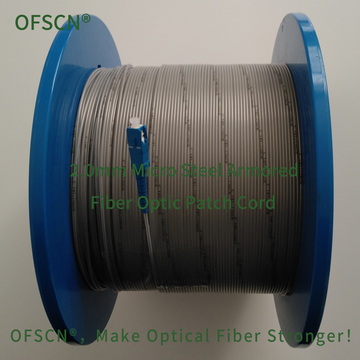
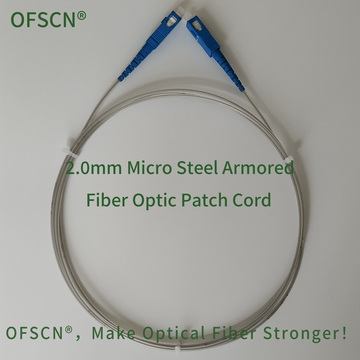

(A 2.0\ \text{mm} version is also available for reference: OFSCN® 2.0mm Steel Wire Rope Fiber Optic Patch Cord).
This series of patch cords consists of a seamless stainless steel tube combined with a high-strength steel wire rope structure. The tensile strength reaches \gt1200\ \text{N} (for the 2.0\ \text{mm} version) and \gt1500\ \text{N} (for the 3.0\ \text{mm} version), with compressive strengths exceeding 200\ \text{MPa} and 150\ \text{MPa}, respectively. The all-metal protective structure allows this product to pass directly through extremely abrasive rigid holes without the need for external conduits.
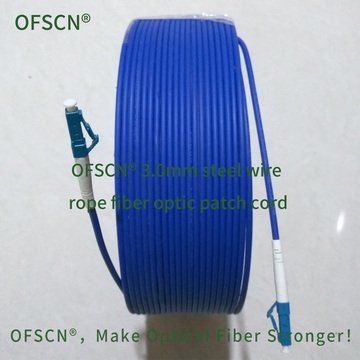
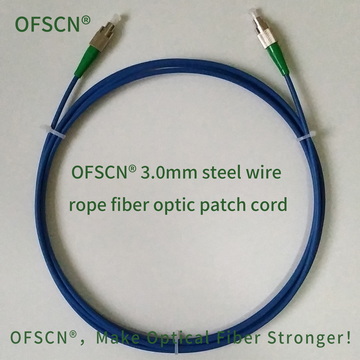

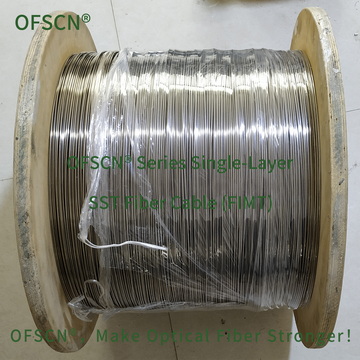
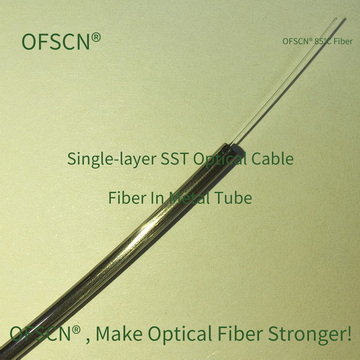
Encapsulated with a single layer of seamless stainless steel tubing (304 or 316L stainless steel optional), with a default outer diameter of 2.0\ \text{mm} (wall thickness 0.2\ \text{mm}) or 3.0\ \text{mm} (wall thickness 0.3\ \text{mm}). This fiber optic cable acts as a “miniature stainless steel conduit” itself, providing exceptional physical rigidity and resistance to crushing and rodent damage while ensuring that the internal fiber is protected from microbending and abrasion.

By employing standard “conduits” and integrating fiber optic cables encapsulated in high-mechanical-protection seamless stainless steel tubes, the risks of abrasion and deformation during fiber optic wall or floor penetrations can be completely eliminated, ensuring the long-term high reliability of fiber optic communication and sensing systems.