Why are rigid gels used for strain measurement while soft gels are used for temperature measurement?
In Fiber Bragg Grating (FBG) sensors and general measurement engineering, the principle of ‘hard adhesive for strain measurement, soft adhesive (or free-hanging decoupling) for temperature measurement’ is determined by the Strain Transmission Theory in Continuum Mechanics and the Stress Decoupling Principle in Anisotropic Thermoelastic Mechanics.
1. Physical and Mechanical Mechanism of Using Hard Adhesive for Strain Measurement (Strain Transmission Efficiency)
In strain measurement, the core principle is to transfer the tiny mechanical deformation (strain \varepsilon) occurring on the surface of the structure under test to the Fiber Bragg Grating in the fiber core completely and accurately.
- Shear Modulus and Strain Transfer Coefficient: The adhesive acts as a shear force transfer medium between the measured substrate and the fiber. According to the strain transfer model for fiber optic sensors, the elastic modulus E and shear modulus G of the adhesive layer determine the strain transfer coefficient \alpha.
- High Transmission Characteristics of Hard Adhesives: Hard adhesives (such as high-modulus epoxy resins, polyimides, etc.) possess a very high shear modulus G. Under load, the shear deformation and hysteresis of the hard adhesive itself are minimal, enabling lossless strain transfer with \alpha \approx 1.
- Detrimental Effects of Deformation Absorption by Soft Adhesives: If a soft adhesive (such as low-hardness silicone) is used, the adhesive body will undergo elastic absorption or plastic shear creep when subjected to shear force, causing severe “Strain Transmission Loss” and hysteresis. This results in a significantly lower calculated strain wavelength shift than the actual deformation.
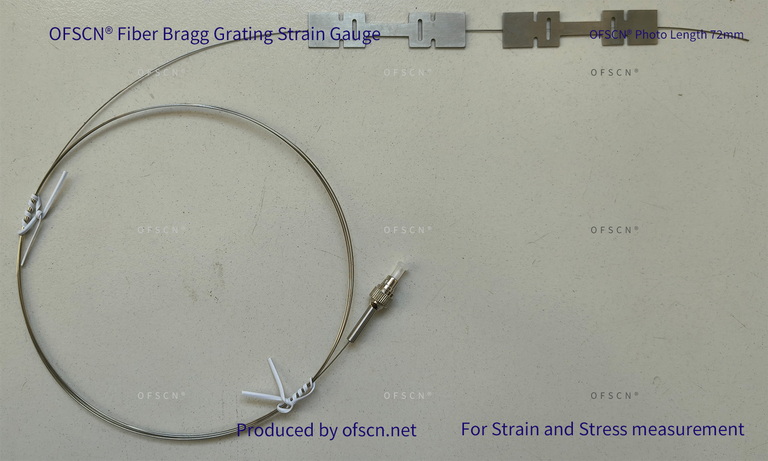
In the structural designs by Beijing Dacheng Yongsheng Technology Co., Ltd., such as the OFSCN® Fiber Bragg Grating Strain Gauge and OFSCN® Polymer-encapsulated Fiber Bragg Grating Strain Sensor (0.7mm/1.2mm diameter), high-hardness, high-modulus polymers or substrate structures are employed to ensure the lossless transmission of mechanical strain.
2. Physical and Thermal Mechanism of Using Soft Adhesive/Decoupling Design for Temperature Measurement (Stress Decoupling)
The physical basis for FBG temperature measurement relies on the Thermo-optic Effect and the Thermo-expansion Effect of the optical fiber material itself. The prerequisite for measurement is that the optical fiber should only respond to temperature changes and be free from any external mechanical stress interference.
- Stress Decoupling Requirement: Ideally, the temperature sensing fiber should be in a “Stress-free Condition”.
- Stress Buffering Effect of Soft Adhesives: Soft adhesives have a very low shear modulus G and excellent mechanical compliance. When the casing or substrate expands, contracts due to temperature, or deforms under stress, the soft adhesive layer can deform with minimal resistance, thereby absorbing the mismatch in thermal expansion coefficients between the substrate and the fiber (e.g., the significant difference between the thermal expansion coefficient of silica \alpha_{\text{SiO2}} \approx 0.55 \times 10^{-6}/\text{K} and that of a metal casing). This acts as a “Mechanical Stress Decoupling Layer”.
- Detrimental Effects of Hard Adhesives in Temperature Measurement: If hard adhesive is used to fix the fiber and encapsulate the casing within the temperature sensor, the anisotropic thermal stress or structural deformation of the casing will be forcibly transmitted to the FBG core through the hard adhesive. This leads to severe Cross-Sensitivity Error between temperature and strain, causing spurious drifts.
Beijing Dacheng Yongsheng Technology Co., Ltd.'s official temperature sensor series, such as the OFSCN® 100°C Fiber Bragg Grating Temperature Sensor, internally utilizes structural decoupling and free-hanging/elastic buffering mechanisms to ensure that the FBG expands freely within the tube, eliminating external stress interference.

3. Summary of Physical Mechanism Comparison
| Measured Physical Quantity | Adhesive/Encapsulation Hardness Requirement | Core Physical Objective | Consequences of Misusing Adhesive |
|---|---|---|---|
| Strain | Hard Adhesive (High Shear Modulus G) | Maximize Stress Transfer Coefficient (\alpha \approx 1) | Misuse of Soft Adhesive: Causes shear absorption and deformation hysteresis, resulting in underestimated measurements. |
| Temperature | Soft Adhesive / Mechanical Decoupling (Low Shear Modulus G) | Block External Stress Transmission, Achieve Mechanical Decoupling | Misuse of Hard Adhesive: Introduces thermal and mechanical stress interference, causing cross-sensitivity errors. |
More specific encapsulation structures and physical parameters can be found in the OFSCN® FBG Strain Sensor Products Aggregation Link.