Why do shunt enclosures in sensor networks require stainless steel tubing or metal boxes?
In fiber optic sensing networks (such as bridges, tunnels, dams, petrochemical pipelines, power grids, etc.), optical splitters, as key optical path distribution nodes, often operate in extremely harsh environments. Unlike the controlled temperature and humidity environments free from mechanical external forces found in traditional telecommunication rooms, industrial sensing sites are subject to significant physical vibrations, pulling, chemical corrosion, and extreme temperature and humidity fluctuations.
Therefore, to ensure the long-term stability and signal transmission accuracy of sensing networks, optical splitters must adopt industrial-grade packaging (e.g., seamless stainless steel tubes or heavy-duty metal box packaging). The core physical and engineering reasons are as follows:
1. Eliminating Micro-stresses in Internal Coupling Regions to Ensure Stable Optical Performance
Whether it’s a Planar Lightwave Circuit (PLC) or a Fused Biconical Taper (FBT) splitter, the internal optical path splitting structure, the coupling interfaces between input/output fibers and the splitter chip (or tapered region) are extremely small.
- Without rigid external casing protection, weak external pressure, tension, or micro-vibrations directly affect the coupling structure.
- This not only significantly increases the splitter’s additional insertion loss ( \text{IL} ) but can even lead to imbalances in the coupling ratio or degradation of polarization-dependent loss (PDL).
- Industrial-grade stainless steel tubes or metal boxes are typically filled with specific low-shrinkage curing adhesives (such as special epoxy resins) to completely fix the splitting region in a zero-stress, zero-vibration protective cavity.
2. Mechanical External Force Protection and Rodent Proofing
During the laying and subsequent maintenance of sensing network fiber optic cables, splitter nodes frequently encounter impacts, trampling, pulling, and side pressure. Stainless steel tubes or metal boxes possess extremely high rigidity and tensile strength:
- They can effectively resist various external physical compressions, protecting fragile fusion splice areas and bare fibers from micro-bending loss ( \alpha_{\text{bending}} ).
- In outdoor or manhole environments, stainless steel tubes and metal casings completely prevent gnawing by rodents (like rats), avoiding instantaneous interruption of optical communication.
3. High-Level Environmental Sealing and Chemical Corrosion Resistance
In many industrial sensing sites (such as underground, chemical, salt spray, or humid environments), moisture and acidic/alkaline media are major enemies of optical components:
- Water vapor infiltration into the fiber coupling region can cause hydrogen loss in the fibers or accelerate the aging of glass in the fused biconical taper section.
- Industrial-grade stainless steel packaging (typically 304 or 316L stainless steel) offers excellent corrosion resistance. Combined with professional sealing (or laser welding sealing), it achieves a high level of waterproof and dustproof protection (e.g., IP67, IP68), thereby isolating external moisture, salt spray, and acidic/alkaline gases.
4. Thermal Expansion Matching for Wide-Temperature Operation
- Ordinary plastic or polyvinyl chloride (PVC) packaging is prone to thermal aging and cracking when exposed to drastic ambient temperature ( T ) fluctuations or high temperatures. Its coefficient of thermal expansion (CTE) significantly mismatches that of the internal fibers and glass wafers, generating stress due to thermal expansion and contraction, leading to optical path degradation.
- Stainless steel and special alloy materials allow for more optimized physical matching designs with curing adhesives and internal glass materials, ensuring the device operates normally across a wide temperature range (e.g., -40\text{ }^{\circ}\text{C} \sim +85\text{ }^{\circ}\text{C} or higher), maintaining consistency in optical parameters.
5. Seamless Integration with Armored Sensing Cables
Sensor networks often use seamless steel tube fiber optic cables (e.g., steel tube armored fiber). The stainless steel tube packaging or metal box packaging at the splitter end enables a rigid transition between the splitter and the steel tube cable in terms of physical structure, preventing damage at the connection point due to long-term pulling or twisting.
OFSCN® Official Industrial-Grade Optical Splitter Products
Addressing the high reliability requirements of the aforementioned industrial and engineering applications, Beijing Dacheng Yongsheng Technology Co., Ltd. (OFSCN®) has launched OFSCN® Optical Fiber Splitter suitable for industrial sensing environments.
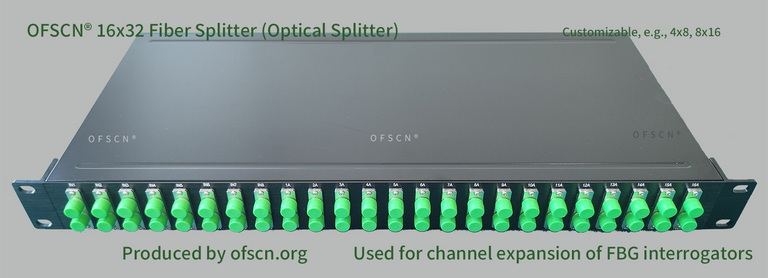
Key Parameters and Features:
- Multi-channel Specifications: Common configurations include 1x32 splitters, 8x16 splitters, 4x8 splitters, 32x64 splitters, etc.
- Primary Use: In large-scale engineering projects, it complements OFSCN® Fiber Bragg Grating (FBG) demodulators. By logically expanding a single physical channel into multiple, it significantly reduces the cost per channel of equipment (wavelength planning requires rigorous physical design due to channel expansion).
- Temperature Resistance: Standard use at ambient temperature. High-temperature splitter products resistant to 250\text{ }^{\circ}\text{C} can also be custom-ordered upon request.