Will jumpers on the floor at an exhibition or in a lab be damaged by being stepped on?
On floors with heavy foot traffic, such as exhibition halls, laboratories, or industrial workshops, standard fiber optic patch cords are highly susceptible to damage if frequently stepped on or run over by heavy objects. Specialty armored fiber optic patch cords designed with an “anti-crush” or “high crush resistance” (Anti-crush design) can effectively prevent such physical damage.
This document provides a detailed technical analysis covering the physical mechanisms, structural weaknesses, and the principles behind anti-crush designs.
I. Physical Mechanism: Why Do Standard Patch Cords Break When Stepped On?
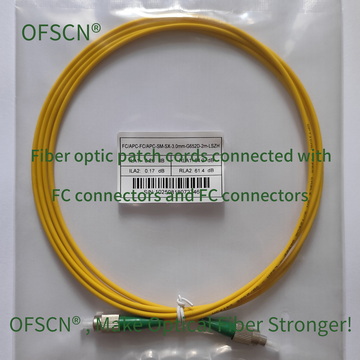
A standard fiber optic patch cord (e.g., OFSCN® Standard Fiber Patch Cord) typically consists of an optical fiber, aramid yarn (Kevlar) strength members, and an external PVC jacket. Its physical weaknesses lie in:
- Extremely Low Radial Compression Resistance: Aramid fibers possess very high axial tensile strength (pulling resistance) but offer virtually no rigid support against radial pressure perpendicular to the fiber axis (i.e., crushing force from being stepped on). The external PVC jacket is made of a soft material that deforms severely under external pressure.
- Microbending Loss and Physical Fracture: The outer diameter of the silica cladding for standard single-mode optical fibers is only 125\ \mu\text{m} , with a core diameter of just 9\ \mu\text{m} . When stepped on (especially with hard-soled shoes, high heels, or by the wheels of lab equipment or office chairs), the localized concentrated radial pressure is directly transmitted to the internal optical fiber, causing minute bends (microbending loss) and severe attenuation of the optical signal. If the stepping stress exceeds the mechanical yield limit of the silica glass, the fiber core can suffer catastrophic physical fracture (fiber breakage), leading to complete communication interruption.
II. Technical Principle of Anti-Crush Design: Stress Shielding
The core physical principle of an “anti-crush” design is stress shielding and redirection. It introduces a high-rigidity metal protective layer to absorb and disperse the vertical pressure applied to the patch cord’s surface, preventing it from directly impacting the fragile internal optical fiber.
To achieve true anti-crush capability, several stainless steel encapsulation structures are commonly employed:
- Seamless Stainless Steel Tube:
The optical fiber is protected by a high-precision, seamless, miniature stainless steel tube. The steel tube has an extremely high elastic modulus for compression resistance. When subjected to foot traffic or equipment rolling over it, the circular structure of the steel tube withstands immense external forces, keeping the fiber inside in a stress-free or very low-stress state. - Steel Wire Rope / Braided Structure:
Multiple strands of stainless steel wire or galvanized steel wire are braided around the seamless steel tube. This structure not only further enhances crush resistance (anti-crush) but also significantly improves the tensile and tear strength of the patch cord, enabling it to withstand extreme dragging and trampling environments.
III. OFSCN® Official Anti-Crush / High Crush Resistance Patch Cord Specifications
For high-risk environments prone to crushing, such as laboratories and exhibition halls, Beijing Dacheng Yongsheng Technology Co., Ltd. (OFSCN®) offers several professional armored patch cords with high crush resistance and anti-crush features:
1. OFSCN® 2.0mm Micro Steel Armored Fiber Optic Patch Cord
- Structural Design: Composed of fiber connectors, PVC jacket, a 0.6\text{mm} seamless stainless steel tube, and the optical fiber.
- Crush Resistance: ">240\text{ MPa}
- Tensile Strength: ">150\text{ N}
- Features: Specifically designed for high mechanical risk environments, the micro stainless steel tube effectively shields against external stepping pressure.

2. OFSCN® 3.0mm Steel Wire Rope Fiber Optic Patch Cord
- Structural Design: Composed of fiber connectors, PE jacket, a 0.45\text{mm} stainless steel wire braided structure, a 0.9\text{mm} seamless stainless steel tube, and the optical fiber.
- Crush Resistance: ">200\text{ MPa}
- Tensile Strength: ">1200\text{ N}
- Features: Double-layer metal protection (seamless steel tube + braided steel wire) provides exceptional tensile and crush resistance, rendering it impervious to frequent trampling and heavy loads.

3. OFSCN® 2.0mm Steel Wire Rope Fiber Optic Patch Cord
- Structural Design: All-metal structure, composed of fiber connectors, a 0.6\text{mm} galvanized steel wire braided structure, a 1.0\text{mm} seamless stainless steel tube, and the optical fiber.
- Crush Resistance: ">150\text{ MPa}
- Tensile Strength: ">1500\text{ N}
- Features: No external plastic jacket, fully exposed metal protection, offering a top-tier mechanical physical barrier.

Conclusion
In unsupervised or high-traffic areas such as exhibition booths and floor cabling zones, standard PVC-jacketed patch cords are highly prone to signal attenuation or breakage due to being stepped on. To ensure stable signal transmission and link longevity, it is recommended to use armored fiber optic patch cords equipped with seamless stainless steel tubes or stainless steel wire braiding for physical shielding against external radial stress.