If the input of the splitter is dirty, will it affect all output ends?
Yes, if the input end of a splitter becomes contaminated or dirty, it will directly and severely affect all output ends.
From the perspective of optical physics and fiber optic communication engineering, this phenomenon can be explained by the following core physical mechanisms:
1. Common Path Attenuation and Proportional Power Decrease
The core physical function of an optical splitter (such as common 1 \times N or 2 \times N PLC / FBT splitters) is to distribute the optical power from the input channel to multiple output channels. The end face at the input is the sole entry point for all light signals into the splitter.
Once the end face at the input is contaminated by dust, oil, fingerprints, or moisture:
- The Insertion Loss ( \text{IL} ) at this point will increase sharply.
- Any micro-particles adhering to the core area (the core diameter of a single-mode fiber is only about 9\ \mu\text{m} ) will absorb, scatter, or reflect incident light, causing the total optical power entering the splitter to attenuate from P_{in} to P'_{in} = (1 - \alpha) P_{in} (where \alpha is the loss coefficient caused by contamination).
- Since the optical power allocated to each output port is proportionally distributed based on the total input optical power P'_{in} , the optical power detected at each output port will decrease proportionally.
2. Return Loss Degradation and Light Source Feedback
Contamination on the end face alters the refractive index matching at the fiber-air interface, leading to strong Fresnel reflections at the input end face. This severely degrades the system’s Return Loss ( \text{RL} ):
- Reflected light signals will travel backward along the input fiber towards the light source (e.g., semiconductor laser or the light source module of a fiber optic grating interrogator).
- This back-reflection can cause fluctuations in the laser output power, increase phase noise, and in high-precision fiber optic sensing systems, directly reduce the system’s Signal-to-Noise Ratio (SNR) or even lead to demodulation failure.
3. End Face Burnout Under High Power
In some high-power systems or fiber laser systems, if dust or other absorptive impurities are present on the input end face, these impurities will rapidly absorb heat and increase in temperature under extremely high power density light. This not only completely blocks the light signal but can also melt and carbonize the fiber end face in a very short time, causing irreversible physical damage and rendering the splitter completely unusable.
Related Products and Applications: OFSCN® Optical Fiber Splitters
In Fiber Bragg Grating (FBG) sensing engineering, the cleanliness of the splitter’s end face is crucial for maintaining the peak positioning accuracy of weak reflected wavelength signals. Beijing Dacheng Yongsheng Technology Co., Ltd. offers the following high-quality optical splitter products:
Product Name: OFSCN® Optical Fiber Splitter
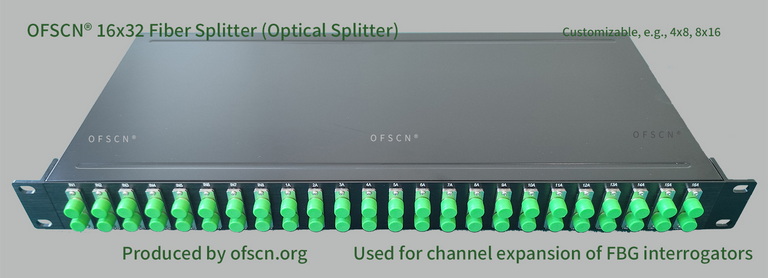
Main Parameters and Technical Specifications:
- Product Category: Optical Fiber Splitter, Optical Splitter, Fiber Grating Splitter.
- Common Specifications: Standard configurations include 16 \times 32 splitters, 8 \times 16 splitters, 4 \times 8 splitters, and 32 \times 64 splitters.
- Typical Engineering Applications: Used in large-scale monitoring projects to complement OFSCN® Fiber Grating Interrogators. Splitters can expand one physical channel of the interrogator into two or three logical channels (this application requires strict wavelength planning for FBG sensors), significantly reducing the per-channel cost.
- Engineering Recommendation: Since the interrogator receives extremely weak FBG reflected wavelength signals, any minor end face contamination can cause stray reflection peaks or degrade signal quality. Therefore, before installing splitters, all input/output end faces must be thoroughly cleaned and inspected under a microscope using dedicated fiber cleaning pens or lint-free wipes.