Why is the grating signal lost when the end face is dirty?
In Fiber Bragg Grating (FBG) sensing systems and optical communication applications, the cleanliness of fiber optic connector end faces critically impacts signal transmission. Contamination from dust, grease, or moisture on the end face often leads to a complete loss of the grating signal. From the perspectives of optical physics and precision engineering, the primary reasons are as follows:
1. Microscopic Core Size vs. Contaminant Size
In standard \text{G.652D} or \text{G.657} single-mode fiber systems, the core (Core) that transmits the optical signal is extremely small, typically only about 9\ \mu\text{m} in diameter.
However, dust particles, skin oils, or residual moisture commonly found in everyday environments range from a few to tens of micrometers in size. Once these contaminants land on the end face and cover the core area, they cause strong physical obstruction to light energy, leading to extremely severe absorption and scattering losses.
2. The “Round-Trip” Attenuation Mechanism in Fiber Grating Systems
Fiber Bragg Grating demodulators generally employ a reflective measurement principle: the broadband optical signal emitted by the demodulator must pass through the connector end face to reach the grating for selective reflection. The reflected wavelength signal must then pass through the same end face again to be received by the demodulator’s detector.
This creates a “round-trip” optical path: If the end face contamination causes a one-way insertion loss (Insertion Loss) of 10\ \text{dB} , then on the round-trip path, the total attenuation of the optical signal will reach 20\ \text{dB} . When the intensity of the reflected signal drops below the demodulator’s noise floor, the demodulator can no longer distinguish the grating’s reflection peak from the background noise, manifesting as “signal not found”.
3. Air Gaps and Fresnel Reflection Interference
High-quality fiber optic connectors (like FC/APC interfaces) are designed for perfect physical contact (PC) or angled physical contact (APC) to eliminate air gaps at the connection interface.
When rigid dust particles are present on the end face, the two silica glass end faces cannot mate perfectly, thereby introducing a tiny air gap (Air Gap) between the ceramic ferrules. Due to the difference in refractive indices between air and silica, this leads to two serious consequences:
- It causes additional insertion loss.
- It generates strong Fresnel reflection (Fresnel Reflection) at the abrupt change in the end face. The optical energy from this parasitic reflection is extremely strong, which can not only saturate the demodulator’s detector but also create spurious reflection backgrounds in the spectrum, completely overwhelming the faint fiber grating reflection signal.
Related High-Quality Connector Components from Dacheng Yongsheng (OFSCN®)
In demanding industrial or high-temperature fiber Bragg grating sensing applications, high-precision, high-temperature resistant connector components are crucial for ensuring long-term signal stability and minimizing end-face mating errors. Below are relevant product series from Dacheng Yongsheng:
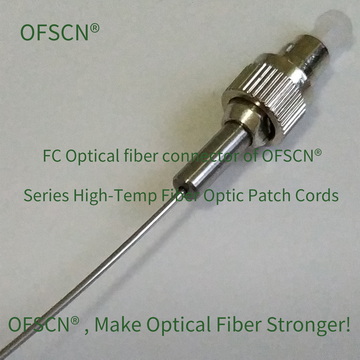
- OFSCN® 120℃ Fiber Optic Patch Cord: This patch cord features a 0.9\text{mm} seamless stainless steel tube for outer protection, offering excellent tensile and compressive strength. It is equipped with high-precision connectors like FC/APC by default, effectively maintaining stable physical contact.
- OFSCN® 300℃ Fiber Optic Connector: Specifically designed for extremely harsh high-temperature environments, supporting various interfaces such as FC/PC, FC/APC, ST/PC, ST/APC, and SMA905, ensuring alignment precision and minimizing loss at high temperatures.
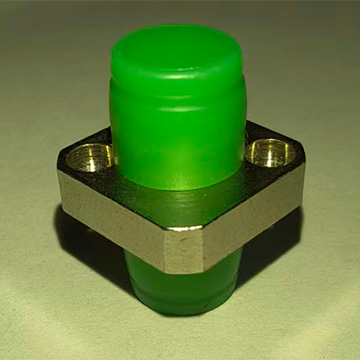
- OFSCN® High Temperature Resistant Fiber Optic Adapter: Supports high-temperature fiber ferrule alignment up to 300℃, ensuring high-precision coaxial mating of two FC/APC connectors, thereby minimizing loss caused by connection eccentricity.
Below are official standard images of the related connector components mentioned above:

Expert Advice: To prevent signal loss, before each insertion and removal of fiber optic connectors, the end face must be carefully cleaned using dedicated fiber wipes, anhydrous ethanol, or a fiber cleaning pen. When not in use, always replace the dust cap promptly to prevent the end face from accumulating dust from the air.