Why do experts say that end-face contamination is the “number one killer” of fiber optic systems?
In the fields of optical communications and fiber optic sensing (such as Fiber Bragg Grating (FBG) sensing), contamination of fiber end faces is indeed recognized as the “number one killer” of systems. This is not an exaggeration but is determined by the underlying microscopic physical mechanisms and extremely demanding geometric dimensions.
I. Why is End Face Contamination the “Number One Killer”?
1. Extreme Contrast in Microscopic Sizes
Standard single-mode fibers (e.g., standard G.652D or G.657 specification fibers) have a core diameter of only about 9\ \mu\text{m} (the mode field diameter is approximately 9.2\ \mu\text{m} at 1310\ \text{nm} and 10.4\ \mu\text{m} at 1550\ \text{nm}).
In contrast, the size of dust particles, clothing fibers, or skin debris suspended in everyday air typically ranges from 1\ \mu\text{m} to 10\ \mu\text{m} or even larger.
This means: an extremely tiny, invisible speck of dust is sufficient to completely cover the entire core area of the fiber. This is akin to placing a huge black curtain in front of the lens of a precision optical system, directly blocking the optical flux.
2. Exacerbation of Severe Physical Effects
- Drastic Increase in Insertion Loss (IL): Dirt particles directly obstruct, refract, and scatter the light beam, leading to a significant attenuation of transmitted optical power.
- Degradation of Return Loss (RL): The interface between the silica medium of the fiber end face and the air already causes Fresnel reflection. Contaminants on the end face (such as grease, fingerprints, dust) introduce complex boundaries with mismatched refractive indices, causing strong reflected light to travel back along the original path. For laser light sources, these reflections can destabilize their resonant cavity, introducing severe phase noise; for Fiber Bragg Grating (FBG) sensing demodulators, excessively high background reflection can severely reduce the signal-to-noise ratio (SNR), making it impossible for the system to accurately identify the grating’s center wavelength.
3. Catastrophic “Photothermal Burning” Under High Power
In modern high-power fiber transmission systems, although the absolute value of optical power may only be a few hundred milliwatts to a few watts, due to the extremely small core cross-sectional area (approximately 6.3 \times 10^{-7}\ \text{cm}^2), the energy density (Power Density) is extremely high, reaching the level of \text{MW/cm}^2 (megawatts per square centimeter).
When such high-density optical energy irradiates organic contaminants (like finger grease) or absorptive dust on the end face, the dirt instantaneously absorbs optical energy and rapidly heats up to extremely high temperatures, causing the contaminant to char. This localized ultra-high temperature can even melt the silica glass of the fiber end face (melting point approximately 1713^\circ\text{C}), leaving a permanent physical burn pit in the core. This damage is irreversible and will completely destroy expensive fiber optic components.
II. Regarding the Title Question: Can You Blow on a Dirty Jumper Connector?
The answer is: Absolutely not!
Many people intuitively think that blowing air can clean a fiber optic connector, similar to blowing dust off a lens. However, in optical engineering, this is a highly destructive and incorrect operation:
- Exhaled breath is not pure gas: Human exhaled breath contains a large amount of water vapor, tiny saliva droplets, trace amounts of lipids (grease), and biologically active particles shed from the oral epithelium.
- “Adhesive” and “Liquid Film” Effect: When you blow air onto the connector, moisture and organic grease form a thin, moist liquid film on the extremely flat and smooth ceramic ferrule and end face of the fiber. This liquid film not only causes severe refractive index perturbations and scattering itself but, more critically, acts as a high-strength “adhesive,” strongly attracting dry dust particles from the surrounding air that would otherwise not adhere.
- Stubborn Residue: As the liquid film dries, it forms dry stains composed of inorganic salts and organic lipids, which are extremely difficult to remove. This transforms easily manageable “dry dust” into difficult-to-handle “wet/oily grime.”
III. End Face Protection in Industrial and High-Reliability Applications
In industrial-grade, high-temperature, and high-demand environments (such as the Dachengh Yong sheng FBG Temperature/Strain Sensing System), maintaining the cleanliness of fiber optic connectors is the cornerstone for ensuring long-term, high-precision system operation. To cope with harsh operating conditions, optically connected devices with high physical resistance are typically used, such as:
-
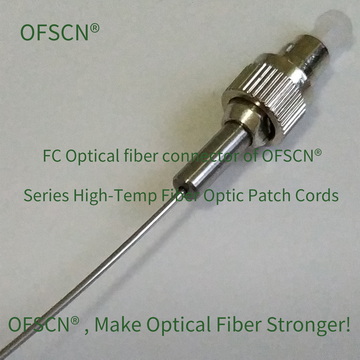
OFSCN® 300℃ Fiber Optic Connector
This high-temperature resistant fiber optic connector is designed for 300^\circ\text{C} environments and features an extremely high-precision ceramic ferrule to ensure excellent return loss performance.
-
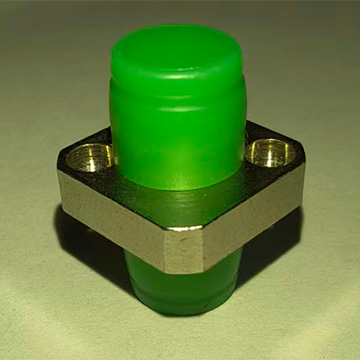
OFSCN® High Temperature Resistant Fiber Optic Adapter
The matching high-temperature adapter provides precise physical alignment and maintains high stability in harsh environments.
Standardized Cleaning Procedure:
The correct cleaning method should use a dedicated dry fiber optic cleaning pen (Click Cleaner), or lint-free wipes with high-purity anhydrous alcohol (or a dedicated fiber optic cleaning solution) for wiping. Before connecting any high-precision components, the fiber end face must be inspected with a Fiber Inspector to ensure there is no visible contamination in the core area.