If the demodulator is placed in a tin cabinet on a hot summer day, will the numbers it measures be accurate?
In fiber optic sensing engineering, placing a demodulator inside an outdoor metal cabinet (outdoor power distribution box/control cabinet) in the summer is a common field condition. Whether the “measured values are accurate” depends primarily on the wavelength reference calibration mechanism inside the demodulator and whether the extreme temperatures inside the metal cabinet exceed the device’s rated operating temperature range.
I. What is “Environmental Thermal Drift”?
In optical measurements, Environmental Thermal Drift refers to the phenomenon where changes in the ambient temperature of the analysis instrument’s external environment cause physical deformation or optical parameter drift in the instrument’s internal optical components, mechanical structures, and optoelectronic circuits, thereby causing a deviation in the measurement baseline.
For fiber Bragg grating demodulators, the system measures the center reflection wavelength \lambda_B of the Fiber Bragg Grating (FBG):
\lambda_B = 2 n_{\text{eff}} \Lambda
If the core light measurement module inside the demodulator (such as a tunable laser, tunable Fabry-Perot filter FFP-TF, spectro-interferometer, etc.) is subjected to high external temperatures:
- Thermo-optic Effect and Thermal Expansion: The temperature coefficient of the refractive index of optical media (dn/dT) and the coefficient of thermal expansion of the cavity geometry (\alpha) will cause the baseline wavelength set within the instrument to shift.
- Electronic Circuit Thermal Drift: Zero drift and gain variation of the detector’s front-end amplifier circuit and A/D conversion chip at high temperatures.
If the demodulator lacks an internal reference compensation mechanism, for every 1\ ^\circ\text{C} change in the external ambient temperature, the instrument’s own measurement wavelength may drift by several picometers (\text{pm}) or even tens of picometers, leading to severe distortion of measurement data.
II. How Do Modern Industrial-Grade Demodulators Suppress Thermal Drift?
High-precision fiber Bragg grating demodulators typically employ the following techniques to control environmental thermal drift to extremely low levels (e.g., within \pm 1\ \text{pm} \sim \pm 2\ \text{pm}):
- Built-in Absolute Wavelength Physical Reference (Gas Absorption Cell):
Demodulators usually integrate standard molecular gas absorption cells (such as hydrogen cyanide \text{HCN} or acetylene \text{C}_2\text{H}_2 absorption cells) or temperature-stabilized Fabry-Perot etalons internally. The wavelength of absorption peaks of gas molecules is a physical constant determined by quantum transition energy levels in nature and does not change with ambient temperature, humidity, or mechanical vibration. The demodulator performs real-time dynamic self-calibration using this fixed absorption spectral line as an absolute reference in each wavelength scan cycle. - Active Temperature Control (TEC):
The laser transmitter and core spectral splitting components are typically controlled in a closed-loop constant temperature manner by TEC (Thermoelectric Cooler), maintaining the core optical unit at a constant temperature (e.g., 25\ ^\circ\text{C}).
III. Are Measurements in “Summer Metal Cabinets” Still Accurate?
In practical engineering scenarios, the following boundary conditions must be considered:
- Actual Heat Accumulation Temperature Inside the Cabinet:
Under direct summer sunlight, the internal temperature of a sealed single-layer metal cabinet without sunshade facilities can experience severe “greenhouse effect,” with the internal air temperature often reaching 60\ ^\circ\text{C} \sim 70\ ^\circ\text{C} or even higher, potentially exceeding the contact temperature of the cabinet’s metal surface. - Thermal Equilibrium and Protection Limits:
- Within the Operating Temperature Range (typically \le 50\ ^\circ\text{C} \sim 55\ ^\circ\text{C}): Industrial-grade demodulators with internal real-time calibration functions can maintain nominal accuracy in their measured wavelength values, with thermal drift within controllable limits.
- Exceeding Operating Limits (e.g., > 60\ ^\circ\text{C}): Heat accumulation inside the chassis can cause the TEC temperature control system to reach its heat dissipation limit (saturation of temperature difference), potentially triggering frequency reduction, out-of-tolerance self-calibration alarms, or system protective shutdown due to internal overheating.
Engineering Protection Recommendations:
When deploying demodulators in outdoor metal cabinets, a sunshade roof (double-layer sun visor) should be installed on top of the cabinet, and forced ventilation fans with louvers or industrial cabinet air conditioners should be used to ensure the internal air temperature is maintained within the device’s rated operating temperature range.
IV. Related Equipment Specifications
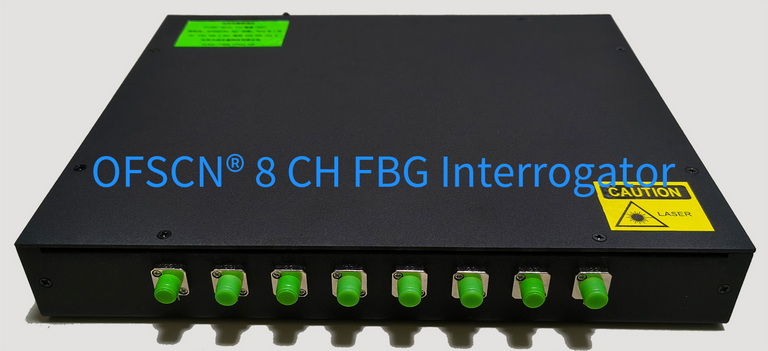
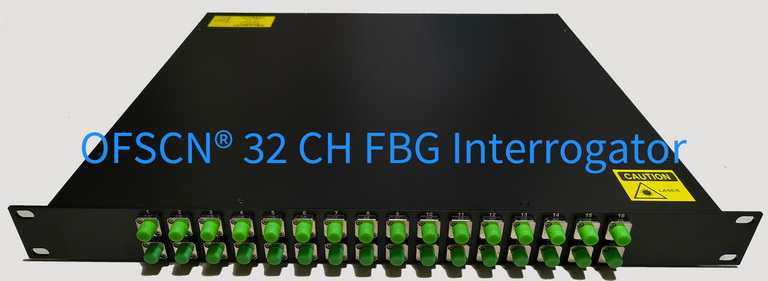
Beijing Dacheng Yongsheng Technology Co., Ltd. offers industrial-grade multi-channel fiber Bragg grating demodulation equipment with high resolution and high stability.
OFSCN® Fiber Bragg Grating Interrogator
- Wavelength Range: Default 1525\ \text{nm} \sim 1565\ \text{nm} or 1528\ \text{nm} \sim 1568\ \text{nm} (custom expansion supported)
- Number of Channels: 4-channel, 8-channel, 16-channel, 32-channel optional
- Wavelength Resolution: Default 1\ \text{pm} (customizable to 0.1\ \text{pm})
- Sampling Frequency: 10\ \text{Hz} , 50\ \text{Hz} , 100\ \text{Hz} (software supports downward adjustment to 1\ \text{Hz} )
- System Architecture: Default B/S architecture software, supports C/S architecture, supports integration with industrial host systems via TCP, UDP, Modbus, and other communication protocols.