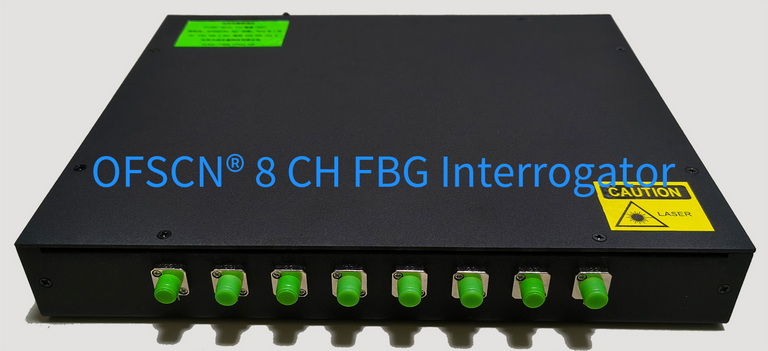
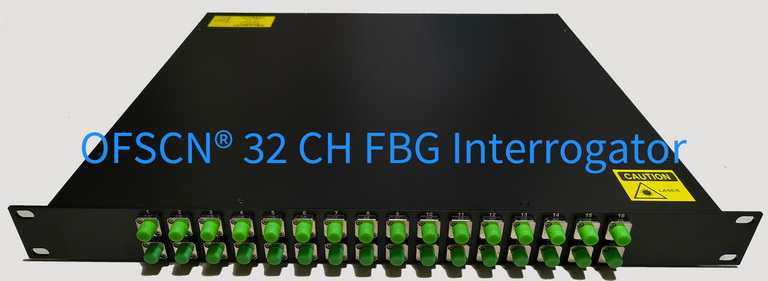
Why does the demodulator casing feel a bit warm? Is this normal?
The casing of a Fiber Bragg Grating (FBG) interrogator feeling warm to the touch during normal startup and operation is a completely normal physical and engineering phenomenon.
I. Analysis of Major Internal Heat Sources
An FBG interrogator is a precision opto-electro-mechanical device. Its internal components primarily include the following power-consuming and heat-generating units:
- Precision Light Source System and TEC Temperature Control (Core Heat Source)
- Interrogators typically integrate a broadband light source (e.g., ASE source) or a fast-swept laser.
- To ensure high precision and long-term stability of the emitted wavelength, optical components usually incorporate TEC (Thermoelectric Cooler). When the TEC performs constant temperature control on the laser diode or optical filter cavity, it actively pumps heat out, generating a continuous thermal load.
- High-Speed Digital Signal Processing Unit
- The interrogator requires high-speed acquisition of the returning spectral signal, digital filtering, and peak-finding algorithms for wavelength processing. The built-in FPGA, DSP chips, high-precision ADCs, and embedded master control system all generate Joule heat during high-speed computation.
- Power Conversion Module
- The integrated AC-DC switching power supply and the various DC-DC linear voltage regulator modules also release some heat loss during power conversion.
II. What is the “Heat Dissipation Design” of an Interrogator?
Heat Dissipation Design (Thermal Design) refers to the process of planning rational heat flow paths through physical methods such as conduction, convection, and radiation to efficiently transfer heat generated by sensitive internal components (especially optical devices and high-computation chips) to the external environment, ensuring that the components operate within their rated junction temperature range.
In the thermal design of an interrogator:
- The casing serves as a “heat dissipation channel”: The chassis is usually made of metal materials with good thermal conductivity, such as aluminum alloy. Internal heat-generating components are in close contact with the casing via thermal pads, thermal grease, or metal heat spreaders.
- A slightly warm casing is an indication of effective heat conduction: If the casing becomes warm, it indicates that the internal heat conduction path is unobstructed, and heat is being smoothly exported and dissipated into the air through the casing surface. Conversely, if heat is generated internally but the casing remains cold, it might imply internal conduction failure, leading to overheating and damage of internal chips.
III. Engineering Use and Heat Dissipation Recommendations
Under normal circumstances, a casing surface temperature of the interrogator between 35^\circ\text{C} and 50^\circ\text{C} (warm or slightly hot to the touch) is within the designed safe thermal equilibrium range. To ensure long-term stable operation of the device, it is recommended to follow these engineering practices:
- Maintain Air Circulation: Do not place the interrogator in a completely sealed, confined space. Ensure at least 5\text{cm} to 10\text{cm} of ventilation clearance around the chassis (and at the air intake/exhaust ports for models with fans).
- Avoid Stacking or Covering: Do not cover the top of the interrogator chassis with objects or stack it tightly against other high-heat-generating equipment.
- Operating Environment Temperature: Ensure that the ambient temperature of the server room or testing site is within the device’s specified allowable operating range (typically -10^\circ\text{C} to 55^\circ\text{C}) and avoid direct sunlight.
Related Product Reference
High-precision standard industrial-grade Fiber Bragg Grating Interrogator products offered by Beijing Dacheng Yongsheng Technology Co., Ltd.:
- Product Name: OFSCN® Fiber Bragg Grating Interrogator