Can a demodulator work in an outdoor cabinet in the middle of summer?
From the perspective of optical engineering and instrument environmental adaptability, direct operation of fiber Bragg grating demodulators in outdoor cabinets during summer poses a high risk and is generally not recommended without active temperature control or forced cooling measures.
Specific reasons and engineering analysis are as follows:
I. What is “Operating Temperature Range”?
Operating Temperature Range refers to the ambient temperature range around the equipment within which the instrument can operate while satisfying all its nominal technical specifications (such as wavelength measurement accuracy, resolution, signal-to-noise ratio, and long-term stability).
When the ambient temperature exceeds this range:
- Measurement data may experience wavelength drift or accuracy degradation;
- The equipment may trigger over-temperature protection mechanisms and shut down automatically;
- Prolonged operation under excessively high temperatures accelerates the aging of optical and electronic components, potentially causing permanent physical damage.
II. Physical Thermal Environment of Outdoor Cabinets in Summer
Under strong summer sunlight, outdoor sealed cabinets (such as metal distribution boxes or monitoring boxes) experience significant solar radiation temperature rise and greenhouse effects:
- When the outdoor ambient temperature is 35^\circ\text{C} \sim 40^\circ\text{C}, the internal temperature of metal cabinets without special insulation or forced heat dissipation can often climb to 60^\circ\text{C} \sim 75^\circ\text{C} or even higher.
- The demodulator itself generates continuous heat during operation (mainboard, power supply, internal laser, and driver circuits), further exacerbating heat accumulation inside the cabinet.
III. Impact of High Temperatures on the Demodulator’s Core Optical Components
Standard fiber Bragg grating demodulators integrate high-precision optoelectronic and microelectromechanical/spectroscopic modules:
- Internal Laser Source and TEC Temperature Control Limits:
The semiconductor laser or tunable light source within the demodulator is typically maintained at a constant temperature by an internal Thermoelectric Cooler (TEC). When the ambient temperature is excessively high, the temperature difference across the TEC’s heat dissipation sides becomes too large, exceeding its cooling limit, leading to fluctuations in the light source’s wavelength and optical power. - Spectral Calibration Reference Drift:
Internal wavelength reference components (such as gas absorption cells or standard FBG reference standards) may exceed their compensation linearity range under extreme temperatures, causing a decrease in the system’s measurement accuracy.
IV. Engineering Recommendations and Solutions
In actual field monitoring projects, the following two engineering solutions are typically employed for demodulator high-temperature protection:
-
Leveraging Fiber Optic Remote Transmission (Recommended Solution)
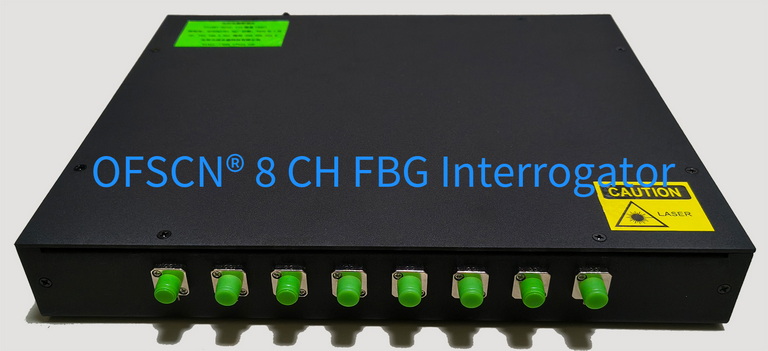
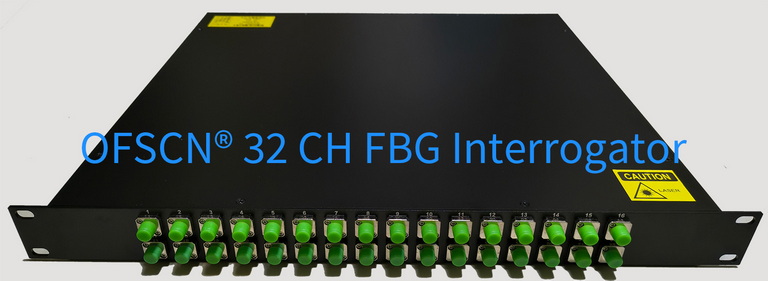
A key advantage of fiber optic sensing technology is its long-distance, low-loss transmission. In the field, only passive “fiber Bragg grating sensors” and “armored optical cables” are deployed in the harsh outdoor environment. The OFSCN® Fiber Bragg Grating Interrogator is installed in an indoor machine room, monitoring station, or control room with constant temperature and ventilation, collecting signals remotely via hundreds of meters to several kilometers of optical cable. -
Outdoor Cabinet Environmental Control Solutions
If deployment within an outdoor cabinet is necessary, the cabinet must be equipped with appropriate thermal design:- Install dedicated industrial air conditioners or heat exchangers for the cabinet:
Strictly control the internal working environment within the equipment’s nominal operating temperature range (typically 0^\circ\text{C} \sim 50^\circ\text{C}). - Sunshade and Insulation Design:
Install sunshades to block direct sunlight, use a double-layer insulated cabinet structure, and equip it with temperature-controlled, linked fans for ventilation.
- Install dedicated industrial air conditioners or heat exchangers for the cabinet:
Related Products
For hardware specifications and parameters of Beijing Dacheng Yongsheng Technology Co., Ltd.'s standard demodulators, please refer to the official product page: