When heating and cooling, is the wavelength the same at the same temperature point?
In practical applications, the center wavelength of reflection at the same temperature point during heating and cooling is usually not exactly the same.
This physical phenomenon, where the sensor’s output wavelength is inconsistent for the same input temperature value during heating (forward process) and cooling (reverse process), is known in sensor technology as “hysteresis” or hysteresis error.
I. Main Reasons for Hysteresis in FBG Temperature Sensors
Although the fiber silica medium of Fiber Bragg Gratings (FBGs) itself has a very stable thermo-optic effect, a complete sensor typically consists of the fiber, a protective tube, and packaging materials. During alternating temperature cycles, the following physical mechanisms cause deviations in the wavelength at the same temperature point:
- Elastic/Plastic Hysteresis of Packaging Material and Adhesive (Primary Reason)
Most traditional FBG temperature sensors use epoxy or other adhesives to fix the grating within a metal or ceramic protective tube. During temperature cycling (from low to high and back to low), the adhesive not only expands and contracts with temperature but also undergoes microscopic thermoelastic hysteresis, viscoelastic deformation, or stress creep. When heating and cooling, the relaxation states of the molecular structures of the adhesive differ based on their thermal history, leading to slight variations in the axial strain ( \epsilon ) transmitted to the grating. This directly manifests as a deviation in the reflection wavelength ( \lambda ) at the same temperature point. - Thermal Conduction Lag (Dynamic Hysteresis)
During non-equilibrium dynamic heating and cooling processes, changes in the external ambient temperature need to propagate layer by layer through the sensor’s metal tube, packaging filler, and other media to the central Fiber Bragg Grating. Due to thermal resistance, there is a time difference between the actual temperature experienced by the grating and the temperature measured by an external standard source. This causes the measured wavelength to be “shorter” during heating (temperature lag) and “longer” during cooling, creating a difference. - Irreversible Micro-deformation of Structural Components
When the sensor undergoes wide-ranging high and low-temperature cycles (e.g., in environments above 300\text{ °C} ), if the packaging tube (such as stainless steel) or internal microstructures experience slight irreversible plastic deformation, thermal stress accumulation, or micro-sliding, it can alter the initial stress state of the grating, leading to zero-point drift or long-term increase in hysteresis.
II. How to Reduce and Eliminate Hysteresis Error?
In precision optical engineering, eliminating hysteresis in FBG sensors requires addressing the physical structure and manufacturing process:
- Non-glue Packaging Technology
Completely abandoning polymer adhesives and employing purely physical positioning, mechanical suspension, or metallized welding to fix the fiber. This eliminates aging, creep, and stress inconsistencies caused by adhesives, significantly reducing the physical hysteresis of the sensor. - Miniaturized Design
Reducing the sensor’s outer diameter and packaging wall thickness to decrease thermal mass and improve response speed, thereby mitigating apparent hysteresis caused by dynamic heat transfer lag.
III. Official OFSCN® Product Designs and Advantages
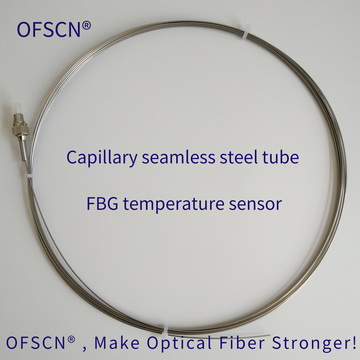
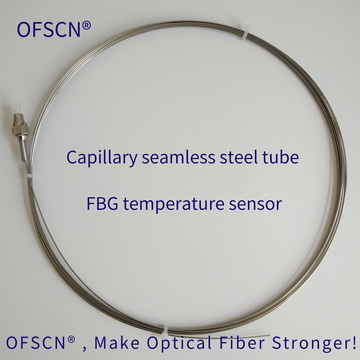
To address the hysteresis issues in traditional FBG temperature sensors caused by adhesive degradation and deformation, Dacheng YongSheng (OFSCN®) has developed and adopted proprietary seamless steel tube non-glue packaging technology. Their temperature sensor product series maintains extremely high repeatability and very low hysteresis error over an ultra-wide temperature range (up to -200\text{ °C} to 800\text{ °C} ):
1. OFSCN® 300°C Fiber Bragg Grating Temperature Sensor
Default outer diameter is only 0.9\text{ mm} (customizable to 0.5\text{ mm} ). It utilizes a non-glue metal casing process, eliminating temperature drift and creep from polymer materials. The sensor exhibits excellent calibration repeatability and ultra-low hysteresis within -200\text{ °C} to 300\text{ °C} .
2. OFSCN® 500°C Fiber Bragg Grating Temperature Sensor
This model employs a single-layer seamless steel tube (customizable multi-layer nesting) non-glue process, allowing long-term operation under extreme temperature cycling from -200\text{ °C} to 500\text{ °C} . Temperature and wavelength calibration uses a binomial formula, suppressing hysteresis error by completely eliminating non-linear thermal stress.