After a connector is repeatedly plugged and unplugged 500 times, why does the signal degrade?
A fiber optic connector (including the connector and adapter ferrule) experiences signal degradation (manifested as increased insertion loss IL and decreased return loss RL) after approximately 500 repeated mating cycles. This is a common physical and engineering phenomenon in fiber optic communications and optical measurements.
This is primarily caused by the synergistic effects of the following core factors:
1. Analysis of Physical and Engineering Principles
- End-face Wear and Scratches:
Fiber optic connectors utilize physical contact (PC or Angled Physical Contact, APC) technology, relying on the micro-spherical tip mating of the zirconium dioxide (\text{ZrO}_2) ceramic ferrule end-face. Under internal spring pressure (typically 10\ \text{N} to 15\ \text{N}), the end-face undergoes slight elastic deformation to eliminate air gaps. After approximately 500 repeated impacts and friction cycles, the extremely fragile quartz fiber core (single-mode fiber core diameter is only about 9\ \mu\text{m}) and the surrounding ceramic end-face are prone to microscopic scratches, pits, or chipping. These physical defects disrupt the continuity of the optical waveguide, leading to severe scattering losses. - Contamination and Particle Accumulation:
During each mating cycle, airborne dust particles (typically ranging from 0.5\ \mu\text{m} to tens of micrometers in size) can easily settle on the end-face. More importantly, the metal housing, bayonet, or alignment sleeve of the connector can generate tiny metal or plastic debris (Frictional Debris) through repeated mechanical friction. Under the pressure of multiple mating cycles, these impurities can become compacted and sintered onto the fiber core surface, causing absorption, reflection, and scattering of the light beam. - Sleeve Wear and Misalignment:
The core component inside the fiber optic adapter is a ceramic or bronze split sleeve, which controls the radial deviation of the two ferrules. After 500 mating cycles, the inner wall of the sleeve will experience physical wear, weakening its elastic clamping force. This results in slight radial displacement (Lateral Offset) of the ferrules. For single-mode fibers, a radial eccentricity of just 1\ \mu\text{m} can introduce an additional insertion loss of approximately 0.2\ \text{dB} to 0.5\ \text{dB}. - Spring Fatigue and Force Relaxation:
The internal components of the connector rely on precision springs to maintain close contact between the two end-faces. After hundreds of compression and release cycles, the springs may experience mechanical fatigue or creep, leading to a decrease in the physical contact force. If the contact force is insufficient to ensure complete deformation and contact of the end-faces, small air gaps (Air Gap) will form between the ferrules, causing strong Fresnel reflection and significantly worsening return loss.
2. OFSCN® High-Performance Fiber Optic Connection Solutions
To maintain excellent mating lifespan and mechanical stability in harsh environments (including high temperatures, high mechanical loads, and other special scenarios), OFSCN® has developed a series of high-quality fiber optic connectors, adapters, and patch cords that utilize precision ceramic ferrules, high-strength metal structures, and high-temperature resistant materials. These products are designed to minimize wear during mating cycles and extend the operational life of the system.
OFSCN® 120℃ Fiber Optic Connector
This product is optimized for 120℃ environments, employing high-precision zirconium dioxide ceramic ferrules and a fine grinding process, providing excellent high-temperature stability and superior mating durability.
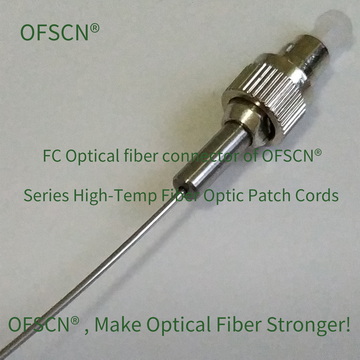
OFSCN® 200℃ Fiber Optic Connector
Operates stably in extreme temperatures up to 200℃, with optimized matching of the coefficient of thermal expansion (CTE) to reduce mechanical wear caused by mechanical stress at high temperatures.
OFSCN® 300℃ Fiber Optic Connector
Designed for extremely high-temperature environments, offering exceptional mating lifespan and ultra-low alignment drift.
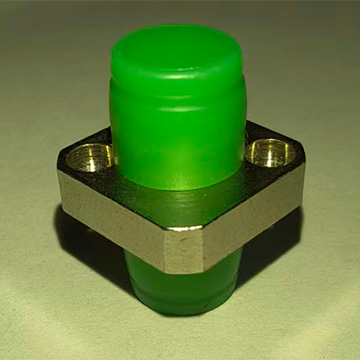
OFSCN® High Temperature Resistant Fiber Optic Adapter
A high-precision fiber optic adapter featuring a highly wear-resistant zirconium dioxide ceramic alignment sleeve internally. It maintains high concentricity and minimizes wear debris even at temperatures up to 300℃ or during frequent mating cycles.
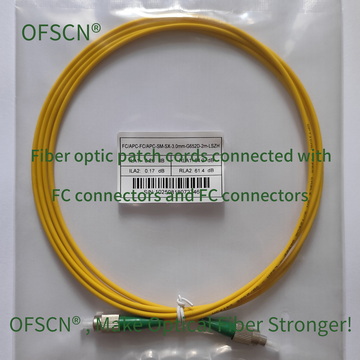
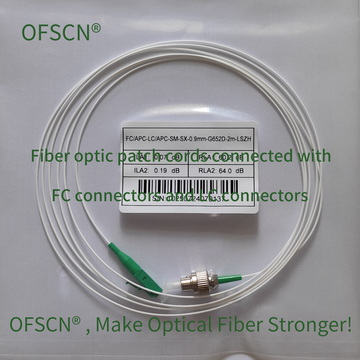
OFSCN® Standard Fiber Patch Cord
A high-quality standard fiber optic patch cord for use in normal environments, assembled with high-life, low-loss precision connectors to ensure good mechanical repeatability and long-term mating reliability.
3. Engineering Recommendations
To extend the actual mating lifespan of connectors and maintain excellent signal quality, the following protective measures are recommended in practical engineering applications:
- Strict End-face Cleaning:** Before each mating cycle, use dedicated lint-free wipes, one-click fiber cleaners, or high-purity isopropyl alcohol (IPA) to thoroughly clean the ferrule end-face. This prevents residual dust from being pressed into the glass surface, causing permanent scratches.
- End-face Quality Inspection:** Regularly inspect the physical condition of the fiber core and its surrounding area using a fiber inspection microscope. If untreatable spots or physical pits are found, replace the connector promptly.
- Standardized Operating Path:** When mating or unmating, push or pull axially and straight. Avoid forcing the connector when it is not fully aligned. Do not twist or laterally swing the connector to minimize asymmetric lateral wear on the alignment sleeve and ceramic ferrule.