Will an optical fiber connector be worn out and become unusable after being plugged and unplugged 500 times?
In fiber optics and engineering standards, a “Mating Durability of 500 cycles” does not imply that a fiber optic connector will be physically scrapped or rendered unusable on the 501st cycle.
This is a common misconception regarding testing standards in the telecommunications and optical sensing industries. Here’s an analysis from the perspectives of physical mechanisms, engineering standards, and actual service life:
1. Physical and Engineering Definition of “500 Mating Cycles”
According to standards from the International Electrotechnical Commission (IEC) (e.g., IEC 61300-2-2) and common industry specifications (e.g., Telcordia GR-326-CORE):
- Standard Definition: Mating Durability refers to the number of times a connector can be repeatedly plugged and unplugged under controlled and specified clean conditions (standard is typically 500 cycles, some designs are 1000 cycles) while its optical performance remains within specified limits.
- Pass/Fail Criteria: After 500 mating cycles:
- Change in Insertion Loss (IL): Typically required to be \Delta \text{IL} \le 0.2\ \text{dB} ;
- Return Loss (RL): Must still meet the corresponding grade requirements (e.g., APC end-faces usually require \text{RL} \ge 60\ \text{dB} ).
Therefore, 500 cycles represent a baseline for guaranteed performance and reliability testing, not an endpoint for physical failure.
2. Physical Wear Mechanisms During Mating
Fiber optic connectors (such as FC, SC, LC, etc.) rely on ceramic ferrules (typically high-hardness Zirconia ceramic, \text{ZrO}_2) for sub-micron alignment of the fiber core. Physical degradation during mating is primarily caused by the following factors:
- End-face Micro-abrasion and Plastic Deformation:
Physical Contact (PC / UPC / APC) end-faces rely on a continuous contact force applied by a spring within the ferrule (contact stress can reach tens to hundreds of \text{MPa}). Repeated mating can cause micro-abrasion in the contact area, slightly altering the radius of curvature (ROC) or the apex offset. - Elastic Fatigue of the Ceramic Sleeve:
The split alignment sleeve within the adapter (coupler) may experience slight attenuation of its clamping force after repeated opening and closing, potentially leading to a minor reduction in alignment coaxially. - Particle Contamination Causing Indentations and Scratches (Primary Failure Cause):
If not rigorously cleaned, microscopic dust particles from the environment, under the high pressure during alignment, can be crushed and cause irreversible deep scratches or pits on the surface of the quartz fiber (with a 125\ \mu\text{m} outer diameter). This is the primary reason for optical performance degradation.
3. Does a Connector Fail After 500 Cycles?
- Proper Operation and Regular Cleaning:
If a fiber end-face inspection device is used before and after each mating, and specialized dust-free cleaning tools are employed, high-quality Zirconia ceramic ferrule connectors can maintain good insertion loss and return loss even after 1000 or more mating cycles. - Improper Operation (Mating with Contamination / Mechanical Shock):
If the end-face has hard particles or is subjected to violent twisting or impact, it may lead to fiber core chipping or severe scratches after only a dozen mating cycles, causing a sharp increase in optical loss and premature failure. - Repairability:
If increased loss is caused by minor scratches on the ferrule end-face, the end-face profile can typically be restored by professional fiber end-face grinding and polishing processes, thus recovering its optical performance.
Related Product Reference
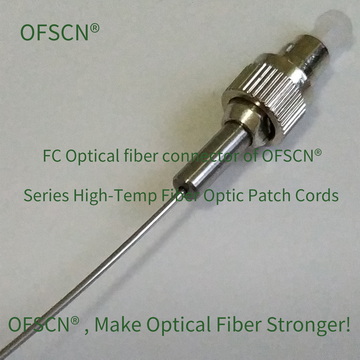
Beijing Dacheng Yongsheng Technology Co., Ltd. (OFSCN®) manufactures standard and high-temperature fiber optic patch cords and connectors that utilize high-precision Zirconia ceramic ferrules and precision metal structures to ensure optical alignment accuracy and mechanical durability under stringent environmental conditions: