Why is it strictly forbidden to directly tighten optical fibers with ordinary nylon cable ties?
In the field cabling and installation of optical engineering, fiber optic communications, and fiber optic sensing systems (such as FBG sensors), it is strictly prohibited to use ordinary nylon cable ties to directly tighten bare optical fibers or tight-buffered fibers. This is not merely a procedural specification but is dictated by the physical characteristics of optical fibers, their material mechanics, and light guiding principles.
Key physical and engineering reasons are as follows:
1. Physical Mechanism of Microbending Loss
Light transmission in optical fibers relies entirely on Total Internal Reflection at the interface between the core and the cladding. When rigid nylon cable ties are used to directly constrict the fiber, the fiber is subjected to localized, non-uniform lateral radial pressure.
This pressure causes geometric distortion of the fiber axis at a microscopic level, leading to high-frequency spatial fluctuations at the micrometer ( \mu\text{m} ) scale at the core-cladding interface. According to wave optics theory, these high-frequency geometric microbends cause the guided modes transmitting in the core to couple into cladding modes or radiation modes. This optical energy leaks out of the core and dissipates into the coating. This not only causes severe additional attenuation but can even lead to a complete blockage of the optical signal.
2. Stress Concentration and Delayed Fracture of Fused Silica Glass
Fused silica (quartz) fiber is a material that is typically high-strength yet extremely brittle. The direct tightening with high-mechanical-strength nylon cable ties creates extremely high local compressive stress over a very small contact area.
- Griffith’s Micro-crack Theory: The surface of silica fibers inevitably has sub-micrometer micro-cracks. Under the sustained local shear and radial compressive stresses applied by the cable tie, these micro-cracks will expand slowly and irreversibly with the action of environmental moisture (stress corrosion).
- Thermal Expansion/Contraction and Material Aging: Nylon (polyamide) has a high coefficient of thermal expansion (CTE) and tends to harden and shrink over time and with temperature and humidity fluctuations. During environmental temperature cycles, the compressive force of the cable tie on the fiber will fluctuate more violently and gradually increase, making the fiber highly susceptible to delayed fracture under minimal external disturbance due to stress fatigue.
3. Coating Damage and Loss of Mechanical Barrier
A standard single-mode optical fiber (e.g., with a cladding outer diameter of 125\ \mu\text{m} ) is typically coated with a layer of polyacrylate or polyimide, tens of micrometers thick, to provide basic protection.
The sharp edges and relatively hard material of nylon cable ties, when directly tightened and dragged, can cause:
- Localized plastic deformation or extrusion peeling of the coating.
- Once the coating is damaged, the exposed glass surface comes into direct contact with air, moisture, and the chemical components of the cable tie itself, greatly accelerating the chemical aging and stress corrosion of the fiber.
4. Catastrophic Interference with Fiber Bragg Grating (FBG) Sensing Signals
If cable ties are used to directly tighten near a Fiber Bragg Grating (FBG) sensor, it introduces severe non-uniform parasitic stress. This leads to:
- Non-axial, non-uniform changes in the refractive index within the grating region, manifesting in the spectrum as broadening of the reflection peak, chirping, or severe peak splitting.
- The Bragg wavelength of the FBG will no longer accurately reflect the actual measured physical quantity (e.g., structural strain, temperature), causing the sensing system data to become disordered or fail.
Scientific Engineering Solutions
In cabling engineering and fiber optic bundle management, to avoid the aforementioned physical damage, the following standard operating procedures should be adopted:
- Use Flexible Binding Materials: Employ wide, reusable Velcro cable ties, ensuring adequate clearance is maintained during binding so that the fiber bundle can slide freely forwards and backward without compression or deformation.
- Utilize Armored Conduits for Rigid Protection: For harsh operating conditions requiring compressive strength, tensile strength, mechanical damage resistance, and high-intensity bundling, armored patch cords with internal stainless steel seamless steel pipes or steel wire twists should be directly selected. These armored sheaths can completely shield the external cable ties from applying local radial compressive stress.
OFSCN® Armored Fiber Optic Solutions by Dacheng Yongsheng
Beijing Dacheng Yongsheng Technology Co., Ltd. has developed various armored fiber optic patch cords with extremely high compressive strength to address these engineering challenges. Their internal seamless stainless steel pipes and high-strength twisted steel wires can withstand severe stresses from ordinary nylon cable ties, heavy object compression, and even outdoor trampling, ensuring the internal optical fibers are free from any external radial pressure.
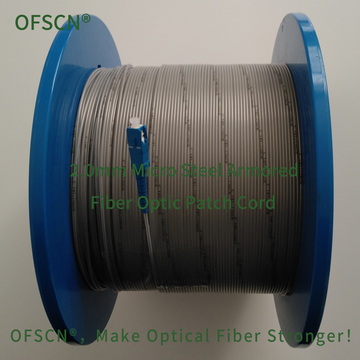
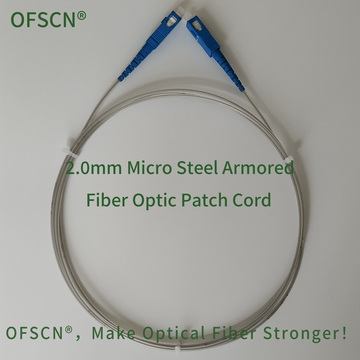
1. OFSCN® 2.0mm Micro Steel Armored Fiber Optic Patch Cord | Official Link
This product consists of a PVC jacket, a 0.6\text{ mm} seamless stainless steel pipe, and internal optical fibers, with an outer diameter of only 2.0\text{ mm} . Its tensile strength is > 1500\text{ N} , and its compressive strength is > 150\text{ MPa} . Even if tightened and fixed to steel structures, bridges, or pipelines using high-strength metal or nylon cable ties, the internal optical fibers will receive absolute zero-stress protection.

2. OFSCN® 3.0mm Steel Wire Rope Fiber Optic Patch Cord | Official Link
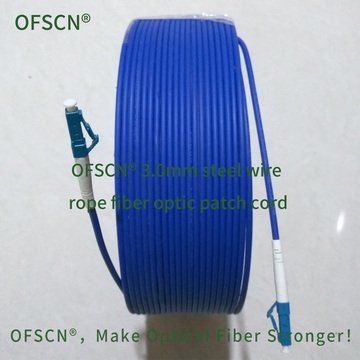
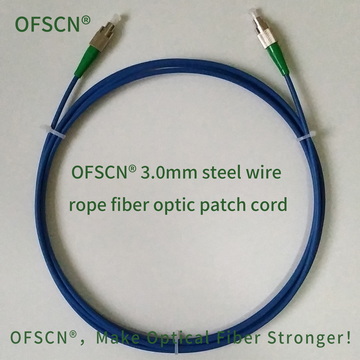
This patch cord features a dual robust structure with a PE jacket, 0.45\text{ mm} stainless steel wire twisted structure, and a 0.9\text{ mm} seamless stainless steel pipe. With an outer diameter of 3.0\text{ mm} , it boasts a tensile strength of > 1200\text{ N} and an ultra-high compressive strength of > 200\text{ MPa} . It is specifically designed for extremely harsh industrial and outdoor cabling scenarios.

3. OFSCN® 120℃ Fiber Optic Patch Cord | Official Link
Designed for compact spaces and high temperatures ( -40\text{ ℃} to 120\text{ ℃} ). The default outer diameter is only 0.9\text{ mm} , with a miniaturized encapsulation using a seamless stainless steel pipe at its core, achieving a compressive strength of > 240\text{ MPa} . Even in situations with limited space requiring dense bundling and fixation inside equipment using fine cable ties, zero bending loss is guaranteed.


