How can several-meter-long thin steel pipes be mailed without breaking?
In the engineering of fiber optic sensing and precision instrument manufacturing, micro-diameter stainless steel tubes (capillary steel tubes / Seamless Steel Tubes) several meters long with an outer diameter typically between 0.5\ \text{mm} \sim 2.0\ \text{mm} are classified as typically slender components with a large length-to-diameter ratio. The “packaging and transportation protection” for such tubes directly determines whether the product can be delivered intact.
I. Analysis of Physical Mechanisms and Causes of Damage
- Low Bending Section Modulus:
For a thin-walled steel tube with outer diameter D and inner diameter d, its cross-sectional bending stiffness depends on the bending section modulus W and the moment of inertia I:I = \frac{\pi (D^4 - d^4)}{64}Since stiffness is proportional to the fourth power of the outer diameter, when the tube diameter is less than 2\ \text{mm} and the length reaches several meters, the length-to-diameter ratio can be thousands of times. - Stress Concentration and Plastic Instability:
During logistics and transportation, goods are highly susceptible to lateral point loads, shear forces, or compression. When a thin steel tube is subjected to a transverse localized bending moment, it can easily exceed the material’s yield limit, resulting in irreversible local buckling (kinking/denting). - Risk of Internal Core Material Fracture:
In the field of fiber Bragg grating sensing (e.g., FBG sensors encapsulated in capillary steel tubes), the stainless steel tube contains a quartz fiber with an outer diameter of only 125\ \mu\text{m}. If the steel tube undergoes sharp kinking, the internal fiber will experience extreme shear and micro-bending stresses, leading to a significant increase in optical loss or even brittle fracture.
II. Core Engineering Protection Solutions to Prevent Breakage
For thin steel tubes several meters long, industry-standard “packaging and transportation protection” primarily employs the following two engineering methods:
Solution 1: Elastic Ring Coiling Method (Recommended First Choice)
- Principle: Micro-diameter steel tubes possess good elastic deformation capabilities under macroscopic, large radii of curvature. As long as the bending radius exceeds its critical plastic deformation radius, the steel tube will not yield and deform.
- Protective Implementation:
- Coil Diameter Control: Uniformly coil the thin steel tube into a ring following its natural orientation. The coil diameter is generally recommended to be controlled at 200\ \text{mm} \ \sim 300\ \text{mm} or larger (strictly greater than the minimum permissible static bending radius).
- Circumferential Soft Fixing: Lightly secure the ring at symmetrical points (e.g., 3 to 4 locations) using Velcro straps or wide tape to avoid excessive tightening that causes localized stress concentration.
- Planar Anti-vibration Packaging: Place the coiled steel tube flat in a custom EPE pearl foam grooved liner or a thick bubble wrap layer. Seal it in a rigid, flat corrugated cardboard box with top and bottom protective layers. This transforms the long component into a flat structural element, uniformly distributing stacking pressure from above and below.
Solution 2: Rigid Sleeve/Protection Tube Method (Applicable for Straight Tubes Requiring Strict Non-Bending)
- Principle: Place the micro-diameter steel tube within an outer high-rigidity structure, allowing the outer rigid casing to withstand external impacts and bending moments.
- Protective Implementation:
- Selection of Rigid Outer Tube: Use PVC tubes with thick walls, industrial paper tubes with thick walls, or aluminum alloy tubes with excellent bending resistance as the outer protective sleeve.
- Internal Limiting and Shock Absorption: Before inserting the thin steel tube into the sleeve, wrap it with a layer of thin bubble wrap or insert high-density foam plugs at both ends of the sleeve to prevent severe axial shaking or collision of the thin steel tube within the sleeve.
- Sealed Hard End Capping: Reinforce and seal both ends of the outer sleeve with dedicated engineering pipe caps. Apply warning labels such as “Do Not Fold, Do Not Step On” to the outer box.
III. Packaging and Engineering Practices for OFSCN® Products
In the manufacturing and delivery of fiber optic sensing products encapsulated in micro-diameter steel tubes (such as fiber Bragg grating temperature sensors, strain sensors, seamless steel tube fiber optic cables, etc.), Beijing Dacheng Yongsheng Technology Co., Ltd. (OFSCN®) has established strict “factory packaging and transportation protection standards” tailored to different wall thicknesses and tube diameters:
- Micro-diameter Stainless Steel Tube Temperature Sensor:
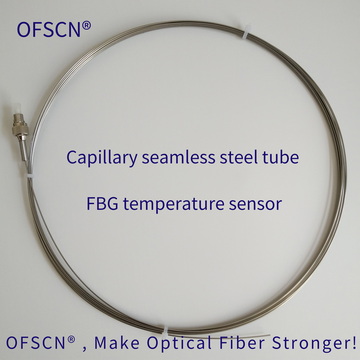
For example, the OFSCN® 300°C Fiber Bragg Grating Temperature Sensor, utilizes a standard single-layer stainless steel seamless steel tube encapsulation with an outer diameter of 0.9\ \text{mm}, and lengths ranging from several meters to tens of meters. It is shipped with a dedicated coiled protective tray and anti-vibration packaging to ensure the FBG sensing points are not damaged by external forces.
- Micro-diameter Steel Tube Armored Patch Cords and Sensing Tubes:
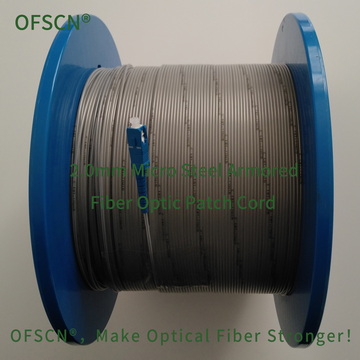
For instance, the OFSCN® 2.0mm Micro Steel Armored Fiber Optic Patch Cord, which contains a 0.6\ \text{mm} stainless steel seamless steel tube inside, is shipped coiled in a ring using a dedicated winding reel. For products requiring specific pre-stretching or rigid straight-tube delivery, such as the OFSCN® Alloy Tube Packaged Fiber Bragg Grating strain sensor, rigid specialized sleeve protection packaging is employed.
Summary: When shipping several-meter-long thin steel tubes, the minimum safe bending radius should be assessed based on the tube diameter. If it possesses elasticity, coiling it into a circular disk with a diameter of \ge 200\ \text{mm} \sim 300\ \text{mm} and placing it in a pearl foam cushioning box is the most secure method. If it must be kept straight, a thick-walled PVC tube or a rigid round paper tube must be used for full-length nesting during shipping.