How long does it take from powering on to data output? Does it support automatic restart after power failure?
In fiber optic sensing systems, System Boot Time / Power-up Time is a general engineering metric that involves electronic hardware, embedded systems, and optical measurement subsystems.
I. What is “System Boot Time”?
In a Fiber Bragg Grating (FBG) sensing interrogation system, the system boot time refers to: The complete time period from the moment the interrogator is powered on or the power switch is pressed, until the system completes all low-level initializations, optical self-checks, and thermal balancing, and begins to output valid physical measurement data (wavelength/temperature/strain, etc.) continuously and stably.
This process typically consists of the following stages:
- Hardware Power-up and Embedded System Boot (OS Boot): The power module supplies stable power, the microprocessor (such as ARM/DSP/FPGA or industrial PC architecture) boots up, loads the bootloader, and runs the low-level operating system and service processes.
- Optical and Temperature Control Module Self-Calibration (Optical Alignment & Thermal Stabilization): The fiber Bragg grating interrogator’s internal light source (such as a broadband light source or high-speed scanning laser), photodetector, and internal gas absorption cell/wavelength reference standard complete self-calibration. The internal temperature controller’s thermoelectric cooler (TEC) needs to stabilize the core optical components at their operating temperature to ensure that the measurement wavelength reaches the nominal resolution (e.g., 1\text{ pm} or 0.1\text{ pm}).
- Communication and Measurement Algorithm Ready (Data Acquisition & Communication Ready): The spectral interrogation algorithm is loaded into memory, the interrogator’s network interface (B/S architecture service, TCP/IP, UDP, or Modbus) completes port listening, and begins to continuously transmit data streams at the set sampling frequency.
II. How long does it take from pressing the power button to outputting data?
For industrial and engineering-grade fiber Bragg grating interrogation equipment:
- Typical Time Consumption: From cold boot (powering on from a completely powered-off state) to establishing the first network connection and stably outputting data, it generally takes about 30 seconds to 2 minutes.
- Main Reasons for Time Differences:
- Fast Communication (approx. 30 ~ 60 seconds): The embedded mainboard loading system and communication daemon are usually ready within tens of seconds, at which point the host computer can connect to the device interface.
- Optical Thermal Stabilization (approx. 1 ~ 2 minutes): To eliminate the impact of ambient temperature fluctuations on measurement accuracy, the optical interference or spectral scanning unit requires a brief warm-up and stabilization time for the system to reach internal baseline thermal equilibrium, thereby ensuring high repeatability and absolute wavelength accuracy of measurements.
III. Does it support automatic restart after power failure?
Yes, it does.
In industrial structural health monitoring, power online monitoring, and unmanned engineering sites in the field, power grid fluctuations or temporary power outages are common operating conditions. Industrial-grade fiber Bragg grating interrogation systems are designed with the following fault tolerance mechanisms at both hardware and firmware levels:
- Power-On Self-Start (Power On / Auto Reboot): The interrogator’s internal power module supports an automatic power-on logic (AC Power-Loss Recovery). When the site power is restored, the system can automatically power on without manual intervention to press the physical power button in the equipment room.
- Working Configuration and Data Auto-Recovery: The system stores channel configurations and calibration formula parameters (such as temperature binomial parameters, strain coefficients, etc.) in non-volatile storage media. After the system boots up, the background acquisition service automatically starts, automatically resumes sampling according to the parameters before power failure, and transmits data externally.
IV. Official Product and Technical Parameters
Beijing Dacheng Yongsheng Technology Co., Ltd. offers standard industrial-grade products suitable for long-term unattended monitoring scenarios:
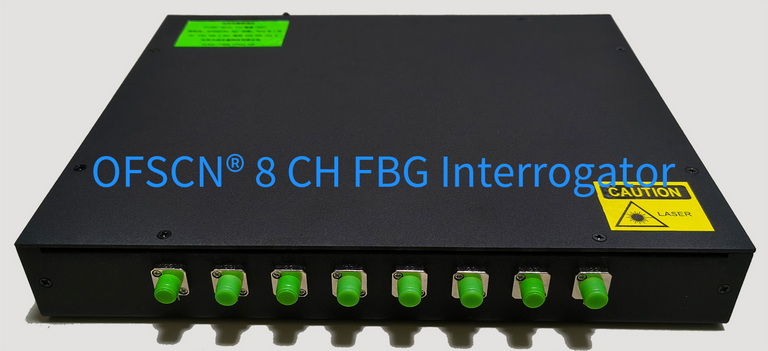
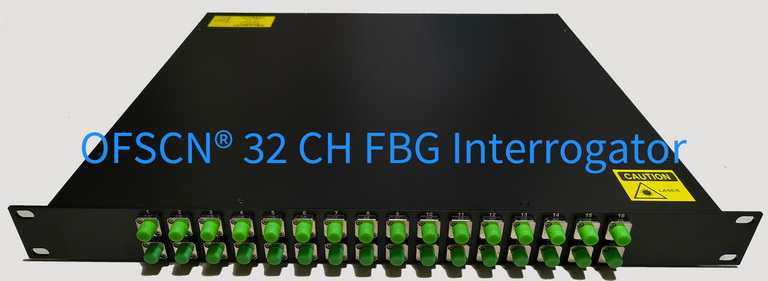
- Product Information: OFSCN® Fiber Bragg Grating Interrogator
- Core Parameters:
- Wavelength Range: Default 1525 \sim 1565\text{ nm} or 1528 \sim 1568\text{ nm} (customizable)
- Number of Channels: 4, 8, 16, 32 channels available (customizable)
- Sampling Frequency: Supports 10\text{ Hz}, 50\text{ Hz}, 100\text{ Hz} options (can be adjusted down to 1\text{ Hz} via software)
- Wavelength Resolution: Default 1\text{ pm} or 0.1\text{ pm} (customizable)
- Network and System Integration: Default B/S architecture software, supports C/S architecture, and integration with third-party control systems via protocols such as TCP, UDP, Modbus.