Are they interchangeable in terms of technical terminology??
In the strict terminology of optical engineering and optical communication technology, “Optical Coupler” and “Optical Splitter” are not completely interchangeable. While they share common ground in their physical concepts, they also have distinct definitions and application differences.
1. Physical Definitions and Distinctions in Technical Terminology
- Optical Coupler — A Broad Concept
In physics, coupling describes the process of energy transfer from one medium or mode to another. An optical coupler is a general term for devices that achieve optical signal splitting, combining, and wavelength-selective coupling. It can not only split one optical signal into multiple paths (splitter function) but also combine multiple optical signals into one (combiner function), or achieve selective coupling of specific wavelengths (e.g., Wavelength Division Multiplexer - WDM). Therefore, its functions encompass splitting, combining, and wavelength multiplexing. - Optical Splitter — A Narrow and Function-Specific Concept
A splitter is a specific type of coupler whose core function is unidirectional splitting, i.e., distributing one input optical signal into multiple output channels according to a specific ratio. Common port configurations are 1 \times N or 2 \times N .
Academic Summary:
Physically and in terms of working principles, all “Optical Splitters” can be categorized as “Optical Couplers,” but not all “Optical Couplers” can be called “Optical Splitters” (e.g., high-power combiners, wavelength-selective couplers, polarization-maintaining couplers, etc., are not splitters).
2. Differences in Manufacturing Processes and Engineering Applications
In engineering practice, due to different manufacturing processes, the emphasis of these two terms also differs:
- Fused Biconical Taper (FBT):
Often used for low-channel-count devices (e.g., 1 \times 2 , 2 \times 2 ). For these devices, the terms “FBT Coupler” or “Taper Coupler” are commonly used in engineering and academia. It can achieve unequal power splitting (e.g., 90/10 , 95/5 splitting ratios). - Planar Lightwave Circuit (PLC):
Often used for high-channel-count, wide-band, equal power splitting devices (e.g., 1 \times 16 , 1 \times 32 , 1 \times 64 ). These devices are almost universally referred to as “PLC Splitters” in engineering, and rarely as couplers.
3. Beijing Dacheng Yongsheng Technology Co., Ltd. (OFSCN®) Related Products and Sensing Applications
In the field of Fiber Bragg Grating (FBG) sensing, high-channel-count “Optical Splitters” are typically used for channel expansion and signal distribution. Beijing Dacheng Yongsheng Technology Co., Ltd. manufactures and provides specialized OFSCN® Optical Fiber Splitters.
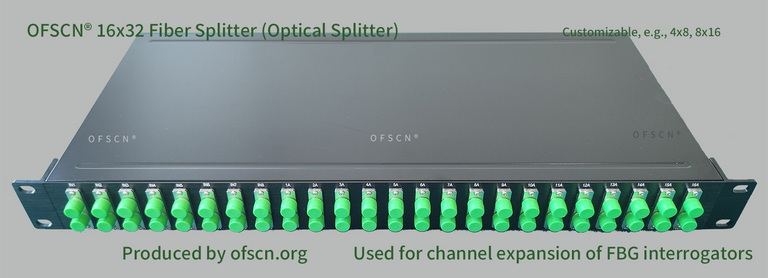
Key Technical Specifications and Engineering Applications:
- Product Name: OFSCN® Optical Fiber Splitter
- Common Specifications: Including 16 \times 32 splitters, 8 \times 16 splitters, 4 \times 8 splitters, 32 \times 64 splitters, etc.
- Temperature Characteristics: Standard use at room temperature, with custom high-temperature splitters supporting temperatures up to 250 ^ \circ \text{C} .
- Physical Application: In large-scale projects, these splitters are used in conjunction with OFSCN® Fiber Optic Grating interrogators (interrogator mainframes). Through the splitter, one physical channel of the interrogator can be spatially expanded into two or three logical channels (while still occupying one physical port), thereby reducing the unit cost per channel. It is important to note that this method of channel expansion requires rigorous wavelength planning design to avoid overlap and conflict of reflection spectra.
For more information on related high-temperature devices and connector classifications, please refer to: OFSCN® High-Temperature Fiber Optic Connectors/Flanges/Splitters Classification Link.