The vacuum chamber space is limited, how to fix the slender fiber optic cable passing through the flange?
In the confined and harsh environment of a vacuum chamber, securely managing the slender optical fibers (typically bare fibers with an outer diameter of 125\ \mu\text{m} or 250\ \mu\text{m}) after they pass through a flange presents a typical yet demanding optical engineering challenge.
I. Core Difficulties in Vacuum Chamber Internal Cabling
- Low Mechanical Strength: Unprotected slender optical fibers are extremely fragile and prone to breakage during mechanical operations or bending in the confined space of a vacuum chamber.
- Vacuum Material Outgassing Restrictions: Common polymer protective jackets for optical fiber patch cords, such as PVC, PVDF, or Hytrel, release organic volatile compounds in a vacuum (especially high vacuum and ultra-high vacuum) environment, contaminating the chamber and optical components. Therefore, large-scale use of such outgassing-prone materials is strictly prohibited inside vacuum chambers.
- Excessive Bending Radius Due to Space Constraints: Without structural support, bare optical fibers in tight spaces struggle to maintain a fixed routing path, potentially leading to increased optical loss or breakage due to excessively small bending radii.
II. Solutions and Cabling Management Methods
1. Employ High-Strength Metal Armored Protection (Recommended Solution)
To securely fix slender optical fibers, the best method is to encase them within ultra-thin stainless steel seamless tubing.
- Mechanical Protection and Shaping: Stainless steel seamless tubing (e.g., with an outer diameter of 0.9\text{mm}) not only provides robust physical protection for the internal fiber, preventing it from breaking during installation, but also offers a degree of flexibility and slight “shaping” capability, facilitating adjustments and maintaining routing paths in confined spaces.
- Vacuum Compatibility: Stainless steel exhibits extremely low outgassing rates in both atmospheric and vacuum environments and can withstand high-temperature bake-outs.
Related Product Recommendation:
Inside vacuum chambers, the OFSCN® 300℃ Fiber Optic Patch Cord is recommended. This patch cord consists of high-quality fiber optic connectors, a stainless steel seamless tube with an outer diameter of only 0.9\text{mm}, and high-temperature resistant polyimide fiber, making it ideal for high-temperature and space-constrained cabling within vacuum chambers.

2. Utilize Integrated Vacuum Flange Patch Cords
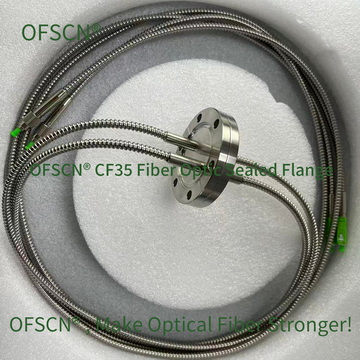
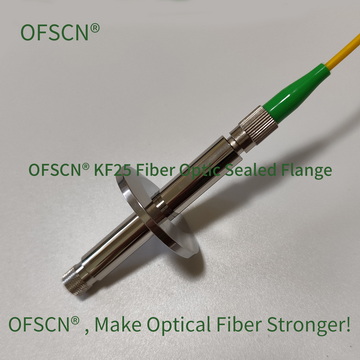
From the initial design stage, manual fiber threading and connection inside the vacuum chamber should be avoided whenever possible. By adopting a structure where the flange and patch cord are integrated and sealed, hermetic sealing can be achieved before shipment, presenting a metal-tube-protected patch cord directly at the output end inside the vacuum chamber.
Related Product Recommendation:
OFSCN® Fiber Optic Vacuum Sealed Flange covers both CF and KF series, with vacuum levels better than 1 \times 10^{-7}\ \text{Pa} to 1 \times 10^{-9}\ \text{Pa}. This product is customizable and can directly extend an armored patch cord protected by stainless steel seamless tubing from the vacuum side of the flange. This integrated structure fundamentally resolves the issue of exposed and unsecured fibers after passing through the flange.
3. On-Site Fixing and Constraint Suggestions
If optical fibers protected by stainless steel seamless tubing are already in use:
- Metal P-Clips: On the inner walls of the vacuum chamber or on support rails, use stainless steel P-clips or U-shaped retaining clips to securely fasten the stainless steel sheathing to structural components.
- Vacuum-Compatible Cable Ties: In locations where screws cannot be used, employ high-temperature resistant and extremely low outgassing PEEK cable ties or specialized Kapton (polyimide) tape to bundle the stainless steel armored fiber optic cables to existing metal pipes or support frames.
- Physical Splicing or Interface Cascading: If sensors (such as Fiber Bragg Gratings) need to be connected inside the vacuum chamber, lead the stainless steel armored patch cord near the sensor and perform high-stability connections via splicing or by using OFSCN® 300℃ Fiber Optic Connector.
Through the methods described above, slender optical fibers can be ensured to receive comprehensive physical protection and achieve standardized, stable cabling management in extremely confined and demanding vacuum environments.