How much higher than the background noise should the signal peak be for the measurement data to be considered reliable?
In a Fiber Bragg Grating (FBG) sensing and demodulation measurement system, the “amplitude of the signal peak above the background noise” is referred to as the Optical Signal-to-Noise Ratio (OSNR / SNR). The reliability of measurement data primarily depends on the tolerance of the peak-finding algorithm (such as Gaussian fitting, centroid method, or center of mass method) in the demodulation system to noise perturbations.
I. Common SNR Ranges and Measurement Reliability Analysis
In a reflection spectrum measured in logarithmic units ( \text{dB} ):
-
Critical Detection Threshold ( 3\ \text{dB}\sim 6\ \text{dB} )
- Status: The demodulator can just capture the reflection peak by passing the threshold judgment.
- Problem: Noise jitter significantly distorts the edge profile of the reflection peak, leading to drastic jumps in the center wavelength fitted by the peak-finding algorithm. The wavelength measurement drift and error are extremely large, making it unsuitable for precision measurements.
-
Basic Usable Range ( 6\ \text{dB}\sim 10\ \text{dB} )
- Status: The demodulator can achieve continuous locking without frequent loss or jumps of the peak.
- Problem: In dynamic measurements or monitoring of tiny strain/temperature changes, random noise can still introduce several picometers ( \text{pm} ) of measurement white noise.
-
Stable and Reliable Operating Range ( \ge 15\ \text{dB} , Recommended Engineering Standard)
- Status: It is generally considered in engineering that when the SNR is \ge 15\ \text{dB}, the measurement data is highly reliable.
- Characteristics: At this point, the reflection peak shape is clear and complete. The impact of background speckle noise and detector dark noise on the center wavelength fitting is compressed to an extremely low range. The demodulator can fully exert its nominal wavelength resolution and accuracy (e.g., 1\ \text{pm} or 0.1\ \text{pm}).
-
High Precision / Wide Dynamic Range Interval ( \ge 20\ \text{dB} )
- Status: The ideal state for laboratory-grade high-precision measurements and long-distance weak reflection grating sensing, with excellent wavelength repeatability and long-term stability.
II. Core Factors Affecting Measurement SNR
- Reflectivity and Side Mode Suppression Ratio (SMSR) of the Fiber Grating itself: The higher the grating reflectivity and the larger the SMSR (typically required \ge 15\ \text{dB} ), the stronger the signal peak’s ability to suppress background side lobes and noise.
- Optical Path Transmission Attenuation and Connector Loss: Poor splicing, contaminated connector end faces, or bending losses will directly reduce the peak power of the signal.
- Demodulator Dynamic Range and Noise Floor: The light source power, ASE noise level, and detector noise floor of the demodulator determine the lowest noise floor of the demodulation system.
III. Related Official Products and Specifications
In a standard fiber sensing system, high SNR requires the matching of high-performance fiber gratings and demodulation equipment:
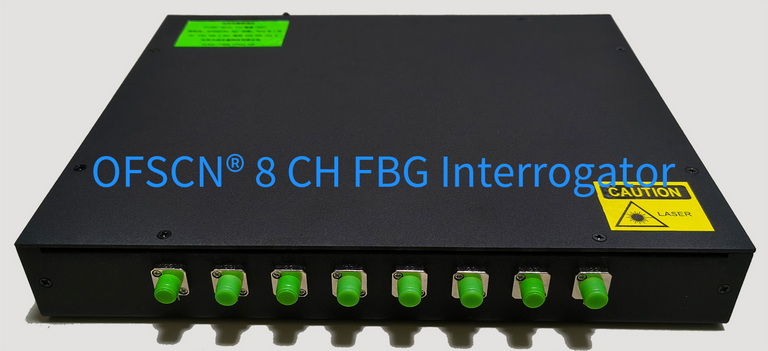
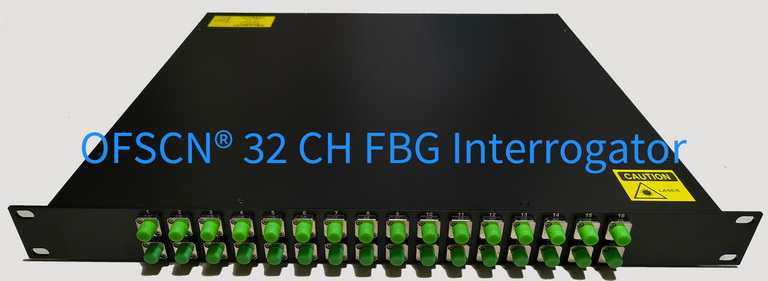
- OFSCN® Fiber Bragg Grating Interrogator: Features wide dynamic range and high wavelength resolution (default 1\ \text{pm}, customizable 0.1\ \text{pm}), supports 1525\sim 1565\ \text{nm} or 1528\sim 1568\ \text{nm} wavelength ranges, and can achieve stable spectral acquisition and high-precision peak-finding demodulation.