What is the approximate thermo-optic coefficient for different fiber materials, such as silica fiber?
The thermo-optic coefficient (TOC) describes how the refractive index of a material changes with temperature. For standard silica optical fiber, the approximate thermo-optic coefficient is around 6 to 7 x 10⁻⁶ /°C.
This coefficient is a crucial parameter for Fiber Bragg Grating (FBG) temperature sensors because the Bragg wavelength of an FBG is sensitive to both temperature and strain. The temperature sensitivity of an FBG is primarily determined by two factors: the thermal expansion coefficient of the fiber material and the thermo-optic coefficient of the fiber core. The change in the refractive index due to temperature (governed by the TOC) is the dominant factor in wavelength shift for temperature sensing in bare FBGs.
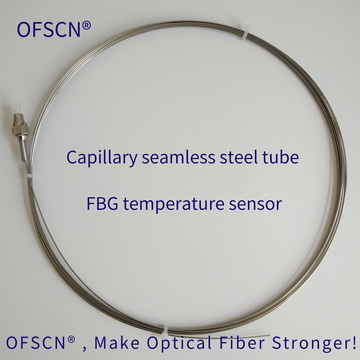
OFSCN offers a range of FBG temperature sensors designed for various environments. For example, the OFSCN® 300°C Fiber Bragg Grating Temperature Sensor utilizes this principle to accurately measure temperatures up to 300°C.
Here are some standard images of the OFSCN® 300°C Fiber Bragg Grating Temperature Sensor: