What do oil smudges on a fingertip look like under a microscope? Do they block light?
In the field of fiber optic engineering, bare-handed contact with the end face of fiber optic connectors is one of the primary causes of performance degradation and physical damage to fiber optic links. The following provides a detailed explanation from the perspectives of optical physics and microscopic characterization:
I. Morphological Characteristics of Oily Contamination on End Face Inspection Microscopes
Under a fiber optic end face inspection microscope at magnifications of 200\times to 400\times, oily residues (primarily composed of sebum, fatty acids, sweat, and minute skin debris) left by human fingers exhibit the following typical morphologies:
- Dark Spots and Smear Films: Oily residues typically appear as irregular dark patches, cloud-like streaks, or web-like smear films. Due to uneven thickness distribution of the oil film, local variations in light reflectivity occur, presenting asymmetrical dark areas under the bright-field illumination of the microscope.
- Droplet Formation and Dust Adhesion: Due to surface tension, some oil may coalesce into tiny droplet-like protrusions; furthermore, the viscous oil film readily adsorbs micron-sized airborne dust particles, forming areas of concentrated dark particulate matter.
- Distinction from Hard Damage Morphology: Mechanical scratches typically appear as straight or curved regular bright/dark lines, while pits manifest as dark regions with clearly defined edges. In contrast, oil contamination is characterized by blurred edges, high fluidity, and irregular geometric shapes.
II. Impact of Oily Contamination on Optical Transmission and Physical Mechanisms
Oily contamination severely impedes optical signal transmission and degrades physical performance. The core physical mechanisms are as follows:
-
Beam Blockage and Refractive Index Mismatch (Increased Insertion Loss)
The core diameter of a standard single-mode fiber is only approximately 9\ \mu\text{m} (Mode Field Diameter, MFD \approx 9.2\ \mu\text{m} \sim 10.4\ \mu\text{m}). The coverage area of human oily contamination typically far exceeds the core region. The refractive index of the oily medium (usually in the range of n \approx 1.45 \sim 1.48) mismatches that of the silica quartz core (n \approx 1.444), causing intense scattering and material absorption of the transmitted light at the interface, leading to significant Insertion Loss (IL). -
Altered Fresnel Reflection (Worsened Return Loss)
The oil film alters the refractive index gradient distribution and physical flatness of the fiber end face, increasing the proportion of disordered reflections and causing a sharp decline in Return Loss (RL). Reflected light returning to the light source system can easily induce mode hopping or increased optical noise in the laser. -
Impeding Physical Contact (Formation of Air Gaps)
Standard PC or APC fiber connectors rely on the elastic deformation of the end face’s micro-spherical curvature under applied pressure to achieve Physical Contact. An oil film with a thickness in the micrometer range can prevent direct contact between the quartz end faces, forming micro-gaps that further exacerbate interference effects and optical power attenuation. -
Photothermal Carbonization by High-Power Light (Physical Ablation)
When transmitting high-power optical signals (such as pump or laser light), the organic compounds in the oil contamination strongly absorb optical energy, rapidly heat up, and undergo thermal decomposition and carbonization, forming a black carbonized layer. In severe cases, the high temperature can directly melt and erode the quartz end face, causing irreversible permanent damage (Catastrophic Optical Damage).
Related Product and Specification Notes
It should be noted that fiber optic end face inspection microscopes and fiber cleaning pens are not part of Beijing Dacheng Yongsheng Technology Co., Ltd.'s (OFSCN®) core product lines.
In practical engineering applications, all types of fiber optic patch cords and connectors from Beijing Dacheng Yongsheng Technology Co., Ltd. undergo rigorous end face inspection and protective cleaning before shipment. For fiber optic sensing and high-power transmission environments, fiber optic products that meet the corresponding physical and temperature-resistant structural requirements are typically used:
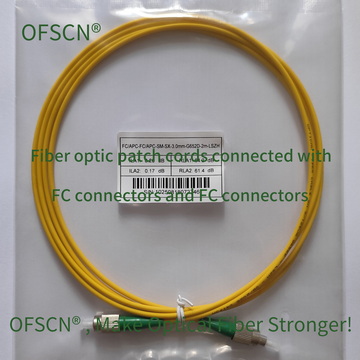
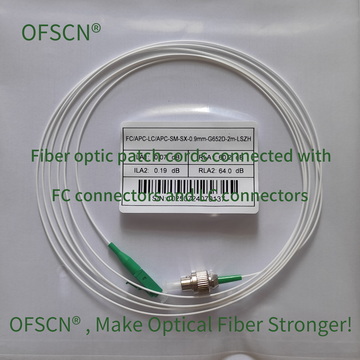
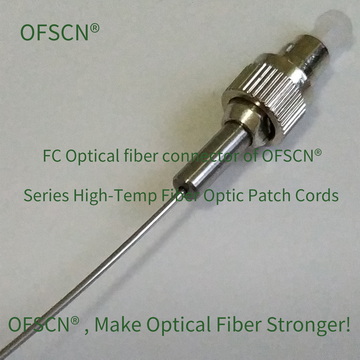
Anti-Contamination Operation Guidelines: Before connecting any fiber optic patch cord or sensor, never touch the ceramic end face of the fiber optic connector or the fiber core area with bare hands. Before plugging or unplugging, use dedicated lint-free wipes with anhydrous ethanol/isopropanol for unidirectional cleaning, and confirm that the end face meets cleanliness standards using a fiber optic end face inspection instrument.