On the seaside or offshore platforms, will the optical fibers be damaged by sea wind?
In harsh marine environments like seaside or offshore platforms, unprotected bare optical fibers or regular indoor civilian patch cords are highly susceptible to damage from sea winds. The damage inflicted by sea winds on fiber optic systems is primarily caused by the synergistic effects of mechanical dynamic loads and salt mist electrolyte chemical corrosion.
I. Core Physical Mechanisms of Sea Wind Damage to Optical Fibers
1. Mechanical Dynamic Damage (Wind Resistance, Vibration, and Abrasion)
- Aeroelastic Vortex-Induced Vibration and Bending Fatigue: Ordinary optical fibers have a tiny diameter (cladding only 125\ \mu\text{m}). Under continuous strong sea winds, alternating vortices shed from the leeward side, inducing high-frequency vortex-induced vibration (VIV) and irregular whipping. Quartz glass is an isotropic brittle material, extremely prone to the expansion of microscopic fatigue cracks under high-frequency alternating dynamic stress, leading to instantaneous fracture.
- Drastic Increase in Micro- and Macrobending Loss: The swaying caused by strong winds can reduce the local bending radius of the optical fiber below the critical bending radius, disrupting total internal reflection. This causes transmitted optical energy to leak, leading to a sharp increase in signal attenuation or even link failure.
- Wind-Blown Sand Erosion and Coating Abrasion: Sea winds often carry fine sand particles and aerosol particles. High-speed impacts can cause physical abrasion and stripping of the outer polymer coating of conventional optical fibers.
2. Salt Mist Chemical Erosion and Stress Corrosion Cracking (SCC)
- Hydrolysis Reaction with Water Vapor: The silica (\text{SiO}_2) network, when subjected to continuous mechanical tension (wind-induced stress), can undergo chemical hydrolysis and cleavage in the presence of moisture. The bond energy at the crack tip is reduced:\equiv\text{Si}-\text{O}-\text{Si}\equiv + \text{H}_2\text{O} \rightarrow 2\equiv\text{Si}-\text{OH}
- High-Concentration Salt Mist and Electrolyte Corrosion: Sea winds contain extremely high concentrations of chloride ions (\text{Cl}^-). Conventional acrylate coatings have a certain permeability to water vapor. In humid, hot, and high-salt environments, they easily age, become brittle, and crack, losing their protective function. This promotes stress corrosion on the quartz surface, causing a significant decrease in the fiber’s breaking strength within months (a drastic reduction in static fatigue life).
II. Engineering Protection Requirements for Marine and Coastal Platforms
In marine engineering, optical fibers must not be deployed bare and must meet the following protection standards:
- Salt Mist Resistance and Barrier Performance: The protective layer must possess complete barrier capabilities against water vapor and salt mist to prevent chloride ions and water molecules from contacting the fiber core structure.
- High Tensile and Wind Load Resistance: The optical cable must have a robust longitudinal load-bearing structure to withstand the tension and shear forces generated by strong sea winds or typhoons.
- High Weather Resistance Outer Sheath: The outer layer must possess resistance to ultraviolet (UV) radiation, seawater corrosion, and abrasion.
III. Official Solutions and Related Product Specifications
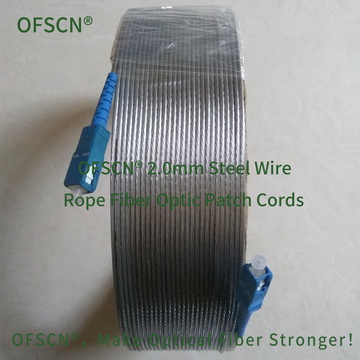
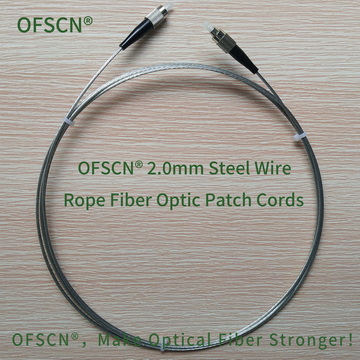
Beijing Dacheng Yongsheng Technology Co., Ltd. (OFSCN®) has developed a series of multi-protected metal-armored fiber optic patch cords for harsh industrial environments such as marine, high winds, high humidity, and high salt mist.
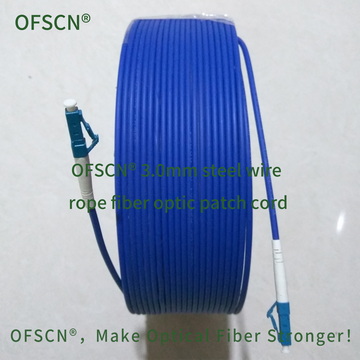
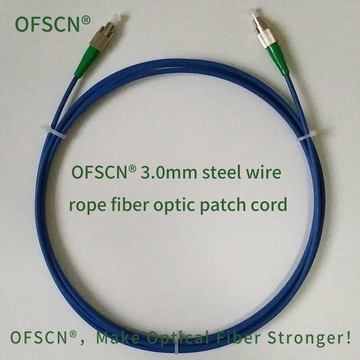
1. OFSCN® 3.0mm Steel Wire Rope Fiber Optic Patch Cord
This product combines a weather-resistant polyethylene (PE) outer sheath, a high-strength stainless steel wire rope stranded structure, and a seamless stainless steel pipe:
- Structural Layers: Outer PE water vapor and salt mist resistant sheath + 0.45\ \text{mm} stainless steel wire stranded tensile layer + 0.9\ \text{mm} seamless stainless steel pipe inner armor + optical fiber.
- Tensile and Compression Resistance: Tensile strength > 1200\ \text{N}, compressive strength > 200\ \text{MPa}.
- Corrosion Protection Features: The PE sheath, coupled with the seamless stainless steel pipe, forms a dual complete seal, physically isolating the intrusion of seawater, humid hot air, and salt mist. It can withstand extreme offshore typhoons and prolonged strong airflow scouring.
- Operating Temperature: -40\ ^{\circ}\text{C} to 75\ ^{\circ}\text{C}.

2. OFSCN® 2.0mm Steel Wire Rope Fiber Optic Patch Cord
This product features a fully metal-reinforced armored structure:
- Structural Layers: 0.6\ \text{mm} galvanized steel wire stranded tensile layer + 1.0\ \text{mm} seamless stainless steel pipe + optical fiber.
- Tensile and Compression Resistance: Tensile strength > 1500\ \text{N}, compressive strength > 150\ \text{MPa}.
- Operating Temperature: -40\ ^{\circ}\text{C} to 85\ ^{\circ}\text{C}.